

Key Takeaways
- Driver assistance systems can meaningfully reduce crash risk but are not substitutes for attentive driving.
- Technologies like automatic emergency braking and lane-keeping assist have documented safety benefits backed by research.
- Sensor limitations, weather conditions, and driver over-reliance are the most common failure points.
- Understanding how each system works - and where it struggles - helps drivers use them more safely.
- Staying engaged behind the wheel remains essential regardless of which assistance features your vehicle includes.
AEB reduces rear-end crash frequency
IIHS research has found automatic emergency braking can significantly reduce rear-end collisions, particularly in stop-and-go urban traffic where reaction time is compressed.
Blind-spot monitoring catches lane-change gaps
These systems flag vehicles in adjacent lanes that mirrors may not fully reveal, addressing a common blind-spot-related collision scenario on multi-lane roads.
Lane-keeping assist reduces drift-related incidents
Unintended lane departures are a leading cause of run-off-road crashes; lane-keeping assist provides an alert or gentle correction before the situation escalates.
Adaptive cruise control reduces highway fatigue
By automating following-distance adjustments, ACC removes a source of cognitive load on long trips, helping drivers stay more mentally fresh over extended highway drives.
Rear cross-traffic alert improves low-speed safety
Backing out of driveways and parking spaces involves substantial blind areas; rear cross-traffic alerts flag approaching vehicles or pedestrians the driver cannot see directly.
Automation complacency reduces driver attention
When drivers trust systems to handle routine monitoring tasks, research indicates they can disengage mentally - which leaves them unprepared when the system reaches its limit or fails.
Sensors degrade in rain, snow, and glare
Camera-based systems are particularly vulnerable to weather and lighting extremes, meaning performance can drop precisely when driving conditions are most demanding.
Systems may misread or miss certain hazards
AEB can fail to detect stationary vehicles, cyclists, or pedestrians in some scenarios; lane-keeping assist can be confused by faded markings or complex intersections.
Minor collision damage can degrade sensor accuracy
Cameras and radar units are often mounted in bumpers and mirrors - areas vulnerable to even low-speed impacts that may not trigger a warning light but can shift calibration.
Inconsistent implementation across manufacturers
There is no universal standard for how ADAS features behave; a lane-keeping system in one vehicle may intervene much more aggressively than the same-named feature in another brand.
Our Verdict
Driver assistance technology represents a genuine step forward in road safety, and research supports its effectiveness in reducing certain types of crashes. However, these systems are designed to assist - not replace - an alert, skilled driver. Their limitations are real, and over-reliance carries its own risks.
Best suited to drivers who take time to understand each system's capabilities and boundaries, and who treat the technology as a safety net rather than an autopilot.
What Driver Assistance Technology Actually Does
Modern vehicles increasingly come equipped with a cluster of electronic systems designed to reduce driver error and improve situational awareness. These fall under the broad umbrella of Advanced Driver Assistance Systems, commonly abbreviated as ADAS. Common features include:
- Automatic Emergency Braking (AEB): Detects an imminent forward collision and applies the brakes if the driver doesn't respond in time.
- Lane-Keeping Assist (LKA): Monitors lane markings and gently steers or alerts the driver when the vehicle drifts without signaling.
- Blind-Spot Monitoring (BSM): Uses radar or cameras to flag vehicles in adjacent lanes that may not be visible in mirrors.
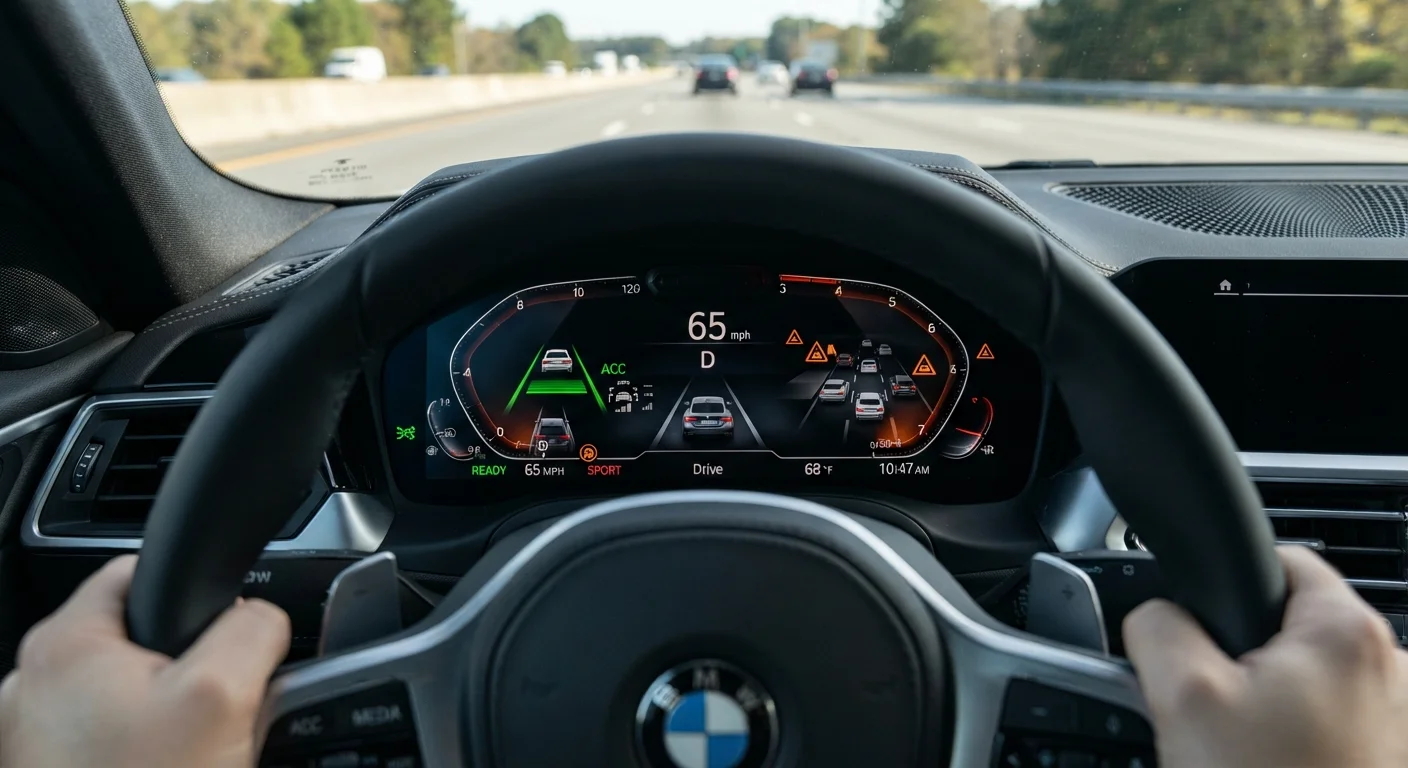
- Adaptive Cruise Control (ACC): Maintains a set speed while also adjusting to keep a safe following distance from the vehicle ahead.
- Rear Cross-Traffic Alert: Warns of approaching vehicles when backing out of a parking space.
Each system relies on a combination of sensors - cameras, radar, ultrasonic sensors, or lidar - to perceive the environment around the vehicle. Understanding what each does (and what it cannot do) is the foundation of using them well. For a broader look at vehicle ownership decisions, see the Vehicle Ownership hub.
Where These Systems Genuinely Help
The safety case for ADAS is well-supported. Research from organizations such as the Insurance Institute for Highway Safety (IIHS) and the National Highway Traffic Safety Administration (NHTSA) has found measurable crash-reduction benefits for several of these technologies.
AEB reduces rear-end crash frequency
IIHS research has found automatic emergency braking can significantly reduce rear-end collisions, particularly in stop-and-go urban traffic where reaction time is compressed.
Blind-spot monitoring catches lane-change gaps
These systems flag vehicles in adjacent lanes that mirrors may not fully reveal, addressing a common blind-spot-related collision scenario on multi-lane roads.
Lane-keeping assist reduces drift-related incidents
Unintended lane departures are a leading cause of run-off-road crashes; lane-keeping assist provides an alert or gentle correction before the situation escalates.
Adaptive cruise control reduces highway fatigue
By automating following-distance adjustments, ACC removes a source of cognitive load on long trips, helping drivers stay more mentally fresh over extended highway drives.
Rear cross-traffic alert improves low-speed safety
Backing out of driveways and parking spaces involves substantial blind areas; rear cross-traffic alerts flag approaching vehicles or pedestrians the driver cannot see directly.
Automatic Emergency Braking, for instance, has been associated with significant reductions in rear-end crashes. Blind-spot monitoring addresses one of the most common lane-change collision scenarios. For drivers navigating high-stress urban environments or long highway stretches, these systems provide a genuine second layer of protection.
Adaptive Cruise Control can also reduce fatigue on long trips by removing the constant micro-adjustments required to maintain following distance - a factor linked to situations where even careful drivers get caught off guard.
Where These Systems Fall Short
No driver assistance feature is infallible, and several failure modes are well-documented by engineers and safety researchers alike.
Automation complacency reduces driver attention
When drivers trust systems to handle routine monitoring tasks, research indicates they can disengage mentally - which leaves them unprepared when the system reaches its limit or fails.
Sensors degrade in rain, snow, and glare
Camera-based systems are particularly vulnerable to weather and lighting extremes, meaning performance can drop precisely when driving conditions are most demanding.
Systems may misread or miss certain hazards
AEB can fail to detect stationary vehicles, cyclists, or pedestrians in some scenarios; lane-keeping assist can be confused by faded markings or complex intersections.
Minor collision damage can degrade sensor accuracy
Cameras and radar units are often mounted in bumpers and mirrors - areas vulnerable to even low-speed impacts that may not trigger a warning light but can shift calibration.
Inconsistent implementation across manufacturers
There is no universal standard for how ADAS features behave; a lane-keeping system in one vehicle may intervene much more aggressively than the same-named feature in another brand.
Perhaps the most consequential risk is automation complacency - the tendency for drivers to disengage mentally when a system is active. Studies have observed that drivers using hands-free or semi-autonomous features can become less attentive over time, which is directly relevant to the findings discussed in the truth about distracted driving.
Sensor limitations are also significant. Cameras struggle in heavy rain, snow, or direct sun glare - the same conditions covered in why drivers misjudge speed at night. Radar performs better in poor visibility but can misread stationary objects. These are not edge cases; they are routine driving conditions for millions of Americans.
How to Use Driver Assistance Features Safely
ADAS Is Not Full Autonomy
Driver assistance features available on most consumer vehicles today are classified as Level 1 or Level 2 automation under SAE International's framework - meaning the human driver must remain in control and attentive at all times. No currently available consumer vehicle for sale in the U.S. provides full self-driving capability. Treating any of these systems as though they can manage the vehicle independently is a documented source of serious accidents.
Getting the most out of ADAS requires treating it as a supplement to - not a replacement for - your own awareness and skill. A few practical principles apply regardless of which systems your vehicle includes:
- Read the owner's manual for each feature. Manufacturers document the specific conditions and limitations for every system. Skipping this step is one of the most common ways drivers develop false confidence in a feature's range.
- Calibrate your expectations by system. Lane-keeping assist is not a self-steering function. Adaptive cruise control does not anticipate sharp curves or stopped vehicles in all scenarios. Know what each one can and cannot do.
- Maintain sensors proactively. Camera lenses and radar emitters need to be clean and properly aligned to function. Damage from minor fender-benders can degrade performance without triggering a visible warning. For related guidance, see what dashboard warning lights are telling you.
- Keep your eyes and mind on the road. ADAS is designed to assist an alert driver - the systems assume human oversight. Pairing them with the hazard-anticipation habits covered in reading the road ahead gives you the strongest safety foundation.
Maintaining adequate space around your vehicle is another habit that works in concert with ADAS rather than against it - explored further in managing space around your vehicle.