

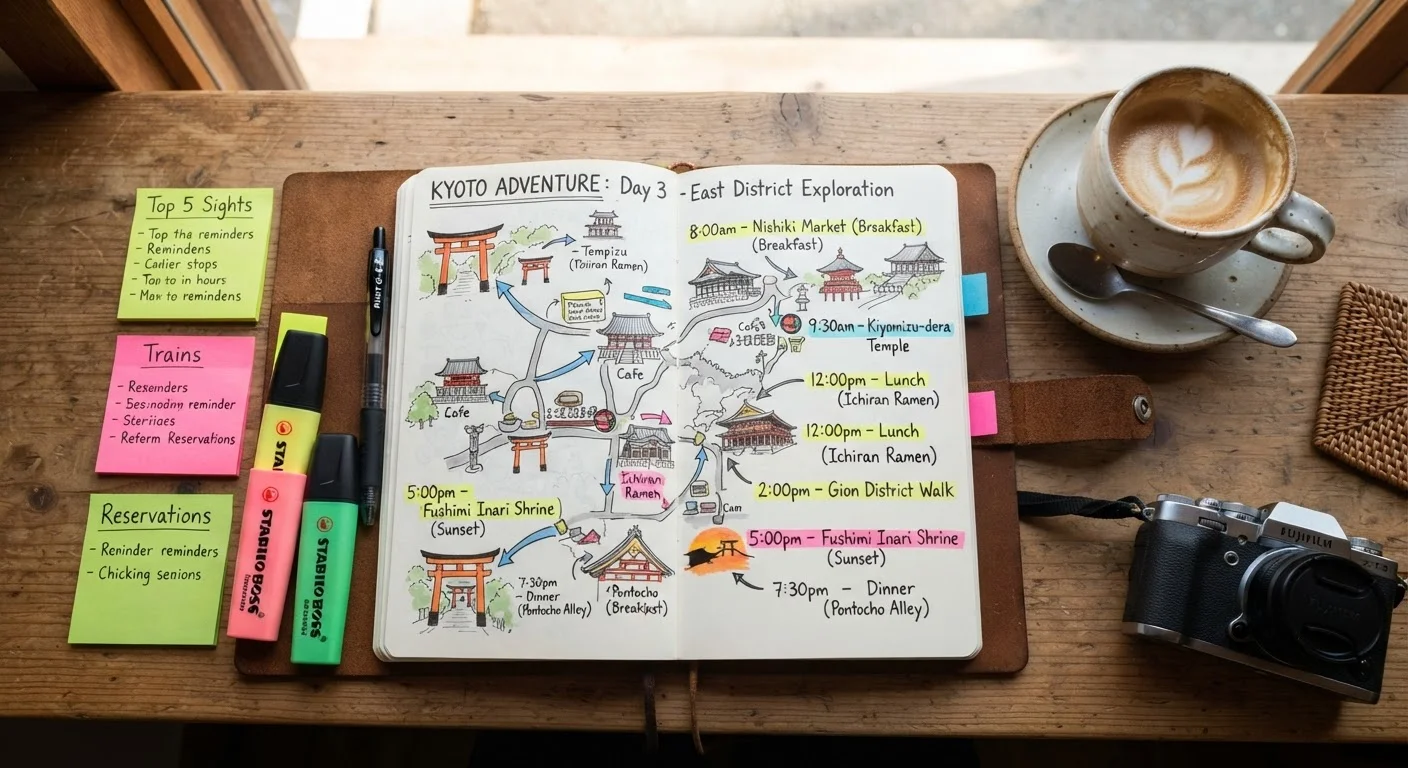
Key Takeaways
- A working itinerary balances scheduled activities with deliberate buffer time each day.
- Grouping activities by neighborhood or district cuts transit time and reduces daily fatigue.
- Rest days are a planning tool, not a planning failure - build them in from the start.
- Your first and last travel days require lighter scheduling due to transit and check-in logistics.
- Writing down time estimates for each activity reveals overloaded days before you travel.
What you will need
Why Most Itineraries Break Down
Most travel itineraries fail for one of two reasons: too much packed in, or no structure at all. The traveler who books eight must-see attractions per day arrives home exhausted. The one who wings it entirely often returns with vague memories and a nagging sense of missed opportunities.
A realistic itinerary sits in the middle - structured enough to give shape to each day, flexible enough to absorb the unexpected. The goal isn't to schedule every hour; it's to make sure the hours you have are used intentionally. For a broader view of everything planning involves, see the complete traveler's planning guide.
Before you build your itinerary, you'll need a few pieces in place:
What you will need
How to Build Your Itinerary Step by Step
Follow these steps in order. Each one builds on the last, and skipping ahead tends to produce the overloaded schedules that collapse on day two.
List everything you want to do - then cut it by a third
Start with a full brainstorm: every museum, neighborhood, restaurant, and day trip you're considering. Write it all down without filtering. Then, once the list is complete, identify the non-negotiables - the experiences that would make the trip feel incomplete without them. Flag those. Everything else is optional and can flex based on time and energy.
This step prevents the common mistake of planning from a wish list rather than from realistic daily capacity.
Estimate honest time blocks for each activity
Next to each item on your list, write a realistic time estimate - including travel to and from the location. A major art museum might take three hours, not one. A scenic viewpoint might take 45 minutes including the walk. Add meals, and factor in that ordering, eating, and paying in an unfamiliar place takes longer than it does at home.
Total those estimates across all your activities. If the sum exceeds your available days by 30% or more, you have a pacing problem to solve before you leave home - not after you arrive.
Group activities by location, not by category
Organize your activities geographically. If three museums, a market, and a restaurant you want to try are all within the same district, that's a natural day. Traveling back and forth across a city to alternate between different types of experiences wastes time and energy that you'll feel by day three.
Use a map - digital or printed - to cluster your list into logical geographic zones. Each zone becomes a candidate day or half-day in your schedule.
Assign activities to specific days, lightest days first and last
Map your geographic clusters onto your actual calendar. Place your arrival day and departure day with very light or no planned activities - these days are dominated by travel, check-in, check-out, and reorientation. Your highest-energy, most complex day (a long hike, a major theme park, a packed museum day) should sit in the middle of your trip, not on day one when you may still be adjusting.
For multi-destination trips, account for travel between locations as half-days or full days depending on the distance involved.
Build in buffer time and at least one rest half-day
Add 30-60 minutes of unscheduled time to each day as a buffer - for the attraction that took longer than expected, the detour you didn't plan, or simply sitting somewhere and doing nothing. For trips of five or more days, include at least one half-day with no scheduled activities. This isn't wasted time; it's the time that often produces the most memorable moments of a trip.
For a different perspective on how much structure is actually useful, the case for planning less explores the value of intentional flexibility.
Write out your day-by-day schedule and share it
Put your finalized plan into a simple document - one page per day works well. Include the name and address of each planned stop, your estimated arrival time, and any reservation confirmation numbers. Share this with anyone traveling with you, and leave a copy with someone at home.
A written itinerary also doubles as a reference if something goes wrong - a lost phone, a change of plans mid-trip, or a need to quickly find an alternative. Pair it with the full trip planning checklist for a complete pre-departure review.
Common Itinerary Mistakes - and How to Avoid Them
Even well-intentioned planners fall into predictable traps. Knowing what they are helps you sidestep them before your trip begins.
- Underestimating transit time. Getting from a museum to a restaurant in an unfamiliar city often takes twice as long as a map app suggests. Add 20-30% to any transit estimate.
- Ignoring opening hours and booking requirements. Some major attractions require advance reservations - in some destinations, popular sites book out weeks ahead. Verify hours and booking requirements before locking in your order of activities. Our guide on what first-time visitors to Japan get wrong illustrates how itinerary assumptions frequently collide with local realities.
- Treating arrival and departure days as full days. A 2 p.m. flight out means your morning is largely consumed by packing, checkout, and airport time. Plan accordingly.
- Skipping financial planning. An itinerary without a budget is a wish list. See our guide on why travel budgets fall apart to align your schedule with your spending reality.
Leave Room for Spontaneity
The best travel experiences are often unplanned - a market you stumble into, a conversation that leads somewhere unexpected, a viewpoint that wasn't on any list. A good itinerary creates the conditions for those moments by not filling every minute. Structure your days enough that you don't feel lost, but not so tightly that you can't say yes to something unscripted.
If you're traveling with others who have different planning preferences, consider reading about traveling with different planning styles in the same group before finalizing anything.