

Key Takeaways
- A shaded area on a carrier's map doesn't guarantee usable 5G signal at street level.
- There are three distinct types of 5G spectrum, and they perform very differently in daily use.
- Building materials like concrete and glass can block or weaken 5G signals significantly.
- Network congestion can slow speeds even in areas with strong coverage.
- Crowd-sourced speed data from real users is more reliable than carrier-published maps.
- Your specific phone model determines which 5G bands it can actually access.
5G Coverage
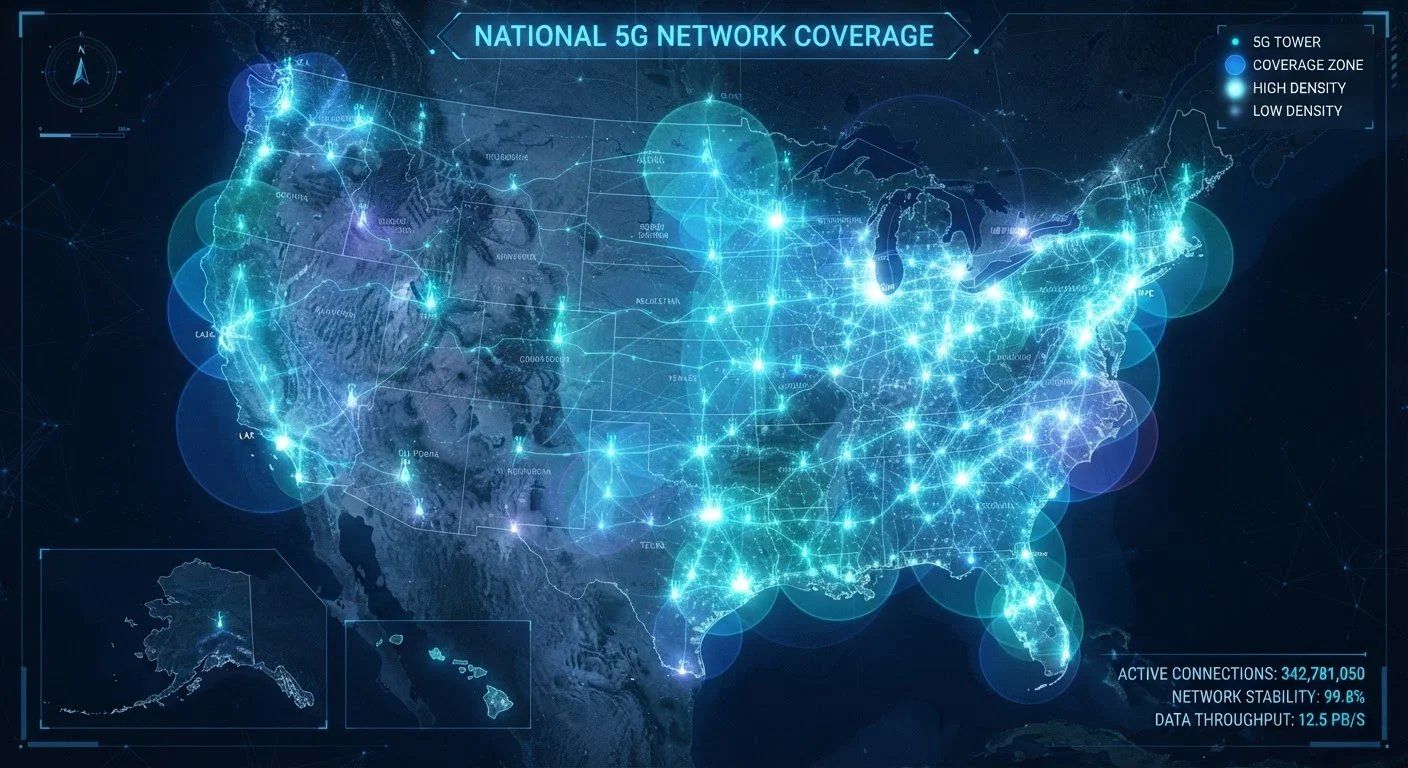
5G coverage refers to the geographic areas where a carrier's fifth-generation wireless network is available. A coverage map shades regions where signals theoretically reach - but that doesn't mean every phone in that zone will experience fast, reliable 5G. Actual performance depends on the type of 5G spectrum used, physical obstacles, and how many people share the network at once.
Carriers operate 5G across three spectrum bands - low-band, mid-band, and high-band (mmWave) - each with fundamentally different speed and range trade-offs, though coverage maps rarely distinguish between them.
How Coverage Maps Are Built - and Where They Fall Short
Carrier coverage maps are generated using predictive models, not direct measurements. Engineers plot tower locations, apply terrain data, and estimate signal propagation outward - then shade the map accordingly. The result looks comprehensive, but it's essentially a best-case forecast, not a ground-truth measurement.
Key factors that maps don't account for include dense tree coverage, urban canyon effects between tall buildings, and the construction materials in your home or office. Concrete, metal framing, and low-emissivity window glass each absorb or reflect wireless signals to varying degrees. A location shown as fully covered on a map can easily drop to marginal or no signal once you step indoors.
For a more realistic view of what you'd actually experience, tools that aggregate crowdsourced speed tests from real users in specific locations tend to be far more informative than carrier-published maps. These sources reflect what people actually measured, not what a propagation model predicted. You can learn more about what causes signal inconsistency in our companion piece, Why Your Signal Drops in Places It Shouldn't.
The Three Types of 5G Spectrum - and Why They're Not Equal
The single most important thing most coverage maps obscure is that "5G" is not one technology - it's a family of deployments across three very different frequency ranges, and the experience they deliver varies dramatically.
3x+
Speed advantage of mid-band over low-band 5G
Independent network testing organizations consistently observe mid-band 5G median download speeds several times higher than low-band deployments under comparable conditions.
~300 ft
Typical effective range of mmWave 5G outdoors
High-band millimeter-wave signals are generally limited to a few hundred feet from a transmitter in open air, with further reduction around physical obstacles.
~70%
Share of US 5G connections on low-band spectrum
Industry analyst estimates suggest the majority of activated 5G connections in the US remain on low-band spectrum, which offers broader reach but more modest speed gains.
Low-Band 5G (Sub-1 GHz)
Low-band spectrum travels long distances and penetrates buildings well, making it easy for carriers to achieve broad geographic coverage quickly. The trade-off: speeds are often only modestly faster than 4G LTE - sometimes in the 50-150 Mbps range rather than the multi-gigabit speeds 5G marketing implies. Most rural and suburban 5G coverage today falls into this category.
Mid-Band 5G (1-6 GHz)
Mid-band - particularly the 2.5 GHz and 3.5 GHz ranges - is where 5G delivers meaningfully faster speeds while still covering reasonable distances. Independent speed tests consistently show mid-band delivering average speeds several times higher than low-band. This is where meaningful 5G performance gains are concentrated for most consumers.
High-Band 5G (mmWave, 24-47 GHz)
Millimeter-wave 5G can deliver multi-gigabit speeds but has an extremely short range - often measured in city blocks - and is blocked by nearly any physical obstacle including glass and human bodies. Real-world mmWave deployments are limited to dense venues like stadiums, airports, and some urban street corridors.
Network Congestion: The Hidden Performance Variable
Even in an area with strong mid-band 5G coverage, the number of simultaneous users sharing a cell tower's capacity directly affects what any individual user experiences. During a packed outdoor concert or a crowded downtown lunch hour, speeds can drop substantially - not because coverage is absent, but because available bandwidth is being divided among many users at once.
Carriers also apply traffic management policies, sometimes called deprioritization, that can further affect speeds during congestion for certain plan tiers. Understanding these policies before choosing a plan is worthwhile - our Mobile Plan Jargon, Decoded explains terms like deprioritization and network management in plain language.
Run Speed Tests at Your Real Locations
Coverage maps tell you whether a signal should reach an area; speed tests tell you what you'd actually get. Run tests at your home, office, and frequent destinations at different times of day - morning and evening results can differ significantly due to congestion patterns. Free speed test tools are widely available and take under a minute each.
This congestion dynamic is broadly similar to what affects home internet: a fast fiber or cable connection shared across many users in a neighborhood can slow down during peak hours. For context on how wired broadband handles this differently, see Fiber vs. Cable Internet: Weighing the Trade-offs for Home Use.
What to Actually Check Before Choosing a Plan or Device
Rather than relying solely on a carrier's coverage map, a more useful approach combines several data sources and personal testing.
- Check third-party speed measurement platforms that show real user data for specific carriers in your zip code or neighborhood, not just modeled coverage.
- Identify which spectrum bands your carrier deploys in your specific area - not just the city or region. Coverage mix varies significantly block by block in some markets.
- Verify your phone supports those bands. A device that lacks mid-band radio hardware won't access mid-band speeds even if the network is available. Check the device specification sheet, not just the marketing label.
- Test before committing. Many carriers allow trial periods. Use one to run speed tests at the locations you use most - your home, workplace, and commute - before making a long-term plan decision.
If you're also evaluating home internet options, the same principle of looking past headline numbers applies - see Getting Reliable Home Internet: What the Setup and Placement Decisions Actually Change for related guidance.