

Key Takeaways
- Fiber uses glass or plastic light-transmitting strands; cable uses coaxial copper infrastructure originally built for TV.
- Fiber typically offers symmetrical upload and download speeds; cable uploads are usually much slower than downloads.
- Cable internet is available to roughly 89% of U.S. households; fiber reaches around 43%, though that share is growing.
- During peak evening hours, cable networks can slow noticeably due to shared neighborhood bandwidth.
- Fiber's consistency advantage matters most for video calls, remote work, and cloud backups requiring reliable upload speeds.
- Availability, not preference, is often the deciding factor - many households cannot yet choose between the two.
Option A
Fiber Internet
The newer, symmetrical, and consistently fast option.
Best for: Households with heavy upload demands, multiple simultaneous users, or low tolerance for peak-hour slowdowns.
Option B
Cable Internet
The widely available, capable workhorse of home broadband.
Best for: Households in areas without fiber access who need solid download speeds at a range of price points.
If you work from home and rely on video conferencing or large file uploads
Fiber Internet
Symmetrical speeds mean your upload performance matches your download, which directly reduces lag and dropped frames on video calls.
If fiber isn't available at your address
Cable Internet
Cable reaches far more U.S. households and can deliver download speeds more than sufficient for streaming, browsing, and casual use.
If your household has four or more simultaneous users or devices
Fiber Internet
Fiber's dedicated connection and higher bandwidth ceiling handles heavy multi-device use with less congestion during peak hours.
If you primarily stream video and browse the web on one or two devices
Cable Internet
Typical cable download speeds are more than adequate for everyday streaming and web use, and cable plans are broadly accessible.
If consistent speeds at all hours of the day are a priority
Fiber Internet
Fiber's point-to-point architecture doesn't share capacity with neighbors, so performance stays stable even during evening peak hours.
How the Technology Actually Differs
The most important thing to understand about fiber versus cable isn't speed tiers on a plan - it's the physical infrastructure each technology uses. That infrastructure determines what's even possible at your address.
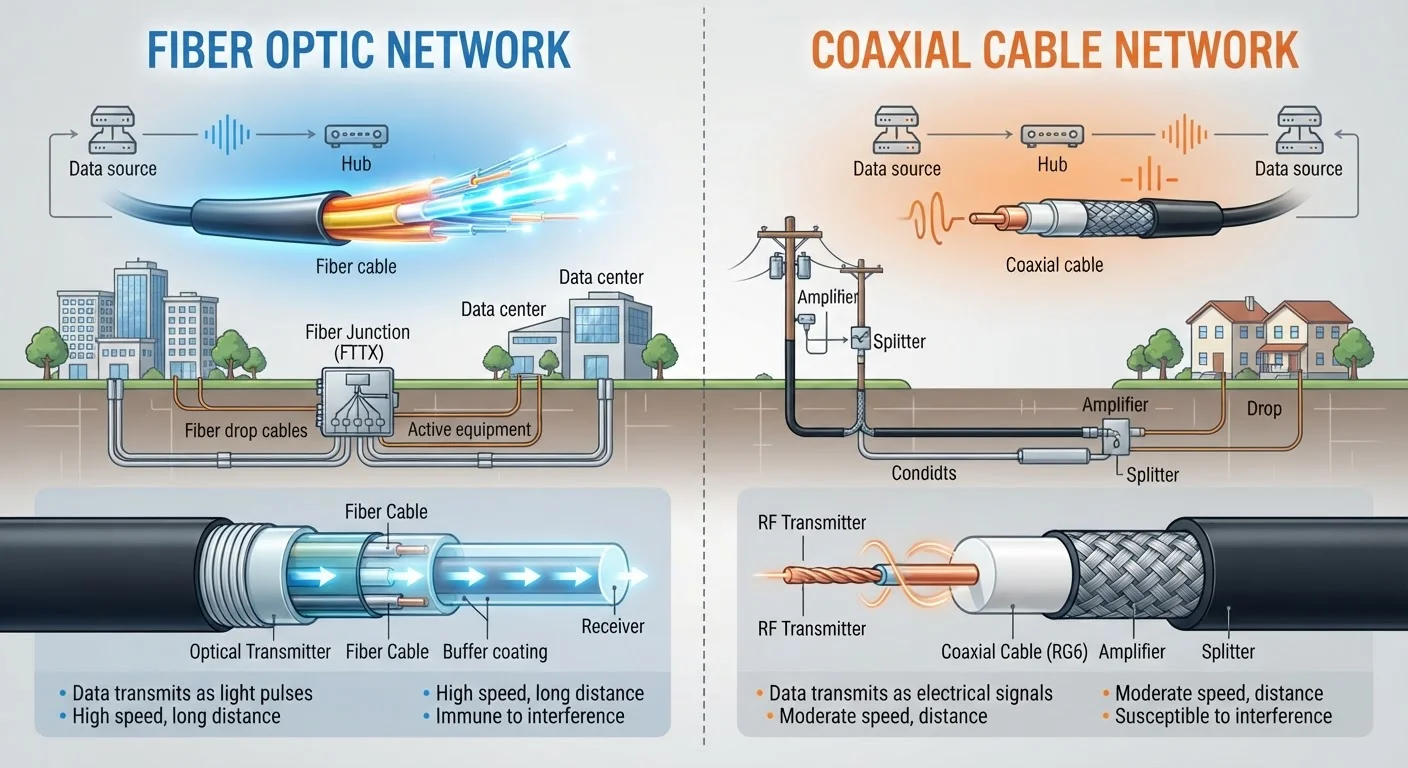
Fiber internet transmits data as pulses of light through glass or plastic strands. Because light doesn't degrade over distance the way electrical signals do, fiber connections can maintain consistent speeds across longer runs and are not subject to electromagnetic interference. The connection from a fiber provider typically runs directly to your home or to a nearby node, depending on the specific deployment type (FTTH - fiber to the home - being the most capable).
Cable internet rides the same coaxial copper lines that originally carried cable TV. It uses a standard called DOCSIS (Data Over Cable Service Interface Specification) to carry internet data alongside TV signals. Modern DOCSIS 3.1 cable can deliver multi-gigabit download speeds in ideal conditions, but the network is shared - meaning the coaxial line in your neighborhood is divided among multiple households simultaneously.
For a broader look at how these technologies fit alongside DSL and satellite, see our guide to broadband types.
| Criterion | Fiber Internet | Cable Internet |
|---|---|---|
| Transmission medium | Light through glass/plastic strands | Electrical signal over coaxial copper |
| Download speeds (typical plans) | 100 Mbps - 5 Gbps | 100 Mbps - 2 Gbps |
| Upload speeds | Symmetrical (matches download) | Asymmetrical (often 10-35 Mbps) |
| Shared neighborhood bandwidth | No (dedicated runs common) | Yes (shared coaxial segment) |
| Peak-hour congestion risk | Low | Moderate to high in dense areas |
| U.S. household availability | ~43% of households | ~89% of households |
| Latency (typical) | 5-15 ms | 15-35 ms |
| Infrastructure maturity | Expanding; still being built out | Mature; broadly deployed |
Speed, Upload, and Real-World Performance
Advertised speeds are download speeds. That number tells only part of the story.
Cable plans are asymmetrical by design: download speeds may reach 500 Mbps or higher, while upload speeds on the same plan often sit between 10 and 35 Mbps. For most casual internet use - streaming, browsing, social media - that asymmetry doesn't matter much. The bottleneck in those activities is almost always download.
Upload speed becomes consequential the moment you're sending data rather than receiving it: video conference calls, uploading to cloud storage, live streaming, or backing up large files. Fiber plans are typically symmetrical - a 500 Mbps fiber plan commonly includes 500 Mbps upload as well. That symmetry is a meaningful functional difference, not a marketing footnote.
Peak-hour congestion is the other real-world factor cable users often notice. Because cable bandwidth is shared at the neighborhood level, speeds during busy evening hours can drop noticeably. Fiber architecture - particularly FTTH - largely avoids this because capacity isn't shared in the same way. To understand what specific speed numbers translate to in actual daily use, see what internet speeds really mean for streaming, gaming, and working from home.
~43%
U.S. households with fiber access
According to FCC broadband deployment data, fiber availability has grown significantly but remains well below cable's reach nationally.
10-35 Mbps
Typical cable upload speed
While cable download speeds have scaled with DOCSIS upgrades, upload bandwidth has historically lagged, affecting video calls and file uploads.
5-15 ms
Typical fiber latency
Fiber consistently delivers lower latency than cable, which matters for real-time applications like video conferencing and online gaming.
Availability: Often the Deciding Factor
For many U.S. households, the fiber-versus-cable question is answered by geography before preference enters the picture. Fiber buildout has accelerated significantly in recent years, aided in part by federal infrastructure investment, but it remains concentrated in urban and suburban markets. Rural and lower-density areas are less likely to have fiber service available at a given address.
Before evaluating plans, it's worth checking actual availability at your address rather than relying on provider coverage maps alone - these maps are known to overstate coverage in some cases. If neither fiber nor cable is available, the comparison shifts entirely. Households in areas with limited wired options may be evaluating satellite or fixed wireless instead - a different set of trade-offs covered in our satellite vs. fixed wireless comparison.
One equipment note worth raising: regardless of whether you have fiber or cable, the modem and router your provider supplies affects performance at home. Renting vs. owning your modem and router is a separate decision with real cost implications over time.
Data Caps: A Factor on Cable, Less So on Fiber
Many cable internet plans include monthly data caps - commonly around 1.2 TB - after which speeds may be throttled or overage fees apply. Fiber plans are more frequently offered without data caps, though this varies by provider. If your household streams heavily, runs smart home devices, or includes remote workers, it's worth reviewing any cap terms carefully before committing to a plan. Our article on data caps on home internet plans covers how these limits work in practice.