

Key Takeaways
- The human eye is significantly less effective at judging speed and distance in low-light conditions.
- Standard headlights illuminate far less road than most drivers assume, creating a dangerous gap between visibility and stopping distance.
- Slowing down, increasing following distance, and scanning further ahead are the most effective nighttime compensations.
- Fatigue compounds night-driving risk - drowsiness impairs reaction time in ways that mirror speed misjudgment.
- Even experienced drivers regularly underestimate how much darkness degrades their driving performance.
Why Darkness Warps Your Speed Perception
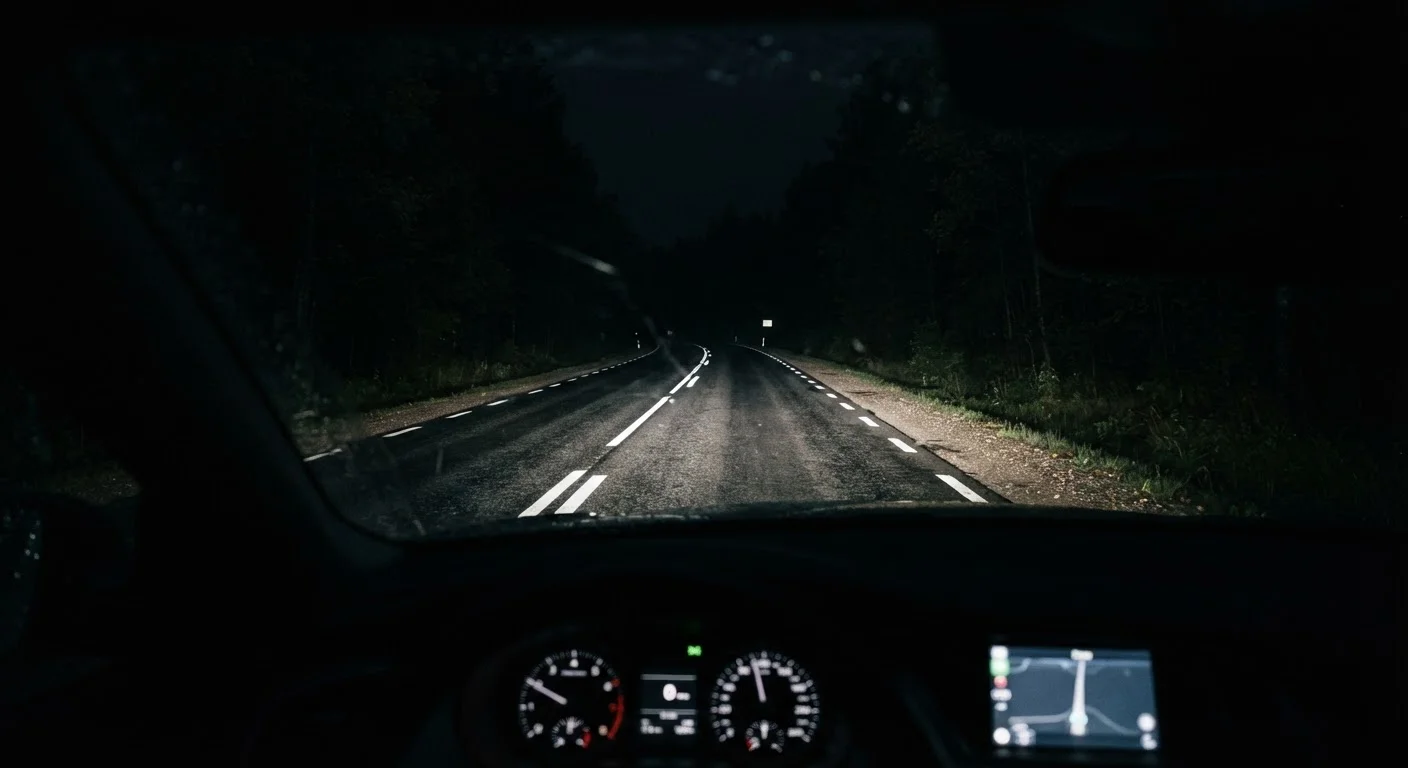
Night driving doesn't just make it harder to see - it fundamentally changes how your brain processes movement and distance. During daylight, your visual system uses dozens of environmental cues simultaneously: road edges, lane markings, other vehicles, buildings, and background scenery all contribute to a stable sense of how fast you're moving. After dark, most of those reference points disappear.
What remains is a narrow corridor of illuminated road ahead. Without surrounding context, the brain struggles to compare your vehicle's position against fixed points - which is exactly how speed perception works. Research in visual perception has consistently shown that low-light conditions impair the ability to judge both speed and closing distance accurately. Drivers commonly feel they are moving slower than they actually are, leading them to hesitate to reduce speed even when conditions demand it.
The problem extends beyond simple visibility. The eye's rod cells, which dominate in low light, are better at detecting motion than detail - but they are not optimized for the kind of rapid, precise distance estimation that safe driving requires. The result is a perceptual lag that compounds the already-reduced reaction window that darkness creates. Understanding how stopping distance and speed interact makes it easier to grasp why a small speed reduction at night can produce a disproportionately large safety benefit.
Headlights Don't Outpace Your Speed
At 60 mph, a vehicle travels roughly 88 feet per second. Standard low-beam headlights typically illuminate about 160-200 feet ahead - which means at highway speeds you may have less than two seconds to react to something at the edge of your headlight range. This gap between visibility and stopping distance is one of the leading contributors to nighttime fatal crashes. Reducing speed is the most direct way to close it.
Common Mistakes Night Drivers Make - and How to Correct Them
Most nighttime driving errors aren't the result of recklessness - they're the result of applying daytime habits to conditions that require a meaningfully different approach. The mistakes below are among the most common, and each one has a practical fix.
Maintaining daytime speed on unlit or poorly lit roads.
Why it happens: Drivers often default to posted speed limits without accounting for reduced visibility - the posted limit reflects ideal conditions, not darkness.
Assuming headlights provide the same effective range as daylight vision.
Why it happens: People are accustomed to daytime driving where peripheral vision and ambient light extend awareness far beyond what headlights offer.
Following too closely behind other vehicles at night.
Why it happens: Taillights create a false sense of orientation - drivers unconsciously use them as an anchor and close the gap without realizing it.
Neglecting to scan far enough ahead on the road.
Why it happens: In darkness, the natural visual focus narrows toward the immediately illuminated zone, causing drivers to look closer in rather than further ahead.
Driving while fatigued - which peaks during nighttime hours.
Why it happens: The body's circadian rhythm naturally promotes sleep after dark; drivers often underestimate how drowsy they are until their reaction time is already severely compromised.
Drivers who also contend with unexpected road situations - such as sun glare at dusk or highway hypnosis after long night drives - face compounding challenges that require deliberate awareness strategies.
Practical Adjustments That Make a Real Difference
Compensating for nighttime speed misjudgment doesn't require advanced driving skills - it requires deliberate habit adjustment. A few consistent practices significantly reduce your exposure to the risks created by reduced visibility.
- Slow down proactively. Reduce speed before conditions force you to. On unfamiliar rural roads or poorly lit stretches, driving 5-10 mph below the posted limit may be appropriate.
- Use high beams responsibly. High beams can nearly double your visible range. Use them whenever oncoming traffic and road conditions allow - and return to low beams promptly when approaching other vehicles to avoid blinding other drivers.
- Increase following distance. Give yourself more space than daytime driving requires. The vehicle ahead may brake for a hazard you haven't yet seen.
- Keep your windshield and headlights clean. Dirt and grime scatter light, reducing the effective reach of your headlights and increasing glare from oncoming vehicles. This is a simple maintenance step with measurable visibility benefits.
- Plan around fatigue. If you know you'll be driving late, build in rest stops. Fatigue accelerates the perceptual distortions that night driving already creates.
Night driving on highways introduces additional considerations compared to city streets - different hazard types, longer braking distances, and reduced pedestrian awareness all shift the risk profile. The differences between highway and city driving are worth reviewing for anyone who regularly drives both environments after dark.
~50%
Of traffic fatalities occur at night
According to the National Safety Council, roughly half of all traffic deaths in the U.S. happen at night, despite significantly less traffic volume during those hours.
3x
Higher nighttime crash fatality rate
The NSC estimates the fatal crash rate per mile driven at night is approximately three times higher than during daylight hours.