

Key Takeaways
- Stopping distance has two components: reaction distance and braking distance - and both grow with speed.
- Braking distance increases exponentially, not proportionally - doubling your speed roughly quadruples the braking distance.
- Wet, icy, or gravel-covered roads can dramatically extend braking distance beyond what drivers expect.
- Even a one-second reaction delay adds significant distance at highway speeds.
- Following distance should be adjusted for speed, road conditions, and vehicle load.
Stopping Distance
Stopping distance is the total distance a vehicle travels from the moment a driver perceives a hazard to the moment the vehicle comes to a complete stop. It combines two separate phases: the distance covered while the driver reacts, and the distance covered while the brakes are actually slowing the car. Both phases are influenced by speed, road conditions, and driver alertness.
In traffic engineering, stopping distance is formally split into 'perception-reaction distance' and 'braking distance.' These are calculated separately because they respond differently to changes in speed - braking distance increases with the square of speed, not linearly.
Breaking Down the Two Phases of Stopping
Most drivers think of stopping as a single action - press the brake, car stops. In reality, stopping unfolds in two distinct phases, each consuming road before your vehicle halts.
Phase 1 - Perception-Reaction Distance: This is the distance your car travels while you recognize a hazard and physically move your foot to the brake pedal. Research from traffic safety studies consistently shows that average perception-reaction time falls between 1.5 and 2.5 seconds. At 60 mph, that alone translates to roughly 130-220 feet of travel before braking even begins.
Phase 2 - Braking Distance: Once the brakes engage, friction between your tires and the road gradually slows the vehicle. On dry pavement at 60 mph, a typical passenger car requires an additional 180 feet or more to stop completely. Add the reaction phase and total stopping distance can exceed 350 feet - longer than a football field.
Understanding that these two phases stack on top of each other is the first step to appreciating why speed has such a dramatic effect on safety margins.
Use a Fixed Object to Check Your Following Gap
Pick a stationary roadside marker - a sign, shadow, or crack - and count the seconds between when the car ahead passes it and when you reach the same point. If you arrive in less than three seconds, ease off the accelerator to create more space. This habit costs you nothing in commute time and provides a meaningful safety buffer.
Why Speed Makes the Problem Exponentially Worse
Speed does not increase stopping distance in a straight line - it multiplies it. Braking distance is governed by physics: specifically, kinetic energy grows with the square of velocity. That means going twice as fast doesn't double your stopping distance - it roughly quadruples it.
4×
Braking distance increase when speed doubles
Because braking distance scales with the square of velocity, doubling speed roughly quadruples the distance needed to stop.
~154 ft
Reaction distance at 70 mph in 1.5 seconds
At 70 mph, a standard 1.5-second perception-reaction time alone consumes approximately 154 feet before braking begins.
50%+
Increase in stopping distance on wet roads
Wet pavement reduces tire friction enough to extend stopping distance by at least 50% compared to dry conditions in many scenarios.
Consider a concrete example. A car traveling at 30 mph might require approximately 75 feet to stop on dry pavement. The same car at 60 mph - traveling only twice as fast - may need around 300 feet. At 70 mph, the distance climbs further still, even though the speed increase from 60 to 70 seems modest.
Reaction distance also grows linearly with speed. At 70 mph, a 1.5-second reaction time alone consumes roughly 154 feet. Combined with braking distance, a driver who spots a hazard at 70 mph on dry pavement may need over 400 feet to stop - a distance that vanishes quickly on a busy highway.
This exponential relationship is why even small speed reductions - slowing from 70 to 60, or 60 to 50 - meaningfully reduce crash risk and impact severity.
How Road Conditions and Driver State Change the Equation
Dry pavement represents the best-case scenario. Real-world driving rarely offers ideal conditions, and each variable that degrades tire grip or slows reaction time adds footage to your stopping distance.
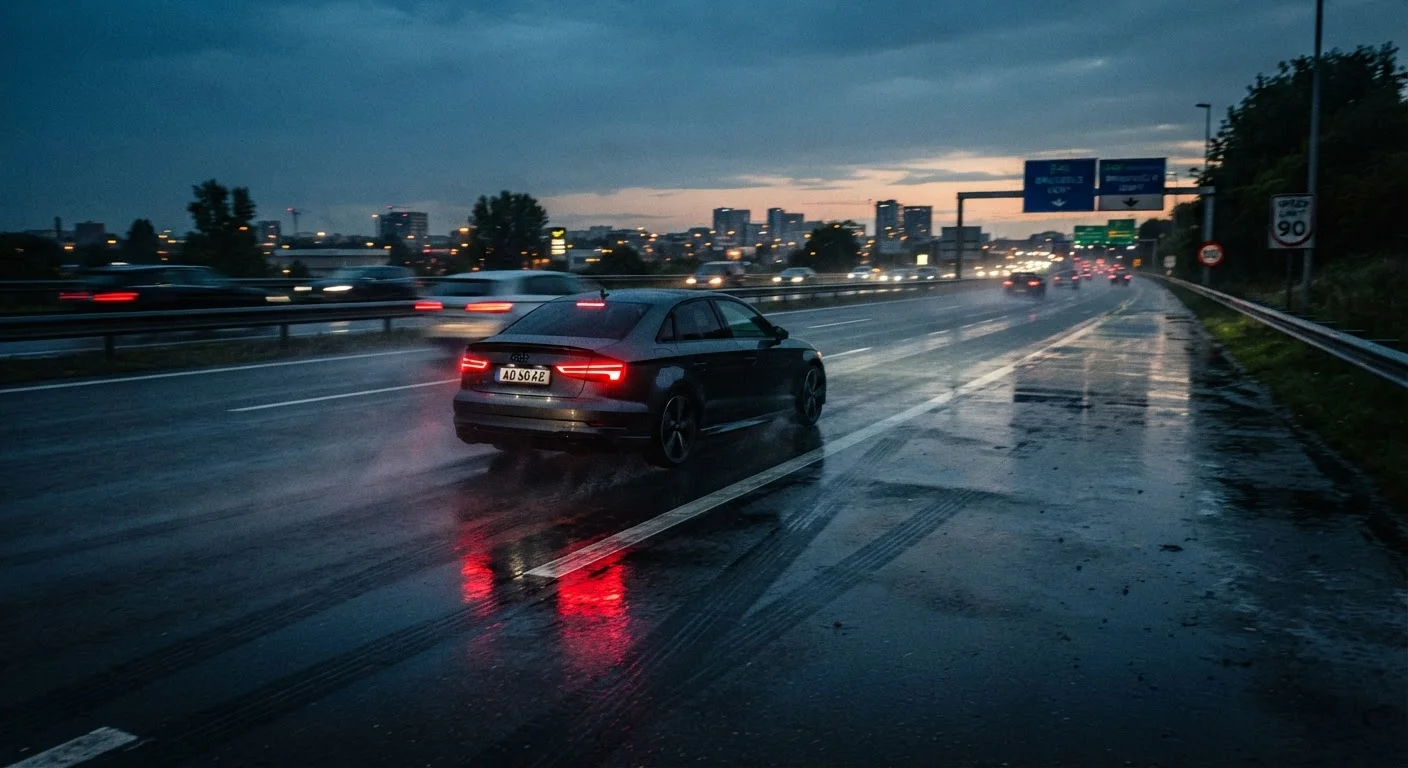
- Wet roads: Rain reduces tire-to-road friction, commonly extending stopping distance by 50% or more. Hydroplaning - where a water film separates tires from the road surface - can cause brakes to become nearly ineffective momentarily.
- Ice and snow: Friction can drop to a fraction of dry-pavement levels. Stopping distances on ice can be 5-10 times longer than on dry asphalt at the same speed.
- Tire condition: Worn tread significantly reduces a tire's ability to channel water and grip the road, extending braking distance on both wet and dry surfaces.
- Driver fatigue or distraction: Even brief inattention - a glance at a phone lasting just 2 seconds at 55 mph covers roughly 160 feet blind. Fatigue slows reaction time comparably to alcohol impairment in some studies.
Night driving introduces a compounding challenge: your headlights may not illuminate far enough ahead to stop in time if you're traveling at typical highway speeds. This phenomenon - sometimes called overdriving your headlights - is worth understanding in depth. Our guide to night driving and speed perception explains how darkness warps speed judgment and what practical adjustments help.
Practical Habits That Give You More Stopping Margin
Understanding stopping distance is valuable only if it shapes how you drive. Several habits directly improve your available stopping margin without requiring any special equipment.
Maintain appropriate following distance. The three-second rule - ensuring at least three seconds of gap between you and the vehicle ahead - gives you time to react and brake. Extend this to four or five seconds in rain or heavy traffic, and to even greater gaps on snow or ice.
Slow down before curves and intersections. Stopping distance applies in all directions. Entering a curve or intersection at lower speed gives you more time to respond to unexpected hazards that emerge into view.
Check tire condition regularly. Tread depth and inflation pressure both affect braking performance. Tires worn below 2/32 of an inch tread depth are generally considered unsafe and should be replaced. A qualified mechanic or tire professional can assess tread and pressure during a routine check.
Reduce speed proactively in poor conditions. Don't wait until you feel the road is slippery to slow down. When rain begins, oil residue on dry pavement creates especially slick conditions before water washes it away.
Stopping distance is ultimately a gap between where danger appears and where your car can stop. Every habit that widens that gap is a habit that keeps you safer.
Vehicle Load Affects Stopping Distance Too
A fully loaded SUV or truck carries significantly more momentum than the same vehicle empty. If you're hauling passengers, cargo, or towing a trailer, your stopping distance will increase beyond what you may be accustomed to. Adjust your following distance accordingly and consult your vehicle owner's manual for towing-specific guidance.