

Key Takeaways
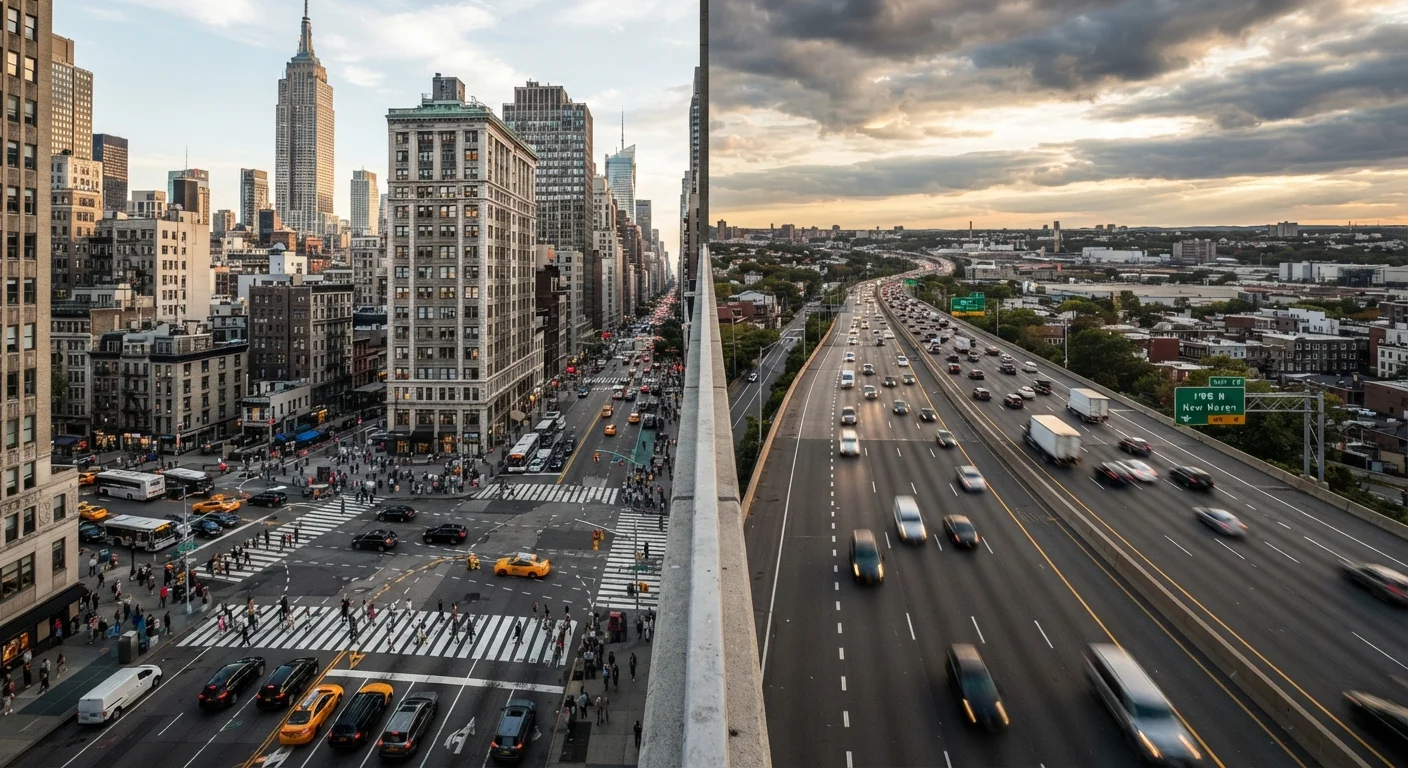
- Highway crashes tend to be more severe due to higher speeds, while city crashes are more frequent due to complexity.
- City driving demands rapid, repeated decision-making; highway driving demands sustained focus over longer periods.
- Tailgating and lane-change errors are leading highway hazards; pedestrians and intersection conflicts dominate city risks.
- Fatigue and highway hypnosis are unique highway dangers with no real equivalent in urban driving.
- Adapting your mental approach - not just your speed - is key to staying safe in each environment.
Option A
Highway Driving
High-speed, sustained attention on open roads.
Best for: Drivers covering long distances between cities or regions who need to manage speed, following distance, and fatigue over extended stretches.
Option B
City Driving
Constant decision-making in dense, unpredictable environments.
Best for: Drivers navigating tight urban streets where pedestrians, cyclists, signals, and frequent stops demand split-second awareness.
If you primarily drive rural interstates or long-distance commutes
Highway Driving awareness
Focus on following distance, merge discipline, and fatigue management - the risks most likely to affect you on open roads at speed.
If you drive in dense urban or suburban areas daily
City Driving awareness
Prioritize intersection scanning, pedestrian awareness, and controlled speed to navigate the unpredictable stop-and-go environment safely.
If your routes regularly mix both environments
Both driving contexts equally
You need to consciously shift your mental mode when transitioning between highway and city - treating each stretch with its own distinct risk profile.
The Core Difference: Frequency vs. Severity
At first glance, highway driving feels safer - lanes are wide, traffic flows in one direction, and there are no stop signs or pedestrians darting across the road. City driving, by contrast, feels chaotic. Yet that intuition is only partly right.
According to the National Highway Traffic Safety Administration (NHTSA), urban roads account for the majority of traffic crashes by volume, largely because of sheer density - more vehicles, more intersections, more vulnerable road users. However, fatal crash rates per mile driven are often higher on rural highways, where speeds are greater and emergency response times are longer.
This is the central tension: city driving is more likely to result in a crash; highway driving is more likely to make that crash deadly. Understanding this distinction helps drivers calibrate their attention appropriately in each setting.
| Criterion | Highway Driving | City Driving |
|---|---|---|
| Crash frequency | Lower per mile | Higher per mile |
| Crash severity | Higher (greater speeds) | Lower on average |
| Primary hazards | Tailgating, merging, fatigue | Intersections, pedestrians, cyclists |
| Cognitive demand | Sustained focus over time | Rapid, repeated decisions |
| Speed environment | High and consistent | Low but variable |
| Vulnerable road users | Rare | Frequent |
| Fatigue risk | High (monotony, hypnosis) | Low to moderate |
| Lane change complexity | High-speed blind-spot risk | Low-speed but frequent |
Highway Hazards: Speed, Monotony, and Merging
On the highway, speed amplifies every mistake. At 70 mph, a vehicle travels roughly 103 feet per second. A distraction lasting just two seconds means covering more than 200 feet blind - enough distance to miss a slowing vehicle ahead entirely.
Following distance becomes critical at highway speeds. The general guidance is a minimum three-second gap between your vehicle and the one ahead, extended further in poor weather. Tailgating at highway speeds leaves almost no margin for error. For a deeper look at how conditions like rain or fog compress that margin further, see our guide on adjusting your habits for rain, fog, and snow.
Merging and lane changes are another major source of highway crashes. Blind-spot failures, sudden braking by lead vehicles, and misjudged closing speeds all contribute. Drivers should signal early, check mirrors and blind spots, and match the speed of traffic before merging rather than forcing gaps.
Perhaps the most underappreciated highway hazard is highway hypnosis - a trance-like state induced by miles of monotonous road where a driver remains technically conscious but mentally disengaged. It's closely related to drowsy driving. Even experienced drivers get caught off guard by how quickly alertness fades on long, featureless stretches. Taking breaks every two hours or 100 miles is a widely recognized prevention strategy.
City Hazards: Complexity, Conflict Points, and Vulnerable Road Users
Urban driving is a constant negotiation. Traffic signals, crosswalks, cyclists, parked cars suddenly opening doors, buses pulling out - every block presents multiple simultaneous decision points. The cognitive load is high even at low speeds.
Intersections are the most dangerous locations in city driving, representing a disproportionate share of urban crashes. Whether navigating a four-way stop or a signalized crossing, drivers must read the intentions of other road users in real time. Our article on roundabouts, four-way stops, and uncontrolled intersections breaks down the right-of-way rules and approach strategies for each type.
Pedestrians and cyclists add unpredictability that simply doesn't exist on highways. Children may run into the street. Cyclists may occupy lane space. Delivery vehicles may stop abruptly. City drivers need a wider field of vision and a habit of scanning not just the lane ahead, but the sidewalks, crosswalks, and driveways to either side.
Speed management in cities isn't just about posted limits - it's about matching speed to conditions. A posted 30 mph limit may still be too fast when visibility is limited by parked vehicles or when a school zone is active. Anticipating hazards before they develop is a skill that pays especially high dividends in dense urban environments.
Night Driving Compounds Both Environments
Both highway and city driving become significantly more hazardous after dark. Reduced visibility shortens reaction windows, and speed perception becomes less reliable - a risk explored in depth in our article on why drivers misjudge speed at night. Whether you're on an interstate or a city boulevard, nighttime demands slower speeds and greater following distance than daytime conditions.
Switching Between Environments: The Mental Gear Shift
Many drivers underestimate the adjustment required when moving from one environment to the other. Exiting a highway after a long drive, speeds that feel slow in the city can still be dangerously fast - a phenomenon sometimes called the speed adaptation effect. Your perception recalibrates to the sustained highway pace, making 35 mph feel sluggish even when it's appropriate.
The reverse also applies. Drivers fresh from city stop-and-go who enter a highway may initially underestimate safe following distances or fail to build enough speed before merging.
Aggressive driving behaviors - including tailgating, erratic lane changes, and failure to yield - occur in both settings and often escalate under the different pressures each environment creates. Our guide on road rage and aggressive driving explains how to recognize escalating situations and stay composed. The conscious act of resetting your mindset when your environment changes is one of the most underused safety tools available to everyday drivers.
This article is for general informational purposes only. Always follow local traffic laws and consult qualified professionals for guidance specific to your vehicle and driving conditions.