
Roundabouts, Four-Way Stops, and Uncontrolled Intersections: Navigating Each Correctly

Key Takeaways
- Roundabouts require yielding to circulating traffic before entering - not stopping unless the way is blocked.
- At four-way stops, arrival order and right-of-way rules determine who moves first.
- Uncontrolled intersections have no signs or signals; treat them as yield situations and proceed with extreme caution.
- Pedestrians and cyclists have right-of-way at all three intersection types in most U.S. states.
- Slowing early and scanning all approaches before committing reduces crash risk at every intersection type.
Our Verdict
No single intersection type is universally safer - each demands a distinct set of habits. Roundabouts generally reduce severe crashes compared to traditional signalized intersections according to traffic safety research, but they require drivers to yield correctly and read lane markings confidently. Four-way stops hinge on clear right-of-way rules that drivers must apply consistently. Uncontrolled intersections carry the highest uncertainty and call for the most conservative approach.
| Best for | Recommended |
|---|---|
| Drivers seeking faster, lower-conflict throughput in urban areas | Roundabouts |
| Low-volume rural or residential intersections with predictable traffic | Four-Way Stops |
| Situations where no control device is present | Uncontrolled Intersections (treat as yield, maximum caution) |
Why Intersections Demand Your Full Attention
Intersections are among the most statistically dangerous locations on any road network. According to the Federal Highway Administration, roughly half of all traffic fatalities and injuries in the United States involve intersection-related crashes. The reason is straightforward: intersections are the places where vehicle paths cross, merge, or diverge - creating multiple opportunities for conflict in a compressed space.
Three intersection types that drivers encounter regularly - roundabouts, four-way stops, and uncontrolled intersections - each operate on different rules. Confusion about those rules, or simply not knowing them, is a primary driver of preventable crashes. Understanding what the road is asking you to do before you reach the decision point is core to staying safe. See our guide to reading the road ahead for broader hazard-anticipation techniques that apply well beyond intersections.
Roundabouts: Yield, Enter, Exit
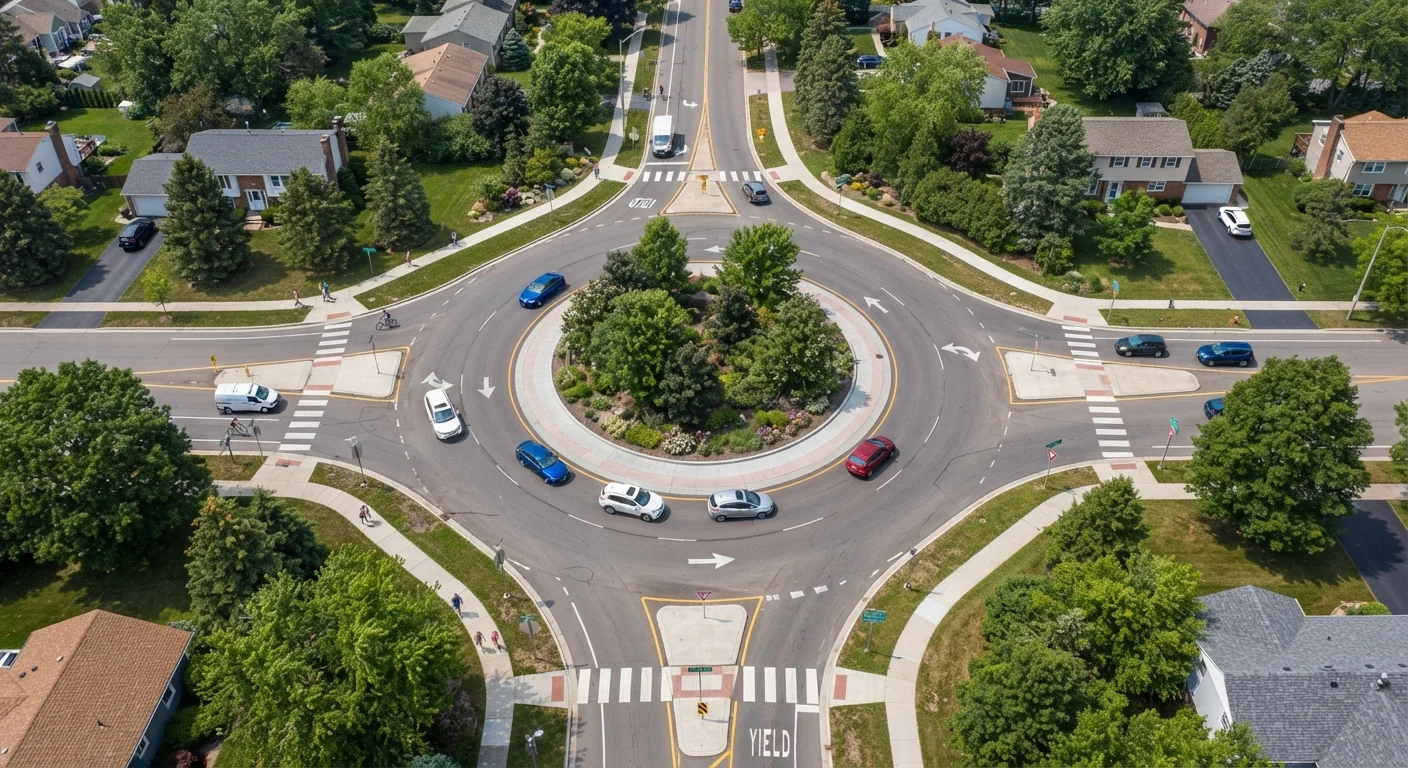
A roundabout is a circular intersection where traffic flows counterclockwise around a central island. Unlike a traditional intersection with a stop sign or traffic light, roundabouts use yield control at entry points - meaning you slow approaching the yield line and enter only when there is a safe gap in circulating traffic.
Key rules for roundabouts
- Yield to circulating traffic. Vehicles already in the roundabout have priority. Do not assume that entering traffic has the right of way.
- Choose your lane before entering. Multi-lane roundabouts require lane selection at the approach. Right lanes are typically for right turns and sometimes straight through; left lanes serve left turns and u-turns. Follow pavement markings carefully.
- Signal your exit. Activate your right turn signal as you pass the exit before yours to alert other drivers you are leaving the circle.
- Watch for pedestrians and cyclists at the marked crosswalks on approach and exit lanes - roundabouts include designated crossing points.
Research from the Insurance Institute for Highway Safety (IIHS) has found that roundabouts can substantially reduce injury crashes compared to traditional signalized intersections, largely because vehicle speeds are lower and right-angle collisions - the most dangerous type - are largely eliminated. That said, driver unfamiliarity remains a real hazard, particularly in areas where roundabouts are newly installed.
Approaching an Unfamiliar Roundabout
If you are unsure which lane to use, choose the right lane - it serves right turns and typically straight-through movements at single-lane roundabouts. Reduce your speed well before the yield line so you have time to read pavement markings and assess gaps in traffic. Hesitation at the yield line is far safer than a rushed entry that cuts off circulating vehicles.
Four-Way Stops: Order, Tie-Breaking, and Common Errors
A four-way stop (also called an all-way stop) requires every approaching driver to come to a full stop before proceeding. Right of way is assigned by a straightforward set of rules - but they require active attention.
The right-of-way hierarchy
- First to stop, first to go. The driver who stopped first has the right to proceed first.
- Tie goes to the right. When two vehicles stop simultaneously, the driver on the left yields to the driver on the right.
- Straight traffic before turning traffic. When facing each other, a driver going straight generally has priority over one turning left across oncoming lanes.
Common mistakes at four-way stops include waving other drivers through out of turn (well-intentioned but disruptive and sometimes illegal), creeping into the intersection before it's your turn, and failing to come to a complete stop - a rolling stop does not satisfy the legal requirement in any U.S. state.
| Roundabout | Four-Way Stop | Uncontrolled Intersection | |
|---|---|---|---|
| Control device | Yield sign at entry | Stop sign on all approaches | None |
| Right-of-way rule | Yield to circulating traffic | First to stop, first to go; yield right on tie | Yield to right; yield to vehicles already in intersection |
| Required stop | No - yield and enter on gap | Yes - full stop mandatory | No - but slow to near-stop pace |
| Typical crash type | Sideswipe, failure to yield | Right-angle, rear-end | Right-angle, failure to yield |
| Pedestrian crossings | Marked on approach/exit legs | At marked crosswalks or crosswalk zone | Often unmarked - use caution |
| Speed through intersection | Low (geometry limits speed) | Near zero then controlled acceleration | Should be low; no enforcement mechanism |
| Driver unfamiliarity risk | Higher - rules often misunderstood | Moderate - rules widely taught | Higher - default rules rarely drilled |
If you're newer to driving or returning after a break, the road safety fundamentals guide covers how right-of-way concepts fit into the broader picture of safe vehicle operation.
Uncontrolled Intersections: Maximum Caution Required
An uncontrolled intersection has no stop sign, yield sign, or traffic signal on any approach. These appear frequently on rural roads, in older neighborhoods, and on low-volume streets. Because no device assigns priority, drivers must apply default right-of-way rules and exercise heightened judgment.
How to navigate them safely
- Treat the intersection as a yield situation. Slow to a speed that allows you to stop completely if necessary.
- The right-of-way default: yield to any vehicle already in the intersection, and when arriving simultaneously with another vehicle, yield to the driver on your right.
- Scan all four quadrants - left, right, ahead, and behind - before committing to a move. Sight lines are often limited by vegetation, parked vehicles, or building setbacks.
- Make eye contact (when possible) with other drivers to confirm mutual understanding before proceeding.
Uncontrolled intersections are particularly hazardous because drivers sometimes assume no sign means no cross-traffic. That assumption is frequently wrong. The situations that catch careful drivers off guard article documents why confident familiarity with a road can lead to lapsed vigilance at exactly these locations.
Understanding how environment and driver behavior interact is central to staying safe - explore that dynamic further in the complete picture of road safety.