

Key Takeaways
- Soil pH controls how well plant roots can absorb nutrients, regardless of how much fertilizer you apply.
- Most vegetables and ornamentals prefer a slightly acidic pH between 6.0 and 7.0.
- Inexpensive test kits and soil lab services can accurately measure your soil's pH.
- Lime raises soil pH; sulfur and acidic organic matter lower it - but changes take time.
- Some plants, like blueberries and azaleas, specifically require acidic soil to thrive.
Soil pH
Soil pH is a measure of how acidic or alkaline your soil is, expressed on a scale from 0 to 14. A pH of 7 is neutral - numbers below that are acidic, and numbers above are alkaline. Most garden plants thrive somewhere in the 6.0-7.0 range, where nutrients in the soil are most accessible to roots.
pH stands for 'potential of hydrogen' and reflects the concentration of hydrogen ions in a solution. Even small shifts on the scale represent large chemical changes, since the scale is logarithmic.
Why pH Matters More Than Fertilizer
Many gardeners assume that struggling plants just need more fertilizer. But even nutrient-rich soil delivers little benefit when the pH is out of range. Soil pH directly controls the chemical form nutrients take - and whether plant roots can absorb them at all.
At a pH that is too high (alkaline), iron, manganese, and zinc become chemically locked and unavailable to plants. At a pH that is too low (acidic), elements like aluminum and manganese can reach toxic levels, while phosphorus becomes difficult to absorb. The result in both cases: pale leaves, stunted growth, and plants that fail despite your best efforts.
This is why understanding pH is foundational to good soil management - more so than fertilizer brand or application schedule. See our guide to organic vs. synthetic fertilizers for a deeper look at how nutrients interact with soil biology.
How to Test Your Soil pH
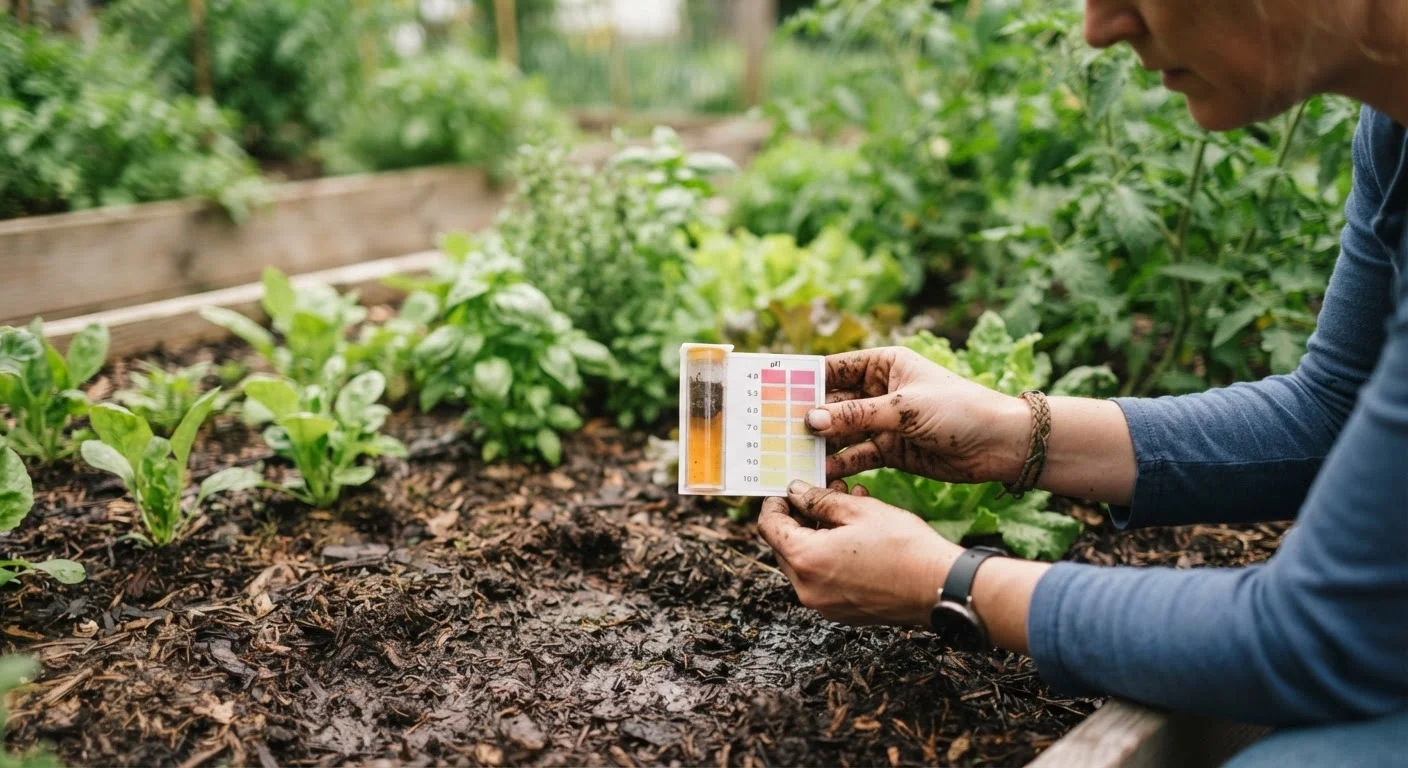
Testing soil pH is straightforward and inexpensive. You have several reliable options:
- Home test kits: Widely available at garden centers, these use color-indicator strips or liquid reagents. They give a useful ballpark reading in minutes.
- Digital pH meters: A probe inserted into moist soil gives a digital readout. Quality varies by meter, so follow calibration instructions carefully.
- Cooperative Extension soil labs: Many U.S. land-grant universities offer low-cost soil testing through local Cooperative Extension offices. These lab tests are the most accurate and typically include nutrient levels along with pH, plus specific amendment recommendations for your region.
When collecting samples, take small amounts from several spots across the garden bed and mix them together before testing. This composite sample gives a more representative picture than any single spot. Test soil when it is slightly moist but not waterlogged.
Use Your Local Cooperative Extension
Cooperative Extension offices, operated through land-grant universities in every U.S. state, offer soil testing services that are often subsidized and highly accurate. Results typically include targeted amendment recommendations for your specific region's soil type, which is more useful than generic package directions.
How to Raise or Lower Soil pH
Once you know your soil's pH, amending it is a deliberate, patient process. Do not expect overnight results - pH shifts take weeks to months.
Raising pH (making soil less acidic)
Ground limestone - commonly called garden lime - is the standard amendment for raising pH in acidic soil. Dolomitic lime also supplies magnesium, which is useful if a soil test shows that nutrient is low. Apply according to your soil test results, since the amount needed depends on your current pH, target pH, and soil texture. Work lime into the top several inches of soil rather than leaving it on the surface.
Lowering pH (making soil more acidic)
Elemental sulfur is the most reliable amendment for reducing pH in alkaline soil. Soil bacteria convert it into sulfuric acid over time, gradually dropping pH. Acidic organic matter - such as peat moss, pine bark, or pine needle mulch - can also nudge pH downward and improve soil structure simultaneously.
If you are planning raised beds where pH control is easier to maintain, our raised garden bed guide covers soil mix strategies worth considering before you build.
Matching Plants to Your Soil's Natural pH
Sometimes the most practical approach is not to fight your soil, but to choose plants that naturally suit it. If your native soil consistently tests acidic, blueberries, azaleas, rhododendrons, and ferns will perform far better with minimal intervention than roses or lavender, which prefer a more neutral range.
Conversely, gardeners in regions with naturally alkaline or chalky soil may find Mediterranean herbs, ornamental grasses, and many drought-tolerant perennials easier to establish. Understanding your baseline conditions makes plant selection simpler and reduces ongoing amendment work.
When planning a mixed garden, grouping plants with similar pH preferences together allows you to amend specific beds rather than trying to uniformly adjust a large area. Our article on perennials vs. annuals can help you think through how plant selection affects your seasonal maintenance load.
6.0-7.0
Optimal pH range for most vegetables
Soil science guidelines consistently identify this range as the window where nutrient availability is broadest for common food crops.
4.5-5.5
Preferred pH for blueberries
Blueberries require strongly acidic soil; plants grown outside this range typically show iron deficiency symptoms and produce poorly.
14-point scale
Full range of the pH scale
The pH scale runs from 0 (most acidic) to 14 (most alkaline), with 7 representing neutral - the midpoint used as a reference in soil testing.
Maintaining pH Over Time
Soil pH is not a one-time fix. Rainfall, decomposing organic matter, fertilizer type, and irrigation water all influence pH gradually. Regions with heavy rainfall tend to see soil acidify over years, while arid climates often skew alkaline.
Building a simple annual routine helps: check pH every two to three years, add organic compost regularly to buffer against swings, and choose fertilizers appropriate for your soil type. High-nitrogen synthetic fertilizers, for instance, can acidify soil over time - a factor worth knowing if your soil is already on the acidic end. This connects directly to how well aeration works, too - compacted soil resists amendment movement, so addressing compaction first can make pH corrections more effective. Learn more in our lawn aeration explainer.
Consistent attention to pH - even just a periodic test - pays dividends across every other aspect of plant care, from root health to how well your watering routine actually translates into growth.