

Key Takeaways
- Most roof failures give visible warnings weeks or months before water infiltrates your home.
- Regular visual checks from the ground and inside the attic can catch problems early.
- Granule loss, sagging, and flashing damage are among the most telling pre-leak indicators.
- Addressing minor roof issues promptly is almost always less expensive than repairing water damage.
- Some warning signs require a professional roofing contractor to safely evaluate and repair.
Why Early Detection Matters
A leaking roof rarely fails without warning. Most homeowners only call for help after water stains appear on a ceiling - but by that point, moisture has often already penetrated sheathing, insulation, or framing. Catching the early indicators costs far less than repairing the downstream damage.
The warning signs below can be spotted during a careful ground-level walk-around, from a ladder at the eaves, or from inside your attic. You don't need to climb onto the roof to detect most of them, and for safety reasons, most homeowners should avoid walking on a roof without professional training. If you spot multiple issues at once, consider scheduling a professional inspection - see what a professional home maintenance inspection covers for context on what that process involves.
Granule Loss in the Gutters or at Downspout Outlets
Asphalt shingles are coated with small mineral granules that protect the underlying mat from UV degradation and weathering. As shingles age or sustain impact damage, these granules detach and wash into your gutter system. Check your gutters after rain - a notable accumulation of grit that resembles coarse sand or tiny pebbles is a reliable indicator that shingles are deteriorating. Spotty or bare patches visible on the shingles themselves confirm the same concern. Proper gutter function is closely tied to roof health; understanding how gutters and downspouts affect water damage is worth reviewing alongside this check.
Grit accumulating in gutters is one of the earliest and most reliable signs of shingle deterioration.
Curling, Cupping, or Buckling Shingles
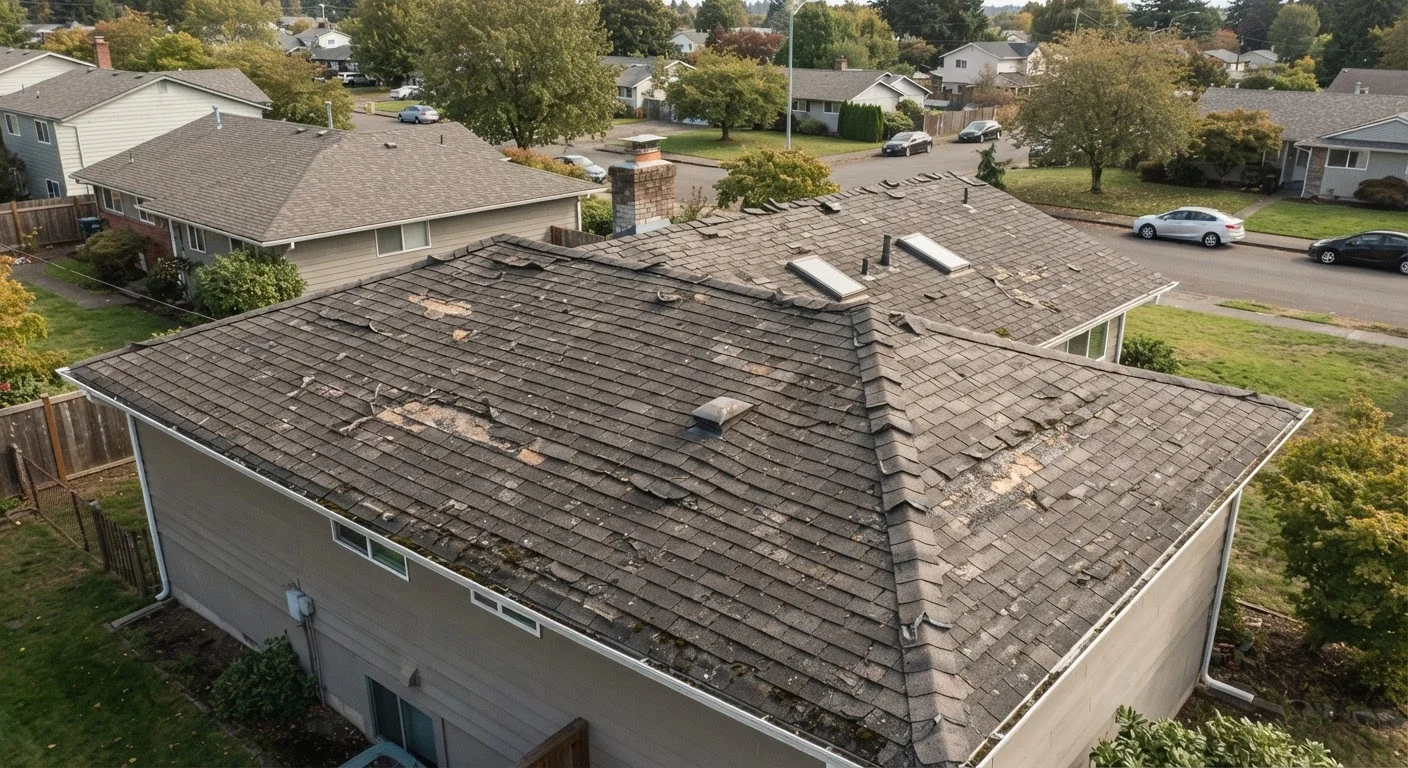
Healthy shingles lie flat against the roof deck. When they begin to curl upward at the edges (called cupping) or lift in the middle (called clawing), they've lost the flexibility needed to seal properly. Buckling - where shingles ripple in a wave pattern - often indicates movement in the underlying decking or improper installation. These deformations create gaps where wind-driven rain can enter. You can often spot curling shingles from the ground using binoculars, particularly at roof edges and ridges where aging tends to appear first.
Curling or buckling shingles can no longer seal against wind-driven rain - replacement is usually necessary.
Damaged or Missing Flashing
Flashing is the thin metal sheeting installed at roof penetrations - chimneys, skylights, vent pipes, and roof-to-wall junctions - to direct water away from seams. It's one of the most common failure points on an otherwise sound roof. Look for flashing that is visibly bent, rusted, or separated from the surface it's sealing. Caulking or sealant that has cracked and pulled away is another indicator. Because flashing failures concentrate water intrusion at specific points, they often cause localized ceiling stains that homeowners mistake for a broader shingle problem.
Failed flashing around chimneys or skylights is one of the most common sources of a pinpoint ceiling stain.
Light, Staining, or Moisture in the Attic
Your attic is the first interior space to register roof problems. On a bright day, turn off all attic lights and look upward - any daylight filtering through the decking or around penetrations signals a gap. Also examine the underside of the roof decking and rafters for dark staining, streaking, or soft spots, which indicate past or ongoing moisture infiltration. A musty smell without visible staining may point to condensation issues, which can be a ventilation problem rather than a shingle failure - but both warrant attention. Bring a flashlight and check after heavy rainfall when moisture patterns are freshest.
Daylight visible through attic decking or dark streaks on rafters confirm that water has found a path in.
Sagging Areas on the Roof Plane
A healthy roof presents a flat, consistent plane between the ridge and the eaves. Any area that appears to dip, sag, or feel spongy underfoot (if a professional is evaluating it) indicates that the structural decking - the plywood or OSB layer beneath the shingles - has absorbed moisture and softened. This is a more serious warning than surface shingle wear because it involves the structural layer. Sagging should be evaluated by a licensed roofing contractor as soon as it's noticed; leaving it unaddressed risks accelerating deck deterioration and increasing the scope of eventual repairs.
Sagging in the roof plane signals decking damage - a structural concern that goes beyond surface shingle wear.
Moss, Algae, or Lichen Growth
Dark streaks across shingles are typically caused by Gloeocapsa magma, a type of algae that feeds on the limestone filler in asphalt shingles. Green moss is a more advanced concern - it holds moisture against the shingle surface and can work its way under edges, accelerating deterioration. Lichen, which forms a crusty gray-green growth, bonds even more aggressively and is harder to remove without damaging the shingle surface. Biological growth alone doesn't mean immediate replacement, but it shortens shingle lifespan and warrants monitoring. Zinc or copper strips near the ridge can slow regrowth over time.
Moss and lichen trap moisture against shingles, quietly accelerating wear well before any leak develops.
Take Action Before the Season Changes
Roof problems tend to worsen fastest during freeze-thaw cycles and heavy rain seasons. If you notice any of these signs heading into fall or winter, addressing them sooner rather than later can prevent minor wear from becoming a major water intrusion. Weatherproofing your home before winter is a natural complement to roof upkeep - drafts, pipe protection, and roofing all benefit from the same pre-season attention.
Deferred roof maintenance rarely stays affordable. Small issues compound: a cracked flashing joint allows water to wick under shingles, which softens the decking, which eventually requires far more than a simple patch. For a broader look at how skipping routine upkeep escalates costs, understand the hidden costs of deferred home maintenance.
Perform a Ground-Level Check Twice a Year
Set a reminder each spring and fall to walk the full perimeter of your home and scan the roofline carefully. Bring binoculars to get a closer look at ridge caps, flashing, and field shingles without climbing. Pair this with a quick attic check after the first significant rainfall of each season. Catching one of these warning signs early typically means a targeted repair rather than a full replacement.
This article is for general informational purposes only. Roof work involving structural assessment, electrical components near the roofline, or significant repairs typically requires a licensed roofing contractor. Always verify local permit and code requirements before undertaking any roofing work.