

Key Takeaways
- The 50/30/20 rule splits after-tax income into needs (50%), wants (30%), and savings or debt payoff (20%).
- "Needs" means true essentials - housing, utilities, groceries, minimum debt payments, and basic transportation.
- "Wants" covers discretionary spending that improves quality of life but isn't strictly necessary.
- The 20% savings bucket can include an emergency fund, retirement contributions, and extra debt payments.
- The ratios are a starting point - high-cost-of-living areas or variable incomes may require adjusted splits.
- Reviewing your budget monthly helps you catch drift and stay on track with your financial goals.
The 50/30/20 Rule
The 50/30/20 rule is a budgeting guideline that divides your after-tax income into three broad categories: 50% for needs, 30% for wants, and 20% for savings or debt repayment. It's designed to give you a simple, memorable structure for managing money without tracking every individual expense. The goal is balance - covering essentials, enjoying your life, and building financial security at the same time.
The framework is commonly attributed to U.S. Senator Elizabeth Warren and her daughter Amelia Warren Tyagi, who outlined it in their 2005 book 'All Your Worth.' It is intended as a general guideline, not a precise financial prescription - individual circumstances may require different allocations.
How the Three Categories Work
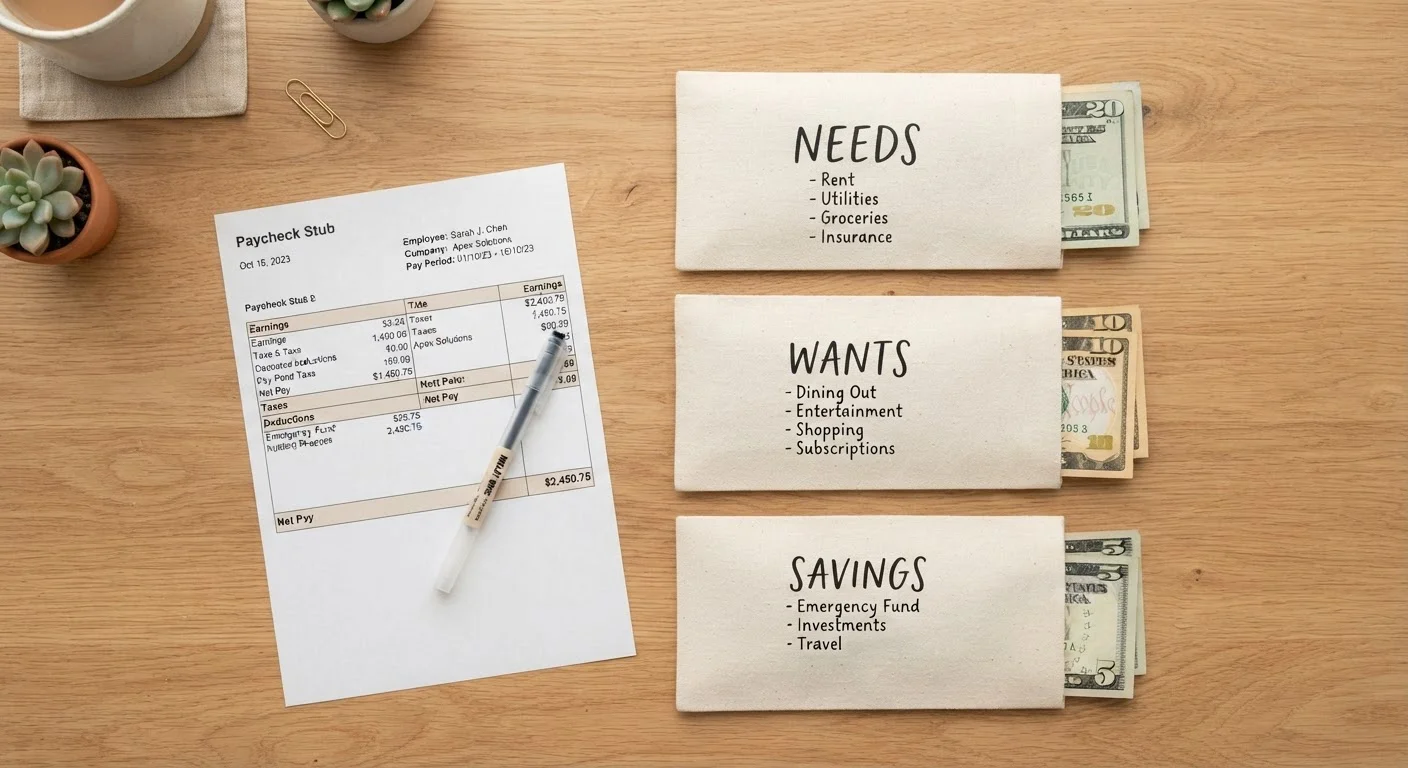
The 50/30/20 rule sorts every after-tax dollar into one of three buckets. Understanding what belongs where is the foundation of making the framework work for you.
50% - Needs
This half of your income covers expenses that are genuinely essential: rent or mortgage payments, basic utilities (electricity, water, heat), groceries, health insurance, minimum required debt payments, and the transportation costs necessary to get to work. The key test for a "need" is this: would going without it cause serious harm or default? If yes, it belongs here. Note that a streaming subscription or a gym membership - even if you use them every day - are wants, not needs.
30% - Wants
Wants are the discretionary expenses that make life enjoyable but aren't survival-critical: dining out, travel, entertainment subscriptions, clothing beyond basics, and hobbies. There's nothing wrong with spending on wants - the rule simply asks you to keep that spending within 30% of your take-home pay so it doesn't crowd out savings or essentials.
20% - Savings and Debt Repayment
The final fifth is directed toward your financial future. This includes contributions to an emergency fund, retirement accounts (such as a 401(k) or IRA), and any debt payments above the required minimum - for example, paying extra on a student loan or credit card balance to reduce interest over time. For guidance on how to balance debt payoff against saving simultaneously, see our article on paying off debt while saving.
57%
Americans living paycheck to paycheck
A 2023 LendingClub report found that approximately 57% of U.S. consumers described themselves as living paycheck to paycheck, underscoring how common it is to lack a structured spending plan.
$1,000
Emergency savings fewer than half of Americans have
Bankrate's 2024 Annual Emergency Savings Report found that fewer than half of U.S. adults could cover a $1,000 emergency expense from savings alone, highlighting the importance of the 20% savings category.
34%
Average share of income U.S. households spend on housing
According to the U.S. Bureau of Labor Statistics Consumer Expenditure Survey, housing consistently accounts for the largest share of household spending, often making the 50% needs target difficult to achieve in high-cost markets.
Putting It Into Practice: A Worked Example
Suppose your monthly take-home pay is $4,000. Here's how the 50/30/20 split looks in dollar terms:
| Category | Percentage | Monthly Amount |
|---|---|---|
| Needs | 50% | $2,000 |
| Wants | 30% | $1,200 |
| Savings / Debt | 20% | $800 |
If your rent is $1,200, your car payment and insurance together run $400, and groceries average $300, your needs total $1,900 - within the $2,000 ceiling. That leaves the $800 savings bucket to split between an emergency fund and retirement contributions based on your personal priorities.
This is meant to be illustrative. Your actual numbers will vary based on where you live, your household size, and your existing financial obligations. The rule gives you a target, not a guarantee.
When to Adjust the Ratios
The 50/30/20 split is a guideline - not a rigid rule that fits every situation. Several common scenarios call for deliberate adjustments.
- High cost-of-living areas: If you live in a city where rent alone consumes 40% of take-home pay, the 50% needs bucket may need to stretch to 60% while you trim wants accordingly.
- Carrying high-interest debt: If you have credit card balances at high interest rates, temporarily shifting more than 20% toward debt repayment typically makes financial sense, since interest charges can erode savings gains. Consult a financial professional to weigh your specific trade-offs.
- Early career or lower income: Hitting a 20% savings rate can be genuinely difficult on a starting salary. Even saving 5-10% consistently builds the habit and grows over time - progress matters more than perfection at the outset.
- Variable income: Freelancers and gig workers may find it easier to apply percentages to an average monthly estimate rather than a fluctuating paycheck. See our guide to budgeting on an irregular income for adapted strategies.
If you want to compare this approach to a more granular method, our 50/30/20 vs. zero-based budgeting comparison walks through the trade-offs side by side.
Making the Framework Stick Over Time
A budget that's set once and forgotten quickly drifts from reality. Building a light review habit is what turns the 50/30/20 rule from a one-time exercise into a living financial plan.
Each month, compare what you actually spent against your three-category targets. Did your "wants" creep past 30%? Did an unexpected car repair push needs over budget? Catching these shifts early gives you time to correct before a pattern solidifies. Our monthly budget review checklist offers a step-by-step process for doing exactly that.
Also revisit your category allocations whenever your income changes significantly - a raise, a job change, or a new recurring expense like a mortgage can all shift the baseline. The 50/30/20 rule works best as a framework you return to and recalibrate, not one you set and ignore.
For a broader view of how this method compares to envelope budgeting, zero-based budgeting, and the pay-yourself-first approach, see our budgeting methods comparison.
This article is for general informational and educational purposes only and does not constitute personalized financial, tax, or investment advice. Consult a qualified financial professional before making decisions based on your individual circumstances.