

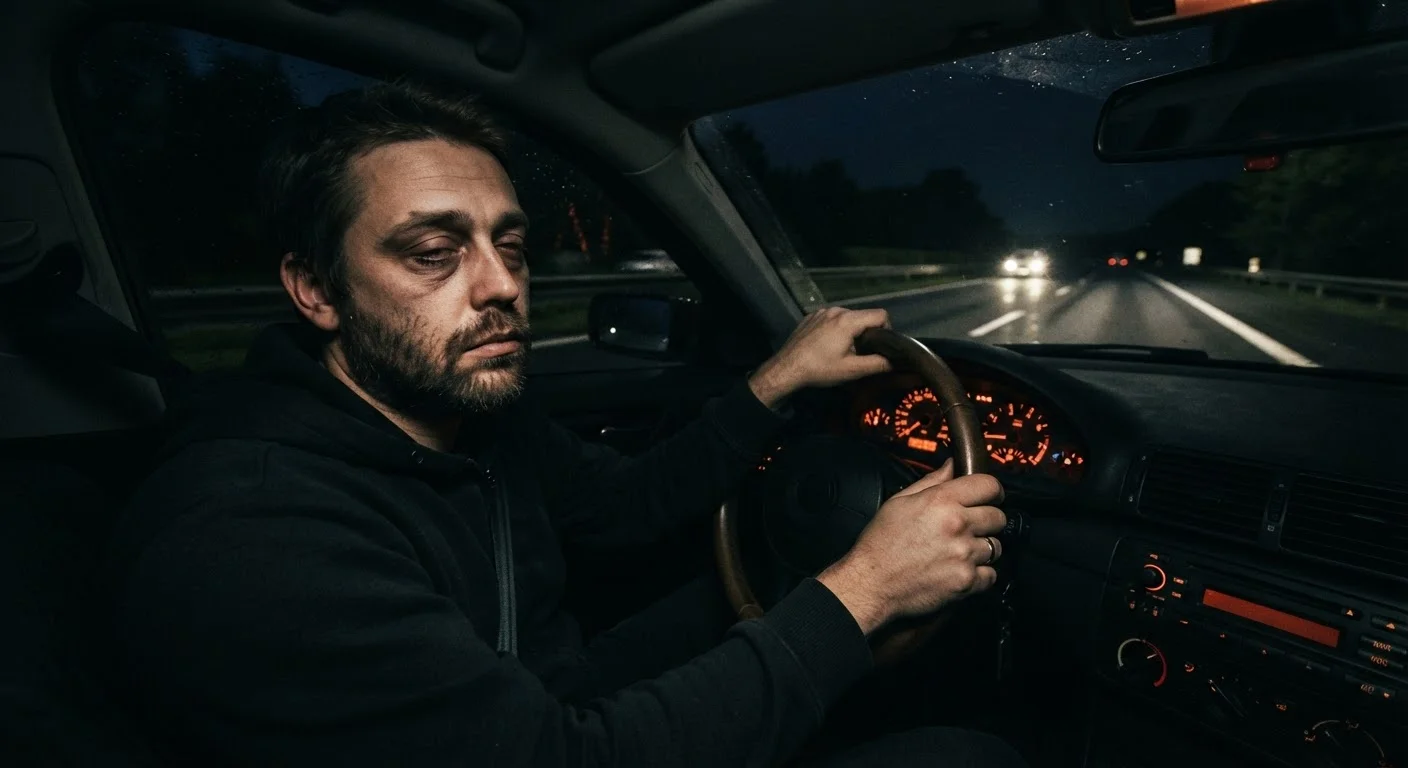
Key Takeaways
- Fatigue impairs driving ability in ways that closely mirror alcohol intoxication.
- Missing even two hours of sleep can meaningfully increase crash risk.
- Drowsy drivers often cannot accurately judge how impaired they are.
- Microsleeps - brief involuntary lapses of consciousness - can last several seconds at highway speed.
- Caffeine and music temporarily mask fatigue but do not restore safe alertness.
- Pulling over to rest is the only reliably safe response to severe drowsiness behind the wheel.
Drowsy Driving
Drowsy driving - also called fatigued driving - refers to operating a vehicle while significantly sleep-deprived or tired to the point where mental and physical performance is impaired. It slows reaction time, reduces situational awareness, and impairs decision-making, all of which are critical to safe vehicle control. Unlike alcohol impairment, fatigue can creep up gradually and without obvious warning, making it especially dangerous.
Research from the AAA Foundation for Traffic Safety has shown that sleeping six to seven hours instead of eight can roughly double crash risk; going without sleep for 20 hours produces impairment comparable to a 0.08% blood alcohol concentration.
How Fatigue Rewires Your Driving Ability
Sleep deprivation does not simply make you feel tired - it actively degrades the cognitive functions that driving depends on. Reaction time slows, sometimes dramatically. The brain's ability to process rapidly changing information - a merging car, a sudden brake light, a pedestrian stepping off a curb - becomes sluggish. Attention narrows and then lapses entirely in brief but dangerous episodes known as microsleeps.
What makes fatigue uniquely treacherous is how poorly drivers assess their own impairment. Studies consistently show that sleep-deprived individuals tend to underestimate how significantly their performance has declined. That false confidence keeps fatigued drivers on the road when they should stop. This dynamic is explored further in our article on situations where even careful drivers get caught off guard.
Fatigue and Adverse Conditions Compound Each Other
Driving while fatigued is dangerous on its own, but it becomes significantly more hazardous when combined with poor weather, low visibility, or unfamiliar roads. Each factor narrows your safety margin, and fatigue reduces your ability to adapt to the unexpected. If you are tired and conditions are challenging, the calculus for stopping becomes even more clear.
Fatigue also compounds the difficulty of navigating challenging conditions. If you are already tired, tasks like driving in rain or low visibility become significantly harder to manage. For more on how conditions change driving demands, see our guide on driving in rain, fog, and snow.
The Warning Signs You Should Never Ignore
Fatigue announces itself - if you know what to look for. The most reliable early indicators include:
- Frequent yawning or eye-rubbing - Your body is signaling oxygen demand and reduced alertness.
- Trouble keeping your eyes open or focused - A direct sign of declining wakefulness.
- Lane drifting - Briefly leaving your lane without intending to is a serious red flag.
- Missing exits or forgetting the last several miles - Indicates your attention has been lapsing.
- Tailgating without realizing it - Slower processing reduces spatial awareness.
- Irritability or difficulty concentrating on a task as routine as steering - Cognitive fatigue reducing executive function.
Any single sign warrants caution. Multiple signs together mean it is time to get off the road. Night driving intensifies many of these risks - fatigue combines with reduced visibility in ways that multiply danger. Our piece on why drivers misjudge speed at night explores how darkness warps driver perception even when you feel awake.
~100,000
Police-reported drowsy driving crashes annually (U.S.)
According to NHTSA estimates, drowsy driving is involved in roughly 100,000 crashes reported by law enforcement each year in the United States.
1.5-2×
Crash risk increase from sleeping 6-7 hours vs. 8
AAA Foundation for Traffic Safety research found that sleeping six to seven hours - one to two hours less than recommended - can roughly double a driver's crash risk.
3 seconds
Typical microsleep duration at highway speed
A three-second microsleep at 65 mph means a vehicle travels approximately 285 feet - nearly the length of a football field - with no driver control.
What Actually Helps - and What Doesn't
Several common tactics for fighting drowsiness behind the wheel provide only brief, partial relief at best:
- Caffeine: Can buy 30 to 45 minutes of improved alertness, but does not restore impaired reaction time or judgment. Effects vary by individual tolerance.
- Loud music or cold air: Marginally stimulating, but mask fatigue rather than address it. These strategies have been shown to lose effectiveness quickly.
- Opening a window: Similar to music - a temporary distraction that does not reverse cognitive impairment.
What genuinely helps is rest. A 20-minute nap in a safe, parked location can meaningfully restore alertness for many drivers. Pulling over entirely and sleeping until you feel recovered is the only reliably safe response to severe drowsiness. Planning around fatigue - adjusting departure times, sharing driving on long trips, and building in scheduled stops - is far more effective than any in-the-moment countermeasure.
This article is for general informational purposes. Always use your own judgment about your condition before driving, and prioritize safety above schedule.