

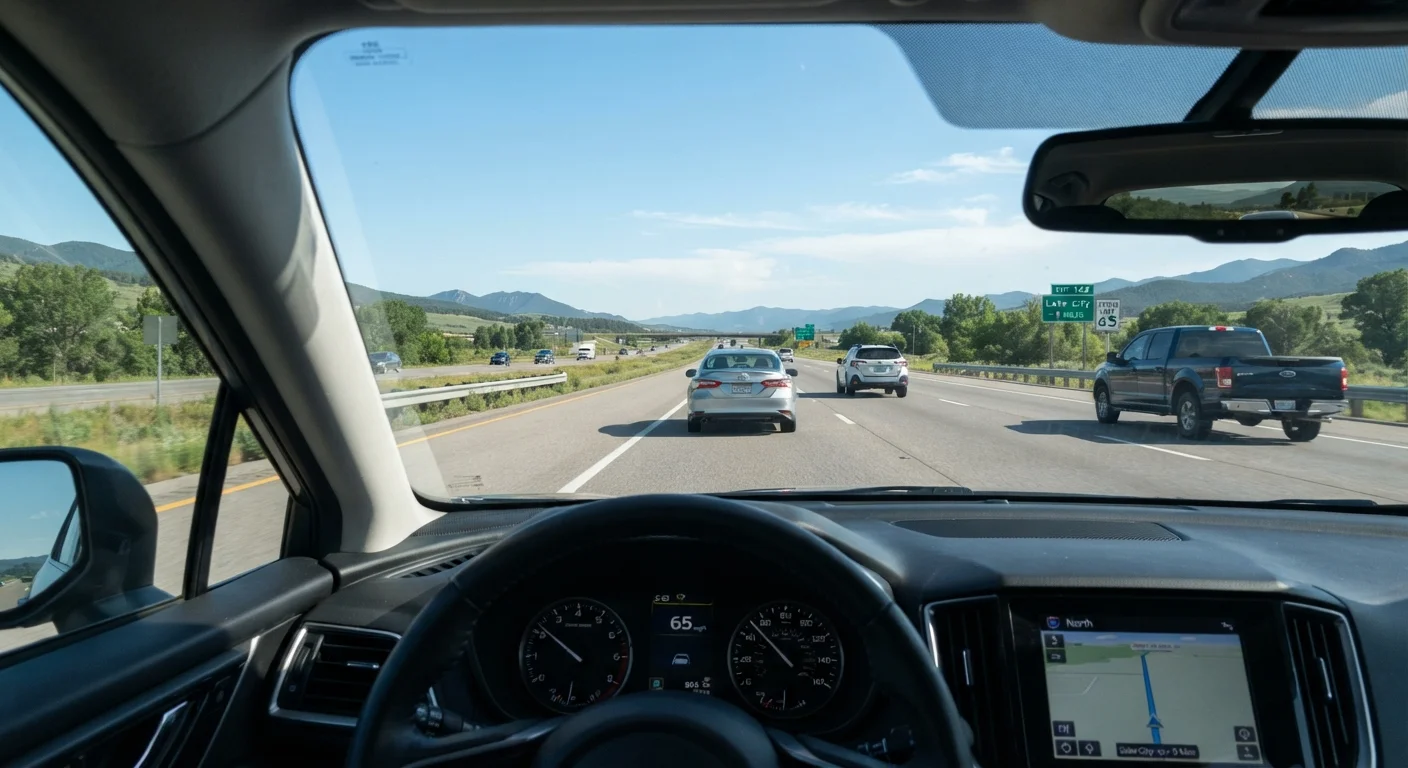
| Baseline following distance rule | Two seconds under ideal conditions |
| Share of crashes that are rear-end collisions | ~29% (National Highway Traffic Safety Administration (NHTSA)) |
| Recommended gap on wet roads | 3-4 seconds minimum |
| Approximate stopping distance at 60 mph | ~240 feet (General driver education reference) |
| Average alert-driver reaction time | ~1.5 seconds |
Why Following Distance Matters More Than Most Drivers Realize
Rear-end collisions are among the most common crash types on American roads. According to the National Highway Traffic Safety Administration (NHTSA), they account for roughly 29% of all traffic crashes each year. The underlying cause in most cases is straightforward: drivers simply don't leave enough space to stop in time.
The challenge is that human perception of space and speed is unreliable - especially at highway speeds. A gap that looks generous at 35 mph can be dangerously short at 65 mph. That's why traffic safety experts have developed easy-to-apply rules that remove the guesswork. Understanding these guidelines and knowing when to adjust them is a core skill for any driver.
See our guide to managing space around your vehicle for a broader look at how front, rear, and side clearance work together in collision avoidance.
| Baseline following distance rule | Two seconds under ideal conditions |
| Share of crashes that are rear-end collisions | ~29% (National Highway Traffic Safety Administration (NHTSA)) |
| Recommended gap on wet roads | 3-4 seconds minimum |
| Approximate stopping distance at 60 mph | ~240 feet (General driver education reference) |
| Average alert-driver reaction time | ~1.5 seconds |
The Two-Second Rule: The Standard Baseline
The two-second rule is the most widely taught following-distance guideline in driver education. Here's how it works:
- Pick a fixed object ahead - a sign, overpass, or road marking.
- When the vehicle in front of you passes that object, begin counting: one-one-thousand, two-one-thousand.
- You should not reach that same object before you finish counting. If you do, you're following too closely.
At typical city speeds (25-40 mph), two seconds translates to roughly 40-80 feet of space. At 60 mph on the highway, it's approximately 176 feet - nearly the length of eighteen cars. The rule scales automatically with speed, which is its main advantage.
Keep in mind: two seconds is a minimum under ideal conditions - dry pavement, good visibility, alert driver. It is not a universal target.
When to Extend Your Following Distance
Several conditions require increasing your cushion well beyond the two-second baseline:
- Wet or icy roads: Stopping distances can double or triple on slick surfaces. A three- to four-second gap is widely recommended in rain; six or more seconds may be appropriate on ice or snow.
- Following large vehicles: Trucks and buses block your sight lines. Extra distance gives you time to see hazards that appear from in front of them.
- Reduced visibility: Fog, heavy rain, and glare all shrink your reaction window. Our article on how darkness distorts speed perception explains why this is especially critical at night.
- Fatigue or distraction: Reaction time increases significantly when a driver is tired or inattentive. If you notice either, increase your gap and consider taking a break.
- Towing a trailer: Added weight increases braking distance considerably. Give yourself extra room whenever you're hauling.
The habit of reading the road ahead pairs directly with following-distance awareness - both are about buying yourself time to respond.
Other Spacing Guidelines Worth Knowing
Beyond the two-second rule, a few additional guidelines help drivers manage space in specific situations:
- The Three-Second Rule
- Recommended for speeds above 55 mph, adverse weather, or any time conditions are less than ideal. Simply extend your count by one second.
- The Four-Second Rule for Trucks and RVs
- Heavier vehicles require significantly more stopping distance. Drivers of larger rigs are generally advised to use a minimum four-second gap in normal conditions.
- Stopping Distance Formula (Urban Reference)
- At 30 mph, the average stopping distance for a passenger vehicle is roughly 75 feet - about the length of seven cars. At 60 mph, that figure rises to approximately 240 feet. These benchmarks help contextualize why time-based rules are practical alternatives.
- Lane-Change Buffer
- When merging or changing lanes, you should have enough space to see the complete front of the vehicle you've passed in your rearview mirror before moving over.
For new drivers, these rules provide essential structure. See Road Safety From the Ground Up for a complete introduction to space management and situational awareness.
Following Distance
The space between the front of your vehicle and the rear of the vehicle ahead. Adequate following distance gives a driver time to perceive a hazard and apply the brakes before a collision.
Two-Second Rule
A driver education guideline that establishes a minimum two-second time gap between your vehicle and the one ahead. It is measured by counting the time it takes you to reach a fixed point the lead vehicle just passed.
Stopping Distance
The total distance a vehicle travels from the moment a driver perceives a hazard to the point the vehicle fully stops. It combines perception time, reaction time, and braking distance.
Reaction Time
The time between when a driver perceives a hazard and when they physically respond - such as pressing the brake pedal. Average reaction time for an alert driver is roughly 1.5 seconds.
Tailgating
Following another vehicle too closely, leaving insufficient time or space to stop safely. Tailgating is a leading cause of rear-end collisions and is illegal in most U.S. states.