

Key Takeaways
- Checked bag fees on domestic U.S. flights typically range from $30 to $40 per bag, each way.
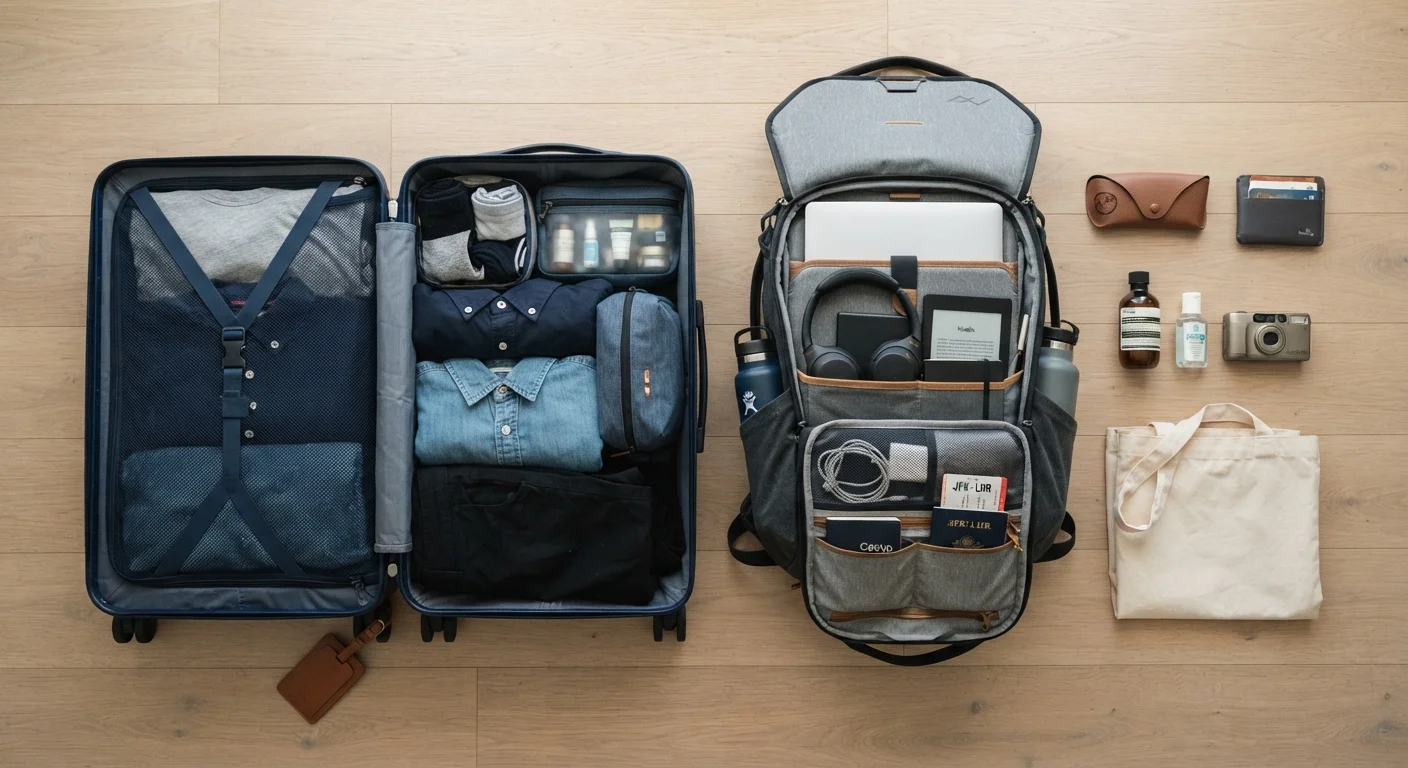
- Carry-on luggage eliminates checked fee costs but requires strict packing discipline and size compliance.
- Trip length, airline policy, destination activities, and connection time all influence the smarter choice.
- Basic economy fares on some airlines restrict carry-on bags to personal items only - always verify before booking.
- Traveling with medications, valuables, or fragile items generally favors carry-on to avoid checked bag risk.
Option A
Checked Baggage
The spacious, hands-free option for longer or gear-heavy trips.
Best for: Travelers heading on extended trips, checking sports equipment, or avoiding strict carry-on size limits.
Option B
Carry-On
The lean, fee-free choice for short trips and flexible travelers.
Best for: Weekend travelers, frequent flyers, and anyone who wants to skip baggage claim and airline fees.
If you're taking a trip of five or more nights
Checked Baggage
Longer trips typically require more clothing, toiletries, and gear than a carry-on can hold comfortably. A checked bag gives you room to pack for varied activities without compromising.
If you're flying for a weekend or three nights or fewer
Carry-On
Short trips rarely require more than a carefully packed carry-on. You'll save on fees, skip baggage claim, and move through the airport faster.
If your itinerary includes tight connections or multiple flights
Carry-On
Checked bags can be delayed or misrouted on multi-leg itineraries. A carry-on keeps your belongings with you throughout the journey.
If you're traveling with sports gear, formal attire, or bulky items
Checked Baggage
Items like ski equipment, suits, or hiking boots rarely fit within carry-on dimensions. A checked bag is the practical solution for gear-specific travel.
If you're flying on a basic economy fare
Carry-On
Many basic economy tickets exclude overhead bin access entirely, so pack a personal item and confirm the airline's specific allowances before departure.
What You're Actually Paying For
The cost difference between checked baggage and carry-on travel is more significant than many travelers realize - and it compounds across a round trip. Most major U.S. carriers charge between $30 and $40 for the first checked bag each way, meaning a domestic round trip could add $60 to $80 per person before you've booked a hotel. For families or groups, that figure multiplies quickly.
Carry-on bags, by contrast, are included at no extra charge on standard economy fares with most U.S. airlines - though this is not universal. Travelers booking basic economy tickets should read the fine print carefully, as some airlines restrict passengers to a personal item only, with overhead bin access unavailable at that fare level.
If cost is a deciding factor, understanding all your travel costs upfront - including fees - helps you budget accurately before you commit to a fare class.
| Criterion | Checked Baggage | Carry-On |
|---|---|---|
| Typical domestic fee | $30-$40 each way | Included (standard economy) |
| Packing capacity | High - suits most trip lengths | Limited - requires discipline |
| Risk of loss or delay | Present - airline-handled | Low - stays with traveler |
| Baggage claim wait | Yes - typically 15-30 minutes | None |
| Tight connection suitability | Higher risk of misrouting | No transfer risk |
| Ideal trip length | 5+ nights or gear-heavy trips | 1-4 nights, light travel |
| Basic economy compatibility | Available at added cost | Check airline rules - varies |
Trip Length and Packing Realities
Trip length is often the clearest guide. For stays of three nights or fewer, most travelers can pack everything they need into a standard carry-on bag with thoughtful preparation. For trips of five nights or longer - especially if the itinerary spans different climates, activities, or dress codes - checked baggage usually becomes practical rather than optional.
The key variable is packing discipline. Many travelers default to a checked bag out of habit rather than necessity. Packing light without sacrificing comfort is genuinely achievable for most one-week trips if you plan your wardrobe around versatile, mix-and-match pieces and use travel-sized toiletries.
That said, destination activities matter. Camping gear, beach equipment, formalwear for a wedding, or cold-weather layers for a ski trip add bulk that simply won't compress into a carry-on. In those cases, checking a bag is the rational call - not a packing failure.
$30-$40
Typical first checked bag fee, each way
Most major U.S. carriers publish domestic checked bag fees in this range, though policies change - always verify directly with your airline.
~30 min
Average baggage claim wait time
Airport wait times for checked luggage vary by airport size and flight volume; busy hub airports can exceed this estimate during peak travel periods.
1 in 170
Checked bags mishandled per passenger
The U.S. Department of Transportation tracks airline baggage reports; mishandling rates have improved in recent years but remain a real consideration for travelers.
Airport Experience and Logistics
Beyond cost and packing, the airport experience itself differs substantially between the two options. Traveling carry-on only means arriving at your destination and walking straight out of the airport - no waiting at baggage claim, no risk of delayed or lost luggage, and no checked-bag receipt to track.
Checked bags, while more spacious, introduce logistical variables. Bags can be delayed, misdirected on connecting flights, or occasionally damaged. Most airlines have formal claims processes for lost or damaged luggage, but resolving those issues takes time and adds stress to the start or end of a trip.
Tight connections are a specific scenario where carry-on luggage has a clear advantage. Checked bags transferred between flights face a higher risk of missing the connection than passengers do, particularly at busy hub airports or on itineraries with less than 60 to 90 minutes between flights.
For travelers who value flexibility and spontaneity - say, extending a trip by a day or changing return flights - carry-on travel also makes that easier. There's no bag to retrieve, rebook, or track if plans shift. If building in that kind of openness appeals to you, leaving room in your itinerary for the unexpected pairs naturally with carry-on-only travel.
Special Considerations That Should Influence Your Choice
Certain situations make one option clearly preferable regardless of trip length. If you're carrying prescription medications, valuables, or fragile items, those should travel in a carry-on - ideally a personal item kept under the seat in front of you. Airlines are not liable for fragile or perishable items packed in checked bags, and medications should never be separated from a traveler who depends on them.
Travelers with mobility limitations may find checked baggage more practical, as it removes the need to lift or maneuver a heavy bag into an overhead bin. Gate-check options (checking a carry-on at the gate for free, particularly on smaller regional aircraft) can offer a middle path: the storage convenience of a checked bag without the upfront fee.
If you're curious how experienced travelers approach this consistently, what frequent flyers actually pack in a carry-on offers practical perspective on what fits - and what gets left behind for good reason.
Ultimately, neither checked baggage nor carry-on is the universally correct answer. The smarter approach is evaluating each trip on its own terms: how long, where, what you'll be doing, and what it will realistically cost you either way.