

Key Takeaways
- eSIMs are built into a phone's hardware and activated digitally - no chip to insert or lose.
- Physical SIMs remain widely supported and are easy to move between compatible devices.
- Most current flagship phones support both formats simultaneously, so you don't have to choose one exclusively.
- International travelers often benefit most from eSIMs, since adding a foreign plan requires no physical card.
- Carrier eSIM support varies - always confirm your carrier supports eSIM before assuming it's available.
Option A
eSIM
The embedded, software-driven approach to carrier connectivity.
Best for: Travelers, frequent carrier-switchers, and anyone who wants a slimmer phone without a SIM tray.
Option B
Physical SIM
The familiar, removable chip that has connected phones for decades.
Best for: People who swap devices regularly, use older phones, or live in areas with limited eSIM carrier support.
If you travel internationally several times a year
eSIM
You can download a local data plan before you land without finding a SIM vendor or swapping cards.
If you frequently swap the same SIM between multiple older devices
Physical SIM
A removable SIM moves instantly between phones without any carrier activation steps or compatibility checks.
If you want to run two numbers on one phone
eSIM
Dual-SIM setups using an eSIM plus a physical SIM let you keep a personal and work number on one device.
If your carrier doesn't yet fully support eSIM
Physical SIM
eSIM activation requires carrier-side support; without it, a physical SIM is your only reliable option.
What Each Format Actually Is
A physical SIM (Subscriber Identity Module) is a small removable chip - available in standard, micro, and nano sizes - that stores your carrier credentials and slides into a tray on your phone. When you switch carriers or devices, you swap the card.
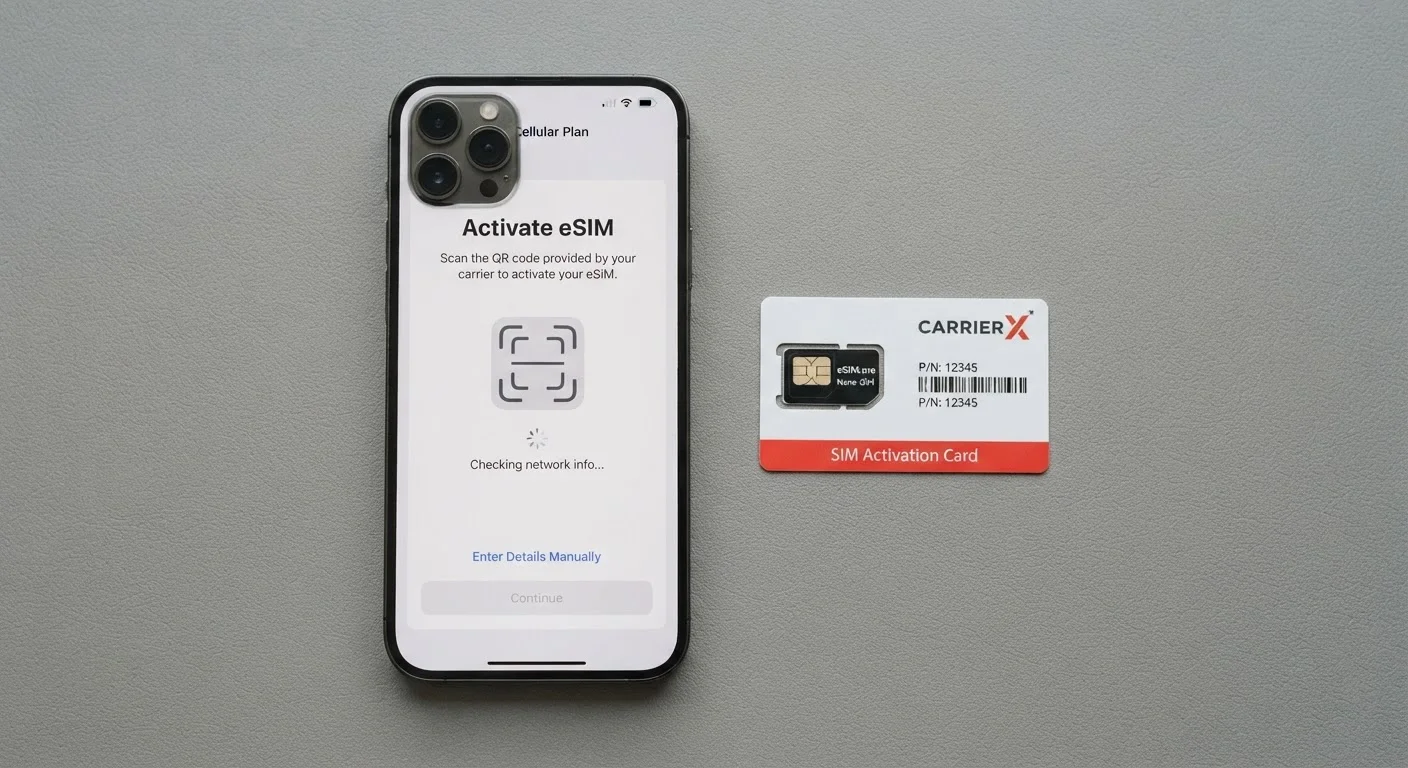
An eSIM (embedded SIM) is a chip soldered directly onto your phone's motherboard. There's nothing to remove. Instead of swapping hardware, you download a carrier profile over the internet - typically by scanning a QR code or using a carrier app. That profile tells the phone which network to connect to and under what account.
Both formats accomplish exactly the same core job: authenticating your device to a mobile network. The difference is entirely in how that authentication is stored and changed.
| Criterion | eSIM | Physical SIM |
|---|---|---|
| Form factor | Embedded chip, no tray needed | Removable nano/micro chip |
| Carrier switching | Software activation, often minutes | Requires new physical card |
| International use | Download foreign plan digitally | Must obtain local SIM card |
| Device compatibility | Most flagships since ~2020 | Nearly all devices |
| Multiple numbers | Supports dual-SIM with physical slot | One number per card slot |
| Device recovery | Carrier must transfer profile | Move chip to new device instantly |
| Carrier support breadth | Major carriers; varies for prepaid | Virtually universal |
How Switching Carriers Compares
With a physical SIM, switching carriers means obtaining a new card - either by visiting a store or waiting for one to arrive by mail - then inserting it into your phone. The process is tangible and simple, but it creates a short gap in service while you wait and swap.
With an eSIM, switching is handled entirely in software. Many carriers let you activate a new plan in minutes through their app or website. However, some carriers limit how often you can transfer an eSIM profile, and not every prepaid or budget carrier offers eSIM activation. If you rely on prepaid plans, it's worth confirming eSIM support before committing to an eSIM-only device.
For travelers, eSIM's advantage is clear: you can purchase and activate a local data plan from a foreign carrier before your flight lands, without tracking down a SIM kiosk at the airport.
Device Compatibility and Practical Limits
Most flagship smartphones released since 2020 include eSIM capability, and some newer models - particularly certain iPhone models sold in the US - have removed the physical SIM tray entirely, making eSIM the only option. Mid-range and budget devices vary widely; always check specifications before assuming eSIM is available.
Physical SIM support remains nearly universal. If you use an older device, a budget phone, or a device purchased outside the US, a physical SIM is almost certainly your option regardless of preference.
One practical consideration worth noting: if your phone is lost or damaged, recovering a physical SIM is as simple as moving the chip to a replacement device. Recovering an eSIM profile requires contacting your carrier, which adds a step - though most carriers handle this routinely.
For readers evaluating a new phone purchase, understanding how each format interacts with your financing or ownership arrangement matters too. See how phone financing and leasing models work before signing a carrier agreement tied to a specific device.
Privacy and Data Considerations
From a network perspective, eSIM and physical SIM expose the same categories of data to your carrier - call records, data usage, location signals, and device identifiers. The format of the SIM itself doesn't meaningfully change what your carrier can observe.
One nuance: because eSIM profiles are managed digitally, the activation process typically involves more data exchange with carrier servers than inserting a physical card does. This isn't a significant risk for most users, but it's a real distinction. If you're curious about the broader picture of what carriers and apps collect from your device, mobile data collection practices are worth understanding separately from SIM format.
Neither format provides anonymity by itself. Both tie your device to a carrier account, and both are subject to the same legal frameworks governing carrier data retention in the US.