

Key Takeaways
- Prepaid plans require payment upfront; postpaid plans bill you after each month of service.
- Postpaid plans typically require a credit check; prepaid plans do not.
- Prepaid plans offer more flexibility - you can switch or cancel without early termination fees.
- Postpaid plans often provide better priority network access and more robust international roaming options.
- Phone financing and device installment plans are generally only available through postpaid carriers.
- Both plan types can run on the same underlying network infrastructure depending on the carrier.
Option A
Prepaid Plans
The pay-before-you-use, no-strings-attached option.
Best for: Readers who want cost control, no credit checks, and the freedom to switch carriers without penalty.
Option B
Postpaid Plans
The traditional billed-monthly model with broader perks and device financing.
Best for: Readers who want phone financing options, family plan discounts, and priority network access.
If you want no credit check and full control over monthly spending
Prepaid Plans
Prepaid requires no credit approval and never surprises you with a larger-than-expected bill at month's end.
If you need to finance a new phone through your carrier
Postpaid Plans
Device installment plans and trade-in credits are almost exclusively tied to postpaid accounts, which require the credit relationship to structure the loan.
If you travel internationally several times a year
Postpaid Plans
Postpaid plans from major carriers generally include more comprehensive international roaming options and wider partner agreements abroad.
If you want to switch carriers or try a new plan without commitment
Prepaid Plans
Prepaid has no contracts or early termination fees, so you can move on the moment a better option appears.
If you're managing a family plan with multiple lines
Postpaid Plans
Multi-line postpaid accounts typically offer per-line discounts that can make the per-person cost competitive, even compared to prepaid alternatives.
The Core Difference: When You Pay
The most fundamental distinction between prepaid and postpaid is the direction money moves relative to service. With a prepaid plan, you pay before your service period begins. Once that balance or allotment runs out, service stops - or auto-renews if you've set that up. With a postpaid plan, the carrier extends you service for a full month and then bills you afterward, similar to a utility.
That payment timing shapes almost every other difference between the two structures. Postpaid requires the carrier to trust you'll pay - hence the credit check. Prepaid requires no trust at all, which is why it's accessible to people building credit, teenagers, or anyone who prefers not to have their financial history reviewed by a phone company.
For a plain-language explanation of plan terminology like deprioritization and MVNOs, see our Mobile Plan Jargon, Decoded.
Cost, Flexibility, and What's Actually in the Bill
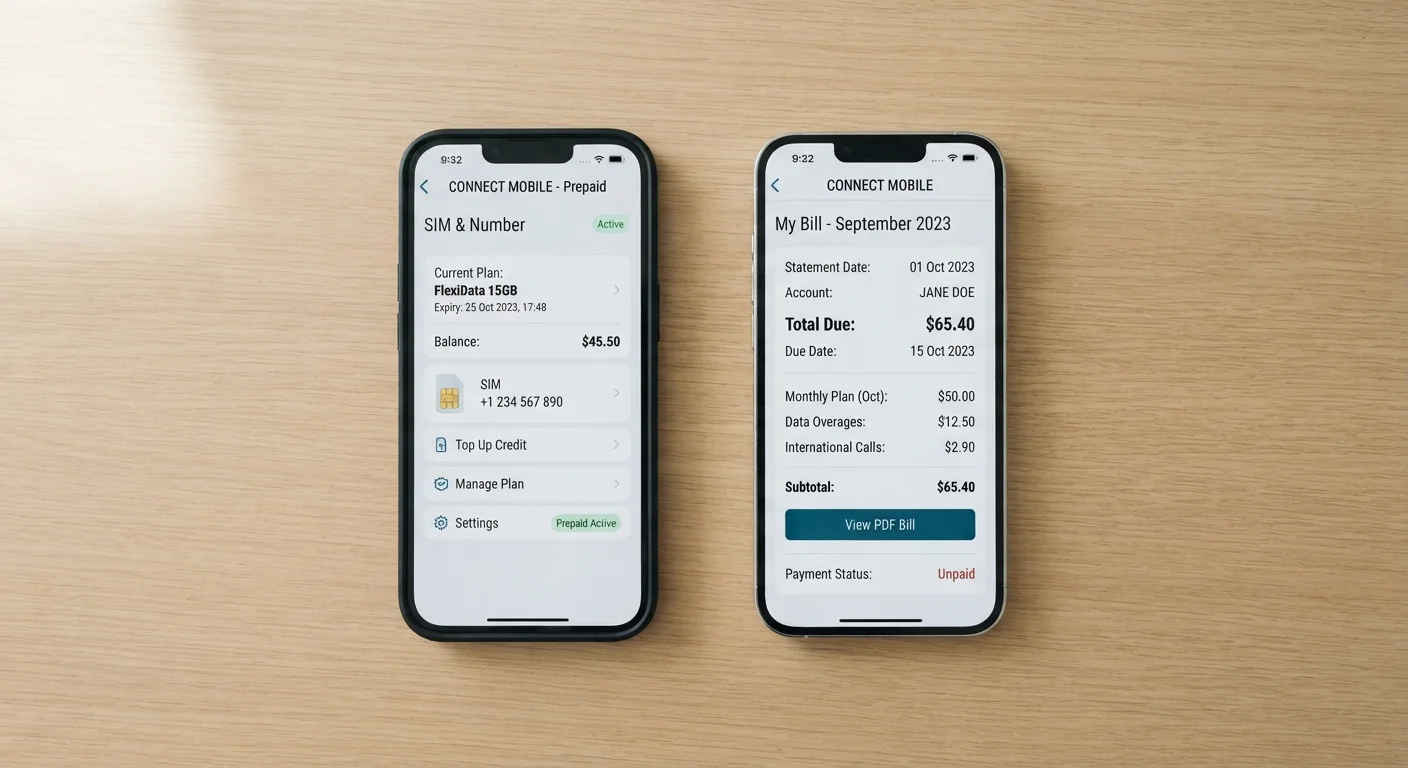
Prepaid plans are often - though not always - less expensive at face value. Because there's no subsidy being extended for a device and no billing overhead, carriers can price them more simply. What you see is generally what you pay, with fewer line-item surcharges. That said, postpaid plans on major networks sometimes include perks like streaming subscriptions, international texting, or hotspot data that can offset a higher sticker price for some users.
Postpaid bills, on the other hand, can grow with taxes, regulatory fees, and add-ons that aren't always visible in the advertised rate. Our line-by-line phone bill breakdown explains what each charge actually means and which are fixed versus negotiable.
| Criterion | Prepaid | Postpaid |
|---|---|---|
| Payment timing | Pay before service begins | Billed after each month |
| Credit check required | No | Yes, typically |
| Contract or commitment | None | Month-to-month; device financing may bind you |
| Phone financing options | Not typically available | Installment plans available |
| Network priority during congestion | Lower priority on most carriers | Higher priority |
| International roaming | Limited or add-on only | Generally included in major plans |
| Bill predictability | Very predictable - fixed upfront cost | Can vary with fees and add-ons |
| Switching carriers | No penalty, anytime | May require paying off device balance |
Flexibility strongly favors prepaid. There are no contracts, so canceling means simply not refilling. Postpaid accounts historically came with two-year contracts, but even though most major carriers have moved to month-to-month billing, device financing agreements can still lock you in - since switching carriers mid-installment usually means paying off the remaining phone balance.
Network Priority, Coverage, and International Use
Both prepaid and postpaid plans can run on the same physical cell towers. However, during network congestion, postpaid customers on major carriers are typically given priority over prepaid subscribers - a policy carriers disclose in their terms. In practice, most users in most locations won't notice any difference day to day. It's primarily relevant in dense urban areas or during large events when towers are under heavy load.
International travel is where the gap widens more noticeably. Postpaid plans from the three major US carriers generally include some level of international roaming - data at reduced speeds, texts included, calls at per-minute rates - in many countries. Prepaid plans, especially from smaller carriers or MVNOs (mobile virtual network operators, companies that lease network access from larger carriers), may offer limited or no international roaming at all. If you travel frequently, check roaming terms carefully before choosing either structure. Our eSIM vs. physical SIM comparison is also worth reading before any international trip, since eSIM flexibility can affect how you swap plans abroad.
Phones, Financing, and Switching
If you want to spread the cost of a new phone across 24 or 36 monthly installments through your carrier, that's almost exclusively a postpaid feature. Device financing is essentially a short-term loan, and carriers extend it through the postpaid billing relationship. Prepaid users typically need to purchase a phone outright - either unlocked or from a prepaid-specific lineup - or bring their own device.
Buying a phone outright or unlocked is not necessarily a disadvantage. An unlocked phone works with any compatible carrier, giving you full freedom to switch plans without complications. For a fuller look at how the math compares, see our guide to phone financing and buying outright.
Bringing Your Own Device
Many prepaid and postpaid plans accept unlocked phones you already own, which removes device cost from the comparison entirely. Before switching, confirm your current phone is unlocked and that it supports the frequency bands used by your target carrier - carriers typically publish compatibility checkers on their websites. Band compatibility matters most for 5G coverage, where support varies by phone model and network.
Switching between carriers is simpler on prepaid - port your number, insert a new SIM (or activate an eSIM), and you're done with no fee. On postpaid with an active device installment plan, you'd need to pay off the remaining balance or, in some cases, the carrier may offer a payoff deal to win your business. Either way, understand what your current agreement requires before you move.