

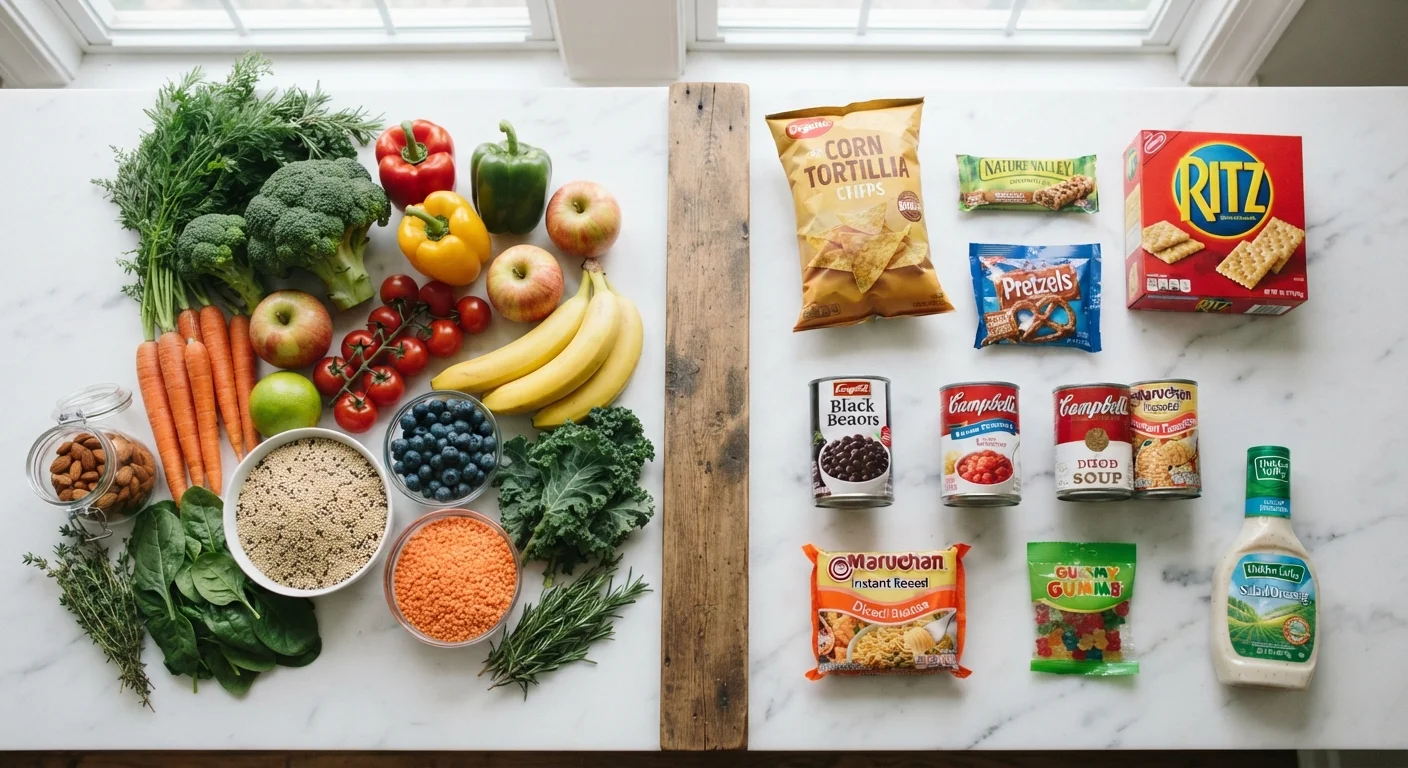
Key Takeaways
- Processing exists on a spectrum - frozen vegetables and canned beans are processed but nutritionally valuable.
- Ultra-processed foods, not all processed foods, are most strongly linked to negative health outcomes.
- Whole foods tend to deliver more fiber, vitamins, and minerals with fewer additives.
- A sustainable, healthy diet can include both whole and minimally processed foods.
- Reading nutrition labels helps you identify where a processed food falls on the quality spectrum.
Option A
Whole Foods
Foods as close to their natural state as possible.
Best for: People seeking maximum nutrient density and minimal added ingredients in their daily diet.
Option B
Processed Foods
Foods altered from their original form - ranging from minimally to heavily modified.
Best for: Consumers who prioritize convenience, shelf stability, or affordability, especially when choosing minimally processed options.
If you want to maximize nutrient density
Whole Foods
Whole foods retain natural fiber, vitamins, and phytonutrients that are often reduced or removed during heavy processing.
If convenience and budget are top priorities
Processed Foods
Minimally processed options like canned legumes, frozen vegetables, and plain yogurt offer solid nutrition with much greater convenience and affordability.
If you're managing a chronic condition or health goal
Whole Foods
Diets emphasizing whole foods are broadly supported by research for heart health, blood sugar regulation, and weight management - always consult your healthcare provider for personalized guidance.
If you want a realistic, long-term eating pattern
Whole Foods
A mostly whole-food diet with room for minimally processed foods is both evidence-based and sustainable for most adults.
What Do These Terms Actually Mean?
The terms "whole foods" and "processed foods" are widely used but rarely defined with precision. Whole foods are those eaten close to their natural state - think fresh fruit, raw nuts, uncooked legumes, or a piece of plain fish. They haven't been significantly altered from the way they occur in nature.
Processed foods cover everything that has been changed from its original form before you eat it. That definition is deliberately broad, because it encompasses an enormous range: frozen spinach, canned chickpeas, plain oats, and packaged cheese are all technically processed - but so are sugary breakfast cereals, fast food, and packaged snack cakes.
Nutrition researchers use the NOVA classification system to make sense of this range. NOVA divides foods into four groups: unprocessed or minimally processed foods, culinary ingredients (like olive oil or salt), processed foods (canned vegetables, cheese), and ultra-processed foods - products that typically contain ingredients rarely found in a home kitchen, such as emulsifiers, flavor enhancers, and modified starches. The crucial takeaway is that the health concerns linked to "processed food" in research are almost always about ultra-processed foods specifically, not processed foods as a whole category.
How Nutrition Changes With Processing
Processing can both degrade and enhance nutritional value, depending on the method and degree. Milling whole wheat into white flour removes much of its fiber and several B vitamins. Frying a potato in industrial oil and adding sodium transforms a nutrient-dense vegetable into a high-calorie, high-sodium snack. These are the changes worth paying attention to.
But processing is not inherently destructive. Freezing vegetables shortly after harvest can preserve micronutrients that degrade during the days a "fresh" vegetable spends in transit and storage. Cooking tomatoes actually increases the bioavailability of lycopene, a beneficial plant compound. Pasteurization makes milk safe without meaningfully altering its protein or calcium content.
| Criterion | Whole Foods | Processed Foods |
|---|---|---|
| Definition | Eaten close to natural state | Altered before consumption |
| Fiber content | Generally high | Often reduced in ultra-processed |
| Added sugars | Naturally occurring only | Frequently added, varies widely |
| Sodium levels | Typically low | Often high in packaged products |
| Shelf life | Short without preservation | Extended via processing |
| Convenience | Requires prep and storage | Ready-to-eat or easy to prepare |
| Cost | Varies; fresh produce can be pricey | Often more affordable per serving |
| Health research link | Associated with better long-term outcomes | Ultra-processed linked to higher disease risk |
The most consistent finding in nutrition research is that diets high in ultra-processed foods - those engineered for hyperpalatability and shelf life - are associated with higher risks of cardiovascular disease, type 2 diabetes, and obesity. A 2019 study published in The BMJ found that each 10% increase in ultra-processed food consumption was linked to a higher risk of cardiovascular disease events. These associations hold across large population studies, though nutritional epidemiology has inherent limitations and correlation does not equal causation.
For practical context, see our guide on what carbohydrates, protein, and fat actually do - understanding macronutrients helps clarify how processing changes a food's nutritional profile.
Reading Between the Labels
One of the most actionable skills for navigating this space is learning to read nutrition labels critically. A short ingredient list featuring recognizable whole-food ingredients is generally a positive signal in any packaged product. Conversely, a long list dense with additives, sweeteners, and artificial flavors suggests a more heavily processed item.
Pay particular attention to added sugars, sodium, and saturated fat - three nutrients that tend to increase substantially in ultra-processed foods. The U.S. Dietary Guidelines recommend limiting added sugars to less than 10% of daily calories and keeping sodium under 2,300 mg per day for most adults. Our guide to reading nutrition labels walks through each section in plain language.
The "Minimally Processed" Middle Ground
Many nutritious staples - plain Greek yogurt, canned tuna in water, frozen edamame, whole-grain bread - fall into the minimally processed category. These foods undergo preservation or basic transformation but retain most of their nutritional value and contain few or no additives. Treating all processed foods as nutritionally equivalent distorts the real picture and can make healthy eating feel unnecessarily restrictive.
It's also worth noting that whole foods are not automatically superior in every context. For people with certain medical conditions - such as kidney disease, where potassium and phosphorus must be carefully managed - some whole foods need to be limited. Always consult a qualified healthcare professional for guidance specific to your health situation.
If you're evaluating protein choices within either category, this comparison of animal and plant protein sources offers evidence-based context on amino acid profiles and digestibility.