

Key Takeaways
- Your owner's manual contains the authoritative maintenance schedule for your specific vehicle.
- Service intervals are based on mileage, time, or both - whichever comes first.
- Skipping scheduled maintenance can lead to accelerated wear and expensive repairs.
- Severe driving conditions typically require more frequent service than the standard schedule.
- A documented maintenance history protects your vehicle's reliability and resale value.
Start here
What a Maintenance Schedule Actually Is
Next
How to Read Your Owner's Manual
Build on it
The Most Common Service Intervals Explained
Go deeper
Severe vs. Normal Driving Conditions
Apply it
Keeping Track of Your Maintenance History
What a Maintenance Schedule Actually Is
A maintenance schedule is a manufacturer-defined timeline that tells you when specific components and fluids in your vehicle need to be inspected, replaced, or serviced. It is not a suggestion - it is the result of engineering testing designed to keep your particular engine, transmission, and drivetrain operating as intended.
Every car rolls off the assembly line with a corresponding owner's manual that includes this schedule. Think of it as the vehicle's health plan: built around what the engineers know about how its parts wear under real-world use. Following it is the single most reliable way to protect your investment and avoid surprises. For a broader overview of what routine upkeep actually involves, see this practical overview of scheduled maintenance.
Service interval
The mileage or time threshold at which a specific maintenance task should be performed - whichever comes first.
Owner's manual
The printed guide provided with every new vehicle that contains manufacturer specifications, operating instructions, and the official maintenance schedule.
Severe driving conditions
A category of driving patterns - such as frequent short trips, towing, or extreme temperatures - that cause faster component wear and require more frequent service.
Synthetic oil
A type of engine oil engineered for longer performance life and better temperature stability than conventional oil, often allowing extended change intervals.
Hygroscopic
Describes a fluid that naturally absorbs moisture from the surrounding environment - a property that causes brake fluid to degrade over time even without heavy use.
Timing belt
A rubber belt inside the engine that synchronizes the crankshaft and camshaft; if it fails, it can cause serious internal engine damage and must be replaced at manufacturer-specified intervals.
How to Read Your Owner's Manual
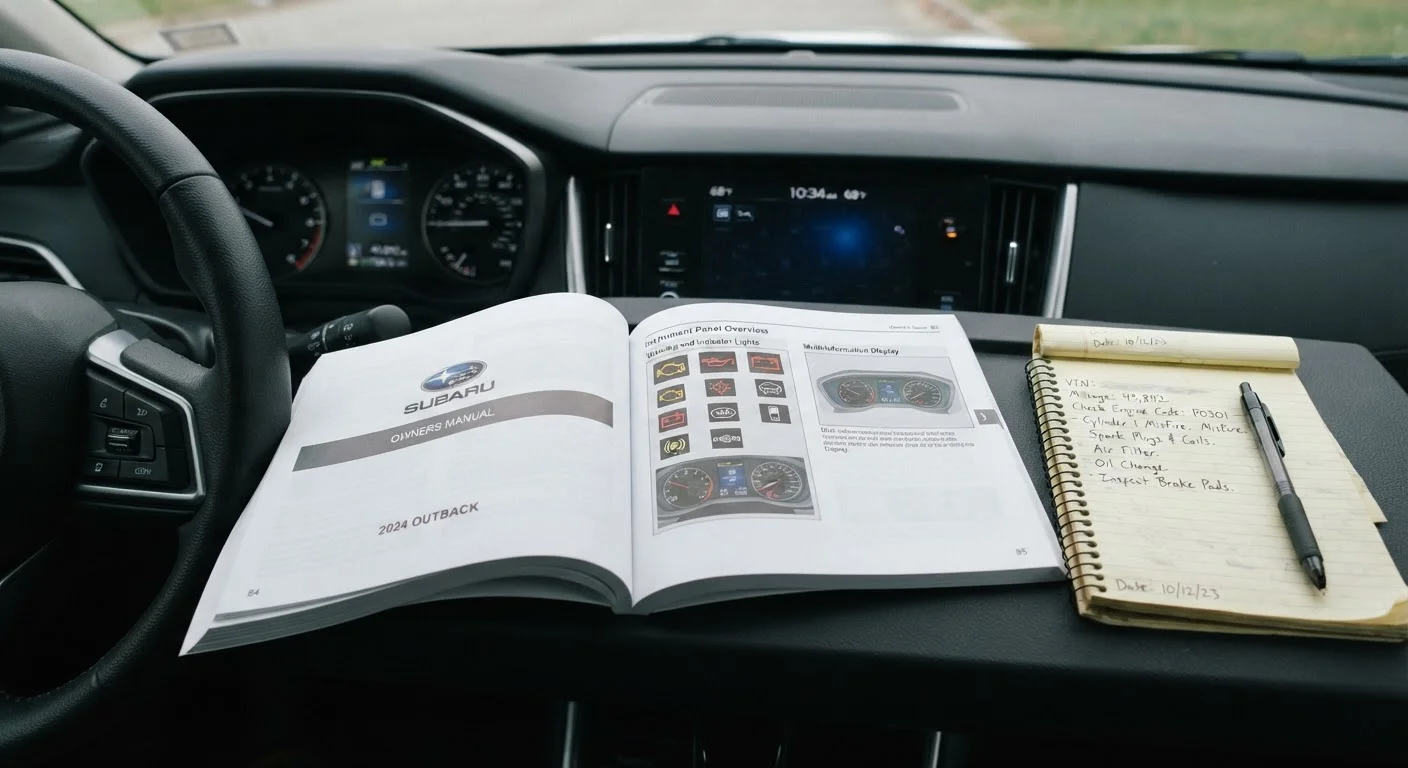
Open your owner's manual and look for a section titled something like "Maintenance Schedule," "Scheduled Maintenance," or "Service Intervals." You will typically find two columns of guidance: one for normal driving conditions and one for severe driving conditions (more on that distinction below).
Service items are usually listed by mileage increments - such as every 5,000, 15,000, or 30,000 miles - alongside time-based thresholds like every 12 months. The rule is straightforward: service at whichever milestone arrives first. If your manual says to change the cabin air filter every 15,000 miles or 12 months, and you only drive 8,000 miles a year, you should still replace it annually. For a closer look at how filters specifically work and age, see our maintenance guide for cabin and engine air filters.
The Most Common Service Intervals Explained
While every vehicle differs, most maintenance schedules cover a consistent set of service items at predictable intervals:
- Engine oil and filter: One of the most frequent services, commonly ranging from every 5,000 to 10,000 miles depending on oil type and engine design. Synthetic oils generally allow longer intervals than conventional oils.
- Tire rotation: Typically recommended every 5,000 to 7,500 miles to promote even tread wear across all four tires.
- Air filters (engine and cabin): Usually inspected or replaced every 15,000 to 30,000 miles, though dusty environments shorten this window considerably.
- Brake fluid: Often overlooked, brake fluid is hygroscopic - meaning it absorbs moisture - and should generally be flushed every two years regardless of mileage.
- Spark plugs: Conventional plugs may need replacement around 30,000 miles; extended-life iridium or platinum plugs can last 60,000 to 100,000 miles.
- Coolant flush: Typically every 30,000 to 50,000 miles, though some manufacturers specify longer intervals for newer formulations.
- Transmission fluid: Intervals vary widely - from 30,000 miles on some vehicles to over 100,000 miles on others. Check your manual specifically.
For a comprehensive breakdown covering all major maintenance categories, see The Full Picture on Car Maintenance.
Why Skipping Services Has Real Consequences
Deferred maintenance is one of the most common - and most avoidable - causes of costly automotive repairs. Each service item on your schedule exists because something specific happens when it is neglected.
Old engine oil turns to sludge, starving metal surfaces of lubrication. A worn timing belt that isn't replaced on schedule can snap, causing catastrophic engine damage. Low coolant or degraded coolant leads to overheating. These are not theoretical risks; they are well-documented failure patterns that mechanics encounter regularly.
Set a Mileage Reminder Right Now
Check your current odometer reading and your owner's manual, then calculate when your next service is due. Most smartphones allow you to set a recurring reminder. Writing the next due mileage on a piece of tape inside your gas cap door is a low-tech method that many experienced drivers still swear by.
It's also worth knowing that some popular car care advice circulating online doesn't hold up to scrutiny. The common car maintenance myths that could actually hurt your vehicle are worth reviewing so you're not over-servicing based on outdated guidance either.
Severe vs. Normal Driving Conditions
Most owner's manuals define two maintenance tracks. The normal schedule applies to drivers who make mostly highway trips of sustained distance under moderate temperature conditions. The severe schedule applies to a wider range of everyday drivers than most people realize.
Severe conditions typically include:
- Frequent trips of less than 5 miles, especially in cold weather
- Sustained stop-and-go city driving
- Towing trailers or hauling heavy cargo regularly
- Operating in extreme heat or cold
- Driving on dusty, muddy, or unpaved surfaces
If your commute involves a lot of short city trips, you may qualify for the severe schedule - meaning more frequent oil changes, filter replacements, and inspections. Many drivers unknowingly follow the normal schedule when their driving patterns require the more aggressive one.
Keeping Track of Your Maintenance History
A documented service history does two important things: it keeps you organized so nothing is accidentally skipped, and it provides verifiable proof of care if you ever sell the vehicle or file a warranty claim.
Simple options include keeping a paper log in the glove box, using a dedicated app, or asking your service shop to maintain digital records on your behalf. Save every receipt. Note the date, mileage, and what was done each time.
If you plan to own your vehicle for many years, a consistent maintenance record becomes especially valuable. Drivers who aim to keep a car well past 100,000 miles rely heavily on this kind of documented discipline - learn what that longer-term commitment looks like in our guide on keeping a car long-term. All of your vehicle ownership decisions benefit from the foundation a reliable maintenance routine provides.