
Tire Rotation, Balancing, and Alignment - Three Different Things Drivers Often Confuse

Key Takeaways
- Rotation, balancing, and alignment each solve a distinct problem - one does not substitute for another.
- Rotation is typically recommended every 5,000-7,500 miles to even out uneven tread wear across all four tires.
- Balancing addresses vibration you feel through the steering wheel or seat, caused by uneven weight distribution.
- Alignment corrects the angles of your wheels relative to each other and the road, affecting handling and tire wear.
- Skipping any of these services can shorten tire life and reduce vehicle safety over time.
Tire Rotation, Balancing & Alignment
Tire rotation moves tires to different positions on your vehicle to even out tread wear. Balancing corrects weight imbalances in a wheel-and-tire assembly to eliminate vibration. Alignment adjusts the angles of your wheels so they make proper contact with the road. These are three separate services that address three different problems.
Wheel alignment is measured in degrees of camber, caster, and toe - angles that determine how the tire meets the road surface. Even small deviations can cause measurable handling and wear issues.
Why the Confusion Happens
Walk into almost any tire shop and you'll hear these three terms used almost interchangeably - and sometimes bundled into a single service package. That bundling can make drivers assume they're all versions of the same thing. They're not. Rotation, balancing, and alignment each target a completely different mechanical problem, have different service intervals, and use different equipment to perform. Confusing them can lead to skipping a service you actually need or paying for one that won't fix your symptom.
Part of the reason these services get lumped together is that they're all tire-related and all affect how your vehicle drives. But so do tire pressure and tread depth - and nobody confuses those. Think of it this way: rotation is about position, balancing is about weight, and alignment is about angle. Each one answers a different question about your tires and wheels.
For a broader look at how these services fit into your overall vehicle care, see our end-to-end maintenance guide.
Tire Rotation: Managing Uneven Wear
Tires don't wear evenly across all four positions. Front tires - especially on front-wheel-drive vehicles - bear the load of steering and, in many cases, propulsion. They typically wear faster than the rears. Left and right tires also wear differently depending on road crown and driving habits. Rotation solves this by periodically swapping tire positions so each tire gets a turn at every location on the vehicle.
The typical rotation interval is every 5,000 to 7,500 miles, though your owner's manual sets the authoritative schedule for your specific vehicle. The pattern used - front-to-rear, cross-pattern, or side-to-side - depends on whether you have directional tires, a full-size spare, or all-wheel drive. A technician will select the right pattern.
5,000-7,500 mi
Typical tire rotation interval
This is the range cited by most vehicle manufacturers; always confirm the interval in your owner's manual.
~$20-$50
Typical cost of a tire rotation
Rotation is one of the lower-cost maintenance items; some retailers include it free with tire purchase programs.
Up to 2x
Potential tire life extension with proper rotation
Automotive industry guidance consistently notes that regular rotation can significantly extend the usable life of a set of tires.
What rotation does not do: it doesn't fix vibration, and it won't correct a pull caused by wheel angles. If either of those symptoms appears, the cause lies elsewhere.
Wheel Balancing: Eliminating Vibration
Even a brand-new tire mounted on a new wheel isn't perfectly uniform in weight. Minor variations in rubber density, the valve stem, and the rim itself all create slight imbalances. When the wheel spins at speed, those imbalances generate a rhythmic wobble - the vibration you feel through the steering wheel or seat at highway speeds.
Balancing is performed on a spin balancer: the wheel and tire assembly is mounted on a machine that rotates it and identifies where weight is uneven. Small adhesive or clip-on weights are then attached to the rim to counteract the imbalance. The result is a smoother ride and more even tread wear.
Balancing is typically done when new tires are mounted, when vibration symptoms appear, or after a significant road impact. It's distinct from alignment - a perfectly balanced tire can still be aimed at the wrong angle, and a correctly aligned wheel can still vibrate if it's out of balance.
Wheel Alignment: Correcting the Angles
Alignment refers to the geometric angles at which your wheels meet the road. Three primary angles matter: camber (the inward or outward tilt of the wheel when viewed from the front), toe (whether the fronts of the tires point inward or outward), and caster (the angle of the steering axis). When these angles fall outside the manufacturer's specifications, you get problems.
A misaligned vehicle may pull to one side, require constant steering correction, or wear tires rapidly on one edge - sometimes going through a tire in half the expected mileage. Alignment can be knocked off by hitting a significant pothole or curb, by suspension wear, or simply by accumulation of minor road impacts over time.
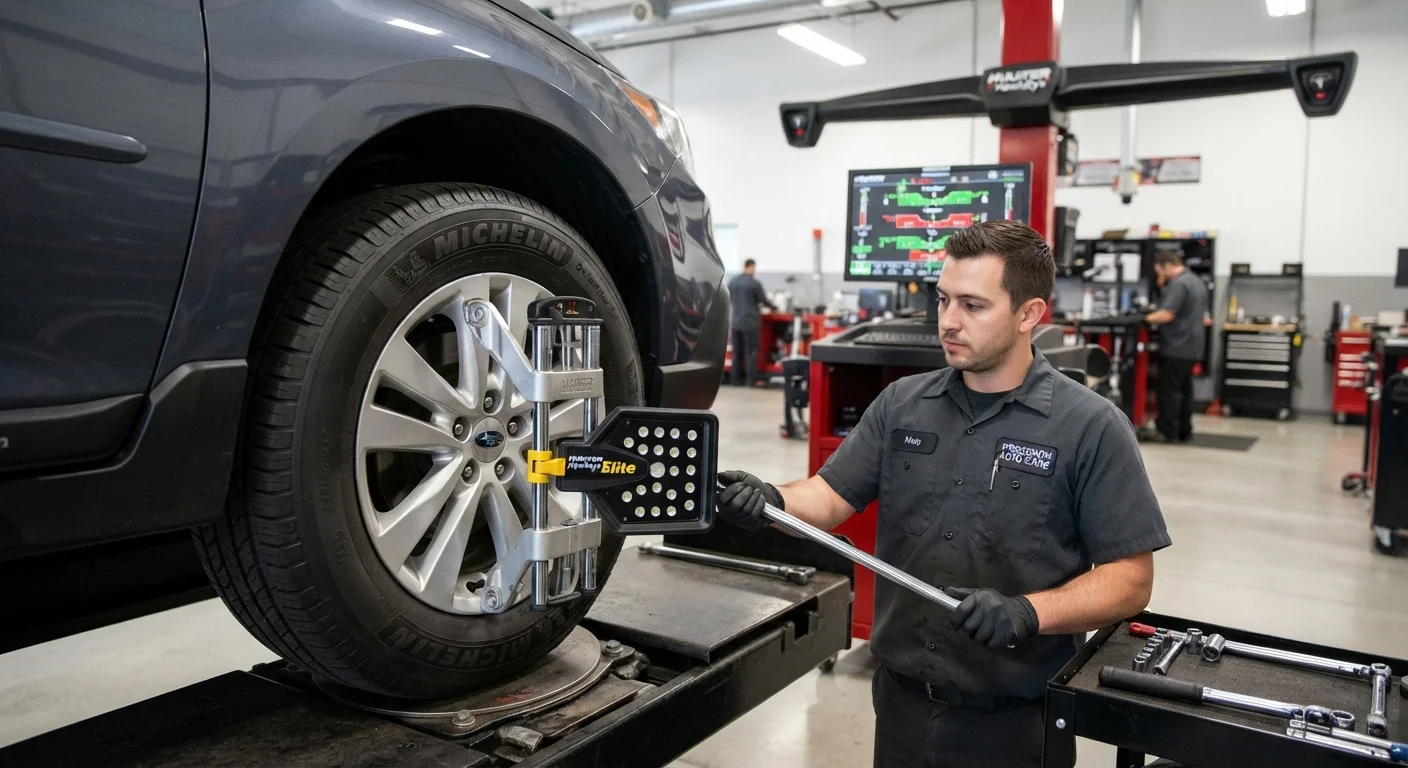
Alignment is checked and corrected using a specialized rack that measures wheel angles precisely and then adjusts tie rods and other suspension components to bring everything back into spec. It requires shop equipment that isn't available to most home mechanics - see our guide to DIY versus professional maintenance for a full breakdown of tasks by skill level.
Tire pressure is another factor that interacts with alignment - under- or over-inflation can mask or mimic alignment symptoms, so always check pressure before attributing a pull to alignment alone.
When Each Service Is Actually Needed
Knowing what triggers each service prevents unnecessary spending and helps you communicate clearly with a technician. Here's a practical framework:
- Rotation: On a mileage schedule - typically every 5,000-7,500 miles. Don't wait for symptoms; this is preventive.
- Balancing: When you feel vibration, when new tires are mounted, or after hitting a significant road hazard. Also worth checking if rotation alone doesn't resolve a vibration complaint.
- Alignment: After any hard impact with a pothole or curb, after suspension or steering component replacement, and when you notice a pull, off-center steering wheel, or edge wear on tires. Many mechanics recommend an alignment check annually for high-mileage drivers.
Skipping these services consistently is one of the ownership decisions that quietly accelerate wear and tear. Tires are one of the most expensive wear items on a vehicle - keeping up with all three services is straightforward insurance against premature replacement.
For a full overview of the maintenance schedule that supports these services, our article on routine maintenance every driver should understand is a practical starting point.