

Key Takeaways
- Tire pressure changes roughly 1 PSI for every 10°F shift in ambient temperature.
- Under-inflated tires increase fuel consumption, generate excess heat, and wear unevenly.
- Even properly sealed tires lose approximately 1-2 PSI per month through normal gas permeation.
- The correct PSI for your vehicle is on the door jamb sticker, not the tire sidewall.
- Check tire pressure when tires are cold - before driving or after sitting for at least three hours.
- Modern vehicles with a TPMS warning light only alert you after pressure drops at least 25% below recommended levels.
Tire Pressure
Tire pressure is the amount of air compressed inside a tire, measured in pounds per square inch (PSI). Tires aren't truly rigid - they hold their shape because pressurized air supports the vehicle's weight. The correct pressure is set by the vehicle manufacturer, not the tire maker, and is found on a sticker inside the driver's door jamb.
PSI readings reflect gauge pressure - the pressure above atmospheric baseline - which is why a completely flat tire may still show a small positive reading.
The Physics of Air in a Confined Space
To understand why tire pressure drifts, it helps to understand what's actually happening inside a tire. The air trapped inside obeys the ideal gas law - a foundational principle of physics stating that pressure, temperature, and volume are tightly linked. When one changes, the others respond.
In practical terms: heat causes air molecules to move faster and push harder against the tire walls, raising pressure. Cold slows those molecules down, reducing the force they exert and dropping pressure. This is why a tire that was perfectly inflated on a 70°F afternoon might read noticeably low after an overnight freeze.
The rule of thumb - roughly 1 PSI gained or lost per 10°F change in temperature - isn't precise for every tire, but it's accurate enough to explain why seasonal pressure checks matter. A 30°F temperature swing, which is common across much of the United States between summer and winter, can shift pressure by 3 PSI or more without any air escaping the tire at all.
~1 PSI
Pressure change per 10°F temperature shift
This is a widely cited engineering approximation used by tire manufacturers and automotive safety educators.
1-2 PSI
Typical monthly pressure loss in a healthy tire
Natural permeation through the rubber and valve components causes this gradual loss even without any puncture or visible damage.
25%
Minimum pressure drop before TPMS light activates
Under U.S. federal regulations, the Tire Pressure Monitoring System must warn drivers when pressure falls at least 25% below the vehicle manufacturer's recommended level.
Why Pressure Drops Even Without a Leak
Drivers often assume that if a tire loses air, something must have punctured it. In reality, all tires lose pressure gradually over time - even when perfectly intact.
Rubber is a permeable material. Air molecules, particularly nitrogen (which makes up about 78% of atmospheric air), are small enough to slowly migrate through the tire wall. This process, called permeation, is responsible for a steady loss of approximately 1-2 PSI per month under normal conditions.
Additional contributors include:
- Valve stem deterioration: The small rubber or metal valve through which you inflate a tire can crack or loosen with age, allowing slow leaks.
- Wheel corrosion: On alloy or steel wheels, corrosion around the bead seat - where the tire contacts the rim - can create a micro-gap that air slowly escapes through.
- Road-induced micro-damage: Repeated impacts from potholes, curbs, and rough pavement gradually degrade the tire's internal structure.
This is why routine maintenance checks treat tire pressure as a monthly item, not a once-a-year concern.
What Incorrect Pressure Actually Does to Your Vehicle
Pressure deviations in either direction carry real consequences - and they compound quietly over time.
Under-Inflation
A tire running low on pressure flexes more than it should with every rotation. That excess flexing generates heat, which accelerates rubber breakdown and increases the risk of a blowout. The tire's footprint - the contact patch touching the road - shifts, causing the outer edges to carry disproportionate weight. This produces characteristic edge wear that shortens the tire's usable life significantly.
Fuel economy also suffers. Under-inflated tires increase rolling resistance, meaning the engine works harder to move the vehicle the same distance. The U.S. Department of Energy has noted that proper inflation can meaningfully reduce fuel waste, though the exact savings vary by vehicle and driving conditions.
Over-Inflation
Too much pressure produces the opposite footprint problem: the tire's center bulges down, so the middle of the tread does most of the work. Center-tread wear, reduced traction, and a harsher ride are the predictable results. Overinflated tires are also less capable of absorbing road impacts, making them more vulnerable to sudden damage.
Neglecting tire pressure is one of the ownership decisions that quietly accelerate wear and tear - the kind that doesn't feel urgent until the damage is already done.
How and When to Check - Correctly
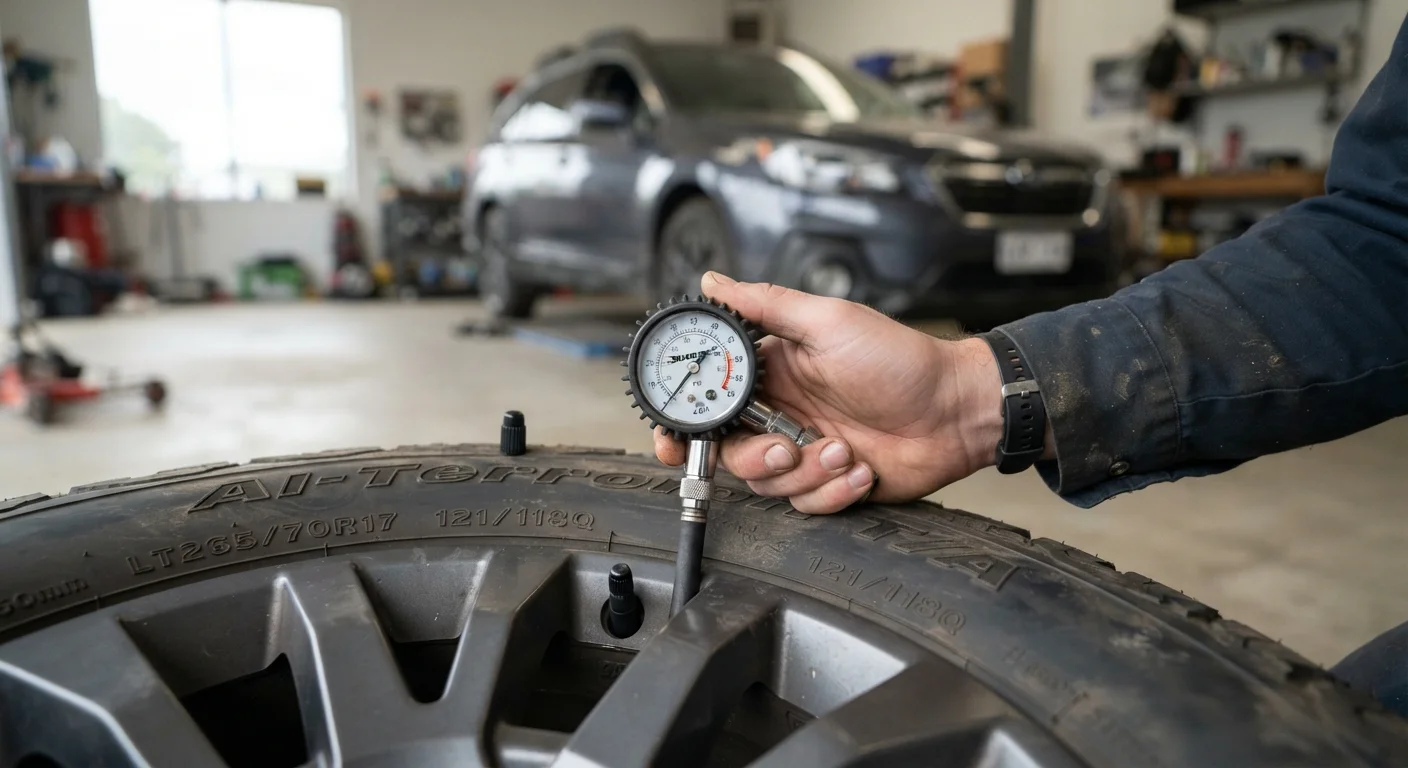
Tire pressure must be measured on cold tires - meaning the vehicle has been parked for at least three hours or driven fewer than a mile at low speed. Driving heats the air inside the tire, temporarily raising the reading. Checking a warm tire and then adjusting to the recommended PSI will leave it underinflated once it cools.
Use the PSI listed on your driver's door jamb sticker. The number printed on the tire sidewall is the maximum pressure the tire can structurally hold - it is not the recommended operating pressure for your vehicle. Front and rear recommendations sometimes differ, so check both.
A basic dial or digital pressure gauge costs only a few dollars and provides more reliable readings than gas station gauges, which are often poorly calibrated. Understanding tire pressure is also foundational to getting the most from related services - the differences between tire rotation, balancing, and alignment all interact with how evenly your tires are inflated and wearing.
Drivers of older or high-mileage vehicles should pay particular attention to valve stem condition, as rubber degrades over time. See our guidance on keeping high-mileage vehicles reliable for more on age-related maintenance priorities.