

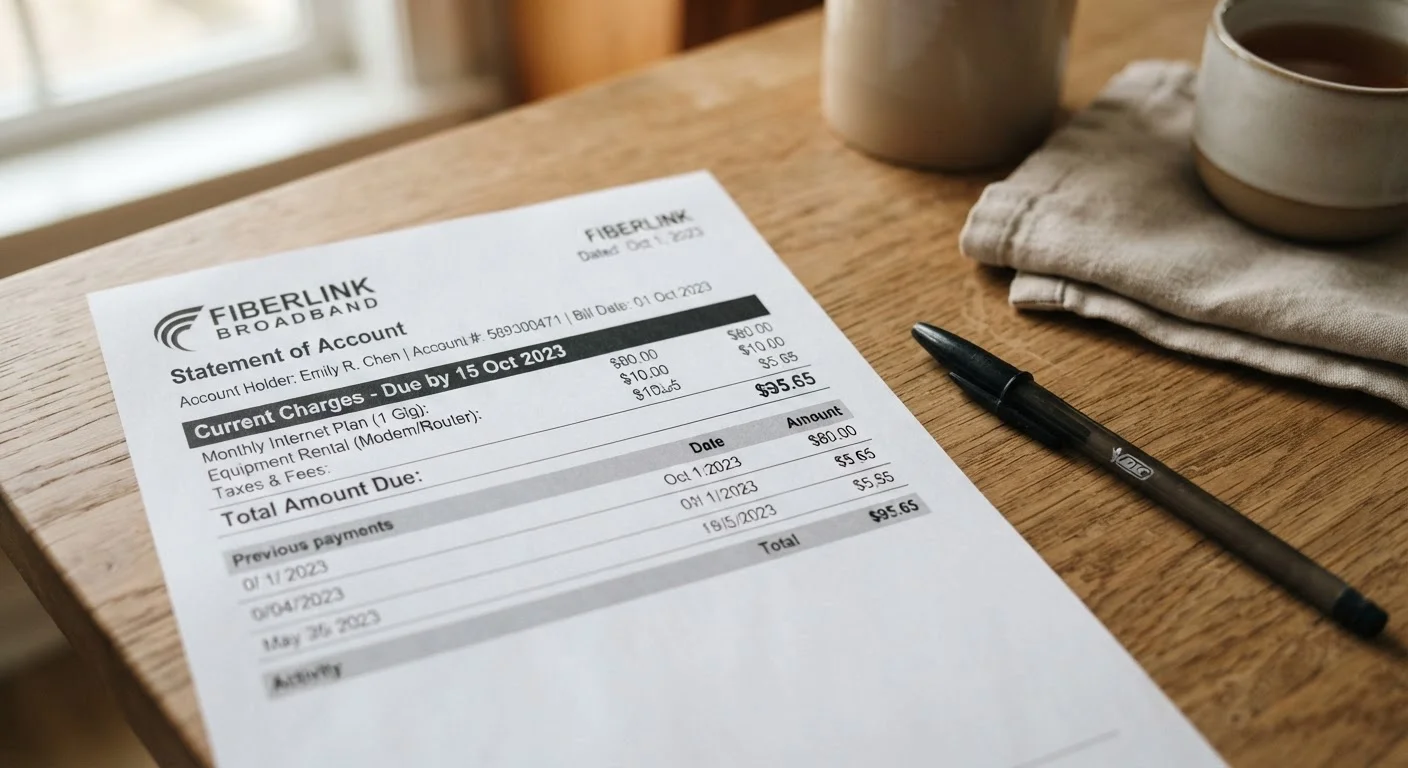
Why Your Internet Bill Is Higher Than the Advertised Price
Internet providers routinely advertise a monthly rate that bears little resemblance to what actually lands in your inbox at billing time. The gap between that headline number and your real total is filled by equipment fees, taxes, and surcharges - some required by law, others discretionary and quietly padded over time.
If you're new to reading these statements, see our plain-language primer on home broadband for context on how internet service is structured before diving into the charges. For a parallel look at wireless billing, our phone bill breakdown covers the same concept for mobile plans.
Breaking the bill into categories - base service, equipment, taxes, and discretionary fees - makes it far easier to spot what's fixed versus what's worth questioning.
The Core Line Items, Explained
Base Service Charge
This is the advertised monthly rate for a specific speed tier, typically expressed as a download speed in Mbps or Gbps. Promotional rates often expire after 12-24 months, reverting to a higher standard rate. Check your original agreement for when any promotional period ends.
Equipment Rental Fee
Most providers charge a monthly rental fee for a modem, router, or combined gateway device. These fees commonly range from roughly $10 to $20 per month. Purchasing a compatible device outright often recovers that cost within a year, though not all providers support customer-owned equipment - confirm compatibility before buying.
Installation or Activation Fee
A one-time charge billed in the first statement. Some providers waive this for self-installation; others charge a technician visit fee regardless. This is frequently negotiable, particularly for new subscribers.
Broadcast or Regional Sports Fee
If your internet service is bundled with television, these pass-through charges from content distributors are added separately. They are not part of the advertised bundle price and have risen steadily in recent years.
Internet Infrastructure or Network Maintenance Surcharge
Unlike government-mandated taxes, these surcharges are set by the provider itself and are not regulated fees. They often appear with official-sounding names but represent discretionary revenue. Because they're self-imposed, they may be negotiable when you call to review your account.
Government Taxes and Regulatory Fees
Federal, state, and local taxes on telecommunications services are required by law and are not negotiable. These vary by location and can add a noticeable percentage to the pre-tax total, especially in states with higher telecom tax rates.
Data Overage Charges
Some plans impose a monthly data cap - commonly 1 TB - and charge a flat or per-GB fee for usage beyond that threshold. If your bill shows overage charges consistently, upgrading to an unlimited tier may cost less than the overages themselves. Common myths about unlimited internet are worth understanding before assuming any plan is truly cap-free.
Base service charge
The advertised monthly rate for internet access at a specific speed tier, before any fees, taxes, or equipment charges are added.
Gateway device
A combined modem and router unit provided by - or rented from - an internet service provider to connect a home network to the internet.
Data cap
A monthly limit on how much data a subscriber can use before incurring overage charges or having speeds reduced by the provider.
Infrastructure surcharge
A discretionary fee set by the provider - not a government tax - often labeled with official-sounding names to cover network costs.
Promotional rate
A discounted monthly price offered for a fixed introductory period, after which the account reverts to the provider's standard rate.
Overage charge
An additional fee billed when a subscriber exceeds their plan's monthly data cap, charged either per GB or as a flat fee per block of data.
Which Charges Are Worth Disputing
Not every charge on your bill is written in stone. Provider-originated surcharges, equipment rental fees, and installation costs are the most commonly waived or reduced for customers who call and ask directly. Government taxes, on the other hand, cannot be removed.
Before you sign a new agreement, use this contract readiness checklist to identify which fees will apply from day one. When calling your provider, request an itemized explanation of any line item that isn't self-explanatory - customer service representatives are generally required to explain each charge. Document the name, date, and outcome of every call in case a billing dispute arises later.
Keep in mind that promotional pricing, fee waivers, and equipment credits are often extended to customers who inquire - but rarely offered proactively. A calm, specific conversation about your bill tends to produce better outcomes than a general complaint.