

Key Takeaways
- Paying down your mortgage guarantees a return equal to your interest rate, with zero market risk.
- Investing extra cash carries risk but has historically offered higher long-term returns than typical mortgage rates.
- Your emergency fund, tax situation, and loan interest rate all influence which path makes more financial sense.
- Many homeowners find a hybrid approach - splitting extra dollars between both goals - reduces the pressure of choosing one.
- This decision depends heavily on individual circumstances; a licensed financial adviser can help tailor a strategy.
Guaranteed, risk-free return equal to your interest rate
Every dollar applied to principal eliminates future interest owed, producing a certain return with no market exposure - valuable when rates are elevated.
Reduced monthly obligations and financial stress
Eliminating or shrinking a mortgage payment lowers the income needed to cover fixed expenses, which can be transformative for retirees or anyone on a variable income.
Builds home equity faster
Accelerated principal paydown increases the ownership stake in the property, which can expand borrowing options and strengthen net worth on paper.
Protects against payment shock if rates reset
Homeowners with adjustable-rate mortgages (ARMs) reduce their balance faster, limiting exposure if rates rise at the adjustment date.
Opportunity cost of missing potentially higher investment returns
Historically, diversified equity markets have returned more over long periods than most mortgage rates, meaning early payoff may sacrifice growth - though past performance is no guarantee.
Home equity is illiquid until accessed or sold
Extra principal payments lock money into the property; tapping that equity later requires a new loan or a sale, which takes time and carries costs.
Foregoes tax-advantaged investment space
Contribution limits on 401(k)s and IRAs are annual and non-recoverable; skipping contributions to pay the mortgage means permanently losing that tax-advantaged capacity.
May forego employer 401(k) match
Directing cash to the mortgage instead of a matched retirement account can mean leaving employer contributions - effectively free compensation - unclaimed.
Low-rate mortgages reduce the financial case for early payoff
Homeowners who locked in sub-4% rates may find that even conservative investments outperform the cost of carrying the loan over time.
Our Verdict
Neither paying off your mortgage early nor investing extra cash is universally superior - the right choice depends on your interest rate, tax situation, risk tolerance, and overall financial security. Homeowners with high-rate loans and low risk appetite may find early payoff delivers meaningful peace of mind alongside a guaranteed return. Those with lower rates, strong emergency savings, and a longer investment horizon may find markets offer better long-term upside. A blended approach often works well for those caught between both goals.
Homeowners who have fully funded their emergency savings, carry no high-interest debt, and want a principled framework for deciding where surplus cash creates the most long-term value.
The Core Tension: A Guaranteed Return vs. a Potentially Higher One
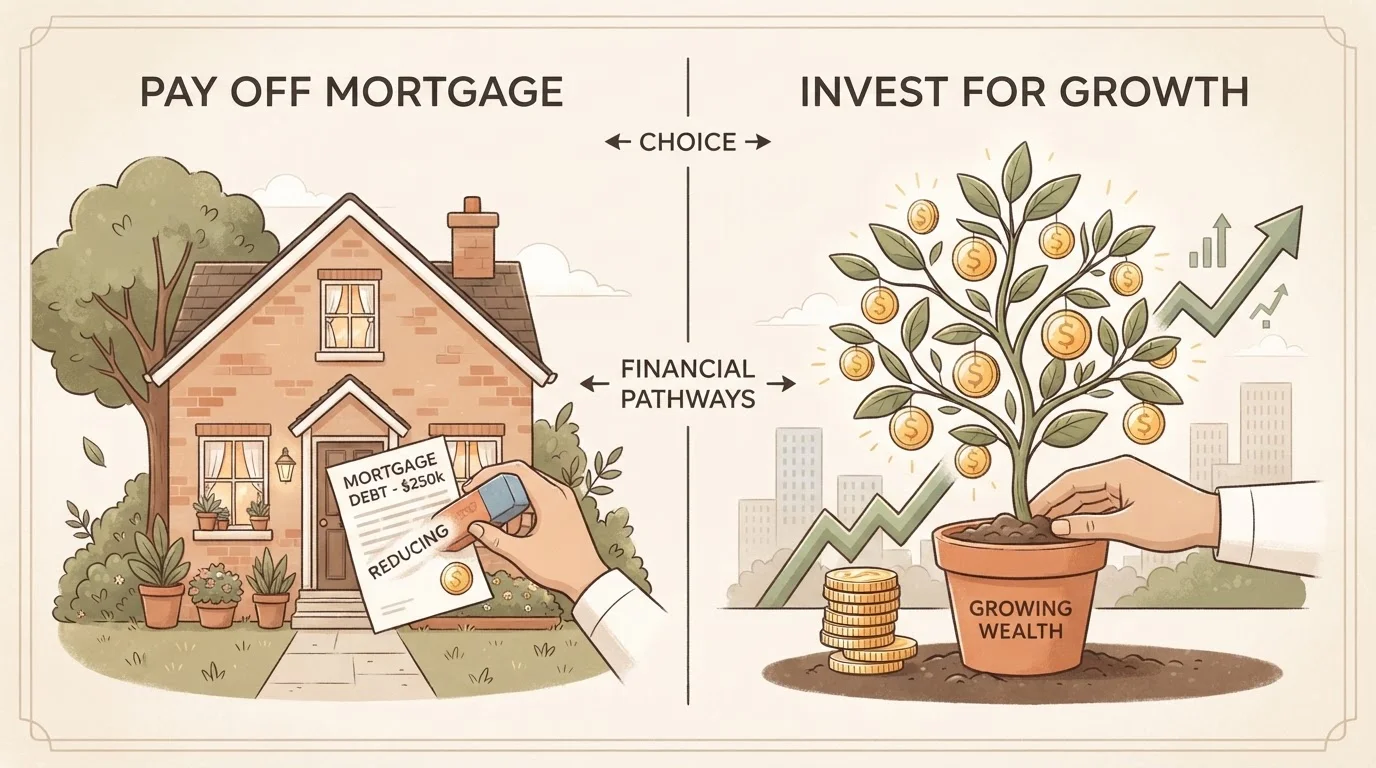
When a homeowner has money left over after covering monthly expenses, two broad options compete for attention: put extra dollars toward the mortgage principal, or direct them into investments such as a retirement account or a taxable brokerage. The tension is real because both are legitimate wealth-building strategies - they just work differently.
Paying down your mortgage early provides a guaranteed, risk-free return equal to your interest rate. If your rate is 6.5%, every dollar of principal you retire early effectively earns 6.5% - because it eliminates future interest you would otherwise owe. That return requires no market participation and carries no volatility.
Investing those same dollars in diversified assets has historically produced higher average annual returns over long periods, but with meaningful short-term swings. Past market performance does not guarantee future results, and downturns can be painful - especially if they coincide with a period of financial stress at home.
Understanding this tradeoff starts with knowing your mortgage interest rate and being honest about how you handle financial risk. For more context on how homeownership fits into broader financial planning, see building long-term wealth through homeownership.
Pros of Paying Off Your Mortgage Early
Early mortgage payoff carries advantages that go beyond the interest math.
Guaranteed, risk-free return equal to your interest rate
Every dollar applied to principal eliminates future interest owed, producing a certain return with no market exposure - valuable when rates are elevated.
Reduced monthly obligations and financial stress
Eliminating or shrinking a mortgage payment lowers the income needed to cover fixed expenses, which can be transformative for retirees or anyone on a variable income.
Builds home equity faster
Accelerated principal paydown increases the ownership stake in the property, which can expand borrowing options and strengthen net worth on paper.
Protects against payment shock if rates reset
Homeowners with adjustable-rate mortgages (ARMs) reduce their balance faster, limiting exposure if rates rise at the adjustment date.
For homeowners who carry anxiety about debt or whose income is variable - freelancers, commission-based workers, those approaching retirement - eliminating a housing payment can provide real psychological and practical security. Owning a home outright also reduces exposure to the costs explored in the real cost of owning a home beyond the mortgage, since a paid-off home requires far fewer dollars to sustain each month.
Cons of Prioritizing Mortgage Payoff
Early payoff is not without meaningful downsides that deserve equal weight.
Opportunity cost of missing potentially higher investment returns
Historically, diversified equity markets have returned more over long periods than most mortgage rates, meaning early payoff may sacrifice growth - though past performance is no guarantee.
Home equity is illiquid until accessed or sold
Extra principal payments lock money into the property; tapping that equity later requires a new loan or a sale, which takes time and carries costs.
Foregoes tax-advantaged investment space
Contribution limits on 401(k)s and IRAs are annual and non-recoverable; skipping contributions to pay the mortgage means permanently losing that tax-advantaged capacity.
May forego employer 401(k) match
Directing cash to the mortgage instead of a matched retirement account can mean leaving employer contributions - effectively free compensation - unclaimed.
Low-rate mortgages reduce the financial case for early payoff
Homeowners who locked in sub-4% rates may find that even conservative investments outperform the cost of carrying the loan over time.
The opportunity cost argument is particularly important for homeowners still decades from retirement. Dollars deployed into tax-advantaged accounts - such as a 401(k) with employer matching - may generate returns that outpace a low mortgage rate over time, and deferring that growth is difficult to recover later. If weighing multiple debt priorities feels unfamiliar, the frameworks covered in avalanche vs. snowball debt payoff methods can help clarify how to sequence payoff decisions.
Key Variables That Shift the Calculus
Several factors can tip the analysis one way or the other for a given household.
What About a Blended Approach?
Many financial planners suggest splitting surplus dollars: for example, directing enough to a retirement account to capture any employer match, maintaining a targeted emergency fund, and then applying a portion of remaining funds to extra mortgage principal. This approach avoids the all-or-nothing tension and allows households to make progress on multiple goals simultaneously. The right split will vary based on individual priorities and financial circumstances.
- Mortgage interest rate: A rate below 4% may be easier to "beat" through investing than a rate above 6.5%, which sets a higher bar for market returns to justify the choice.
- Tax deductibility: Homeowners who itemize deductions may receive some tax benefit from mortgage interest, effectively lowering the cost of carrying the loan. Those taking the standard deduction get no such offset.
- Employer match availability: If an employer matches 401(k) contributions up to a certain percentage of salary, not capturing that match is leaving compensation on the table - a strong argument to invest at least enough to claim the full match before directing extra dollars to the mortgage.
- Emergency fund status: Extra mortgage payments make sense only once a household has adequate liquid savings. Paying down a mortgage accelerates equity but equity is illiquid; accessing it requires refinancing, a home equity loan, or a sale.
- Time horizon: Homeowners closer to retirement may weight guaranteed debt elimination more heavily than those with 25+ years before they need their savings.
For a related look at balancing debt payoff with saving goals simultaneously, see paying off debt while saving at the same time.
~$165,000
Interest saved by paying off a 30-year $300K loan 5 years early
Illustrative calculation at a 6.5% fixed rate, showing how aggressively applied principal payments reduce total interest cost over the life of a loan.
~50%
US homeowners who carry mortgage debt into retirement
According to research from the Harvard Joint Center for Housing Studies, a growing share of older Americans are entering retirement with outstanding mortgage balances, raising the stakes of early payoff decisions.
This article is for general informational purposes only and does not constitute personalized financial, tax, or legal advice. Consult a qualified financial adviser or tax professional before making decisions about your mortgage or investment strategy.