

Key Takeaways
- Payment history is the single largest factor, accounting for about 35% of a FICO® Score.
- Credit utilization - how much of your available credit you use - makes up roughly 30% of your score.
- A longer credit history generally helps your score, all else being equal.
- Opening several new accounts in a short period can temporarily lower your score.
- Your score reflects borrowing behavior only - income, savings, and net worth are not included.
- The same underlying credit data can produce slightly different scores depending on which model a lender uses.
Credit Score
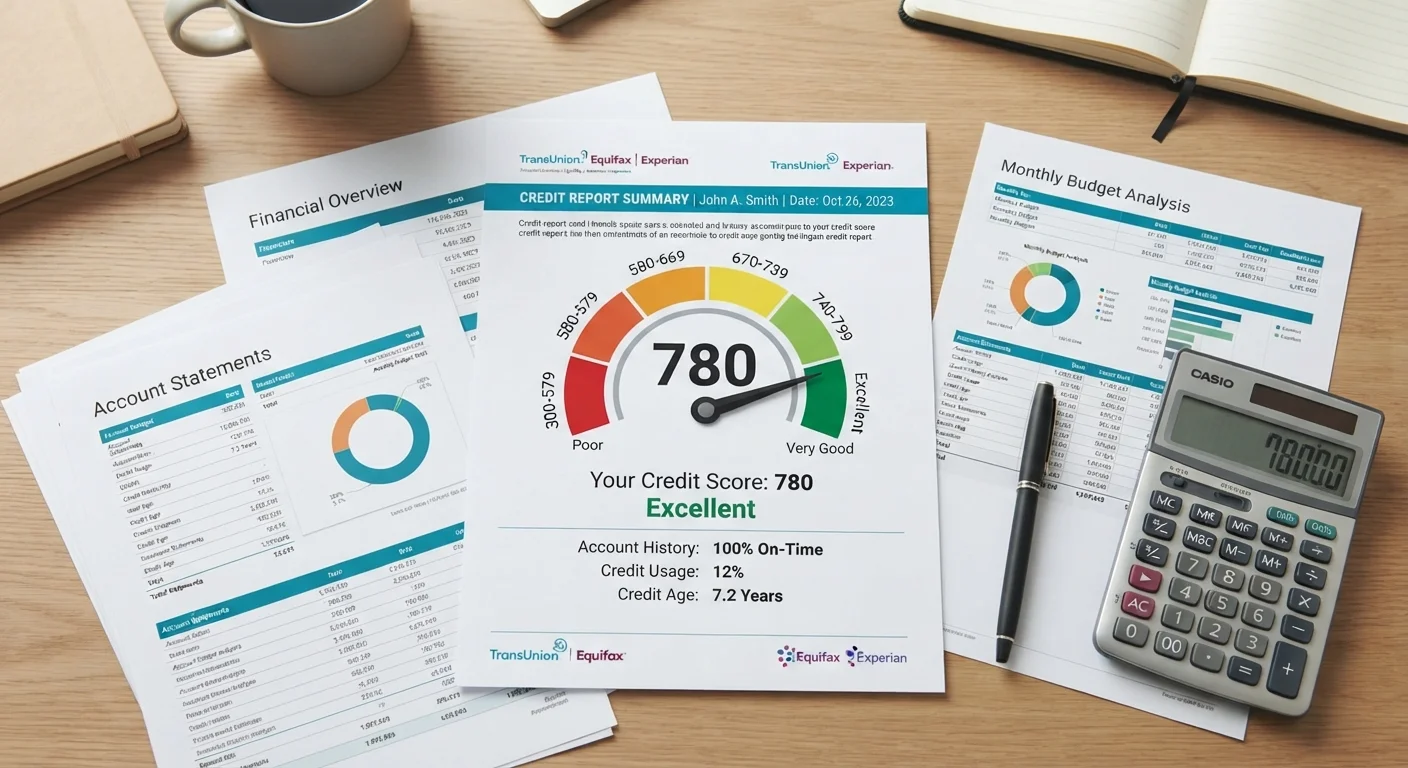
A credit score is a three-digit number - typically ranging from 300 to 850 - that summarizes how reliably you have managed borrowed money in the past. Lenders use it to quickly assess how likely you are to repay future debts on time. The higher your score, the lower the perceived risk you represent to a lender.
The most widely used scoring model in the U.S. is the FICO® Score, developed by Fair Isaac Corporation, though VantageScore is also used by many lenders. Both models pull data from your credit reports maintained by the three major bureaus: Equifax, Experian, and TransUnion.
The Five Factors Behind Every Score
A credit score is not a single judgment call - it is a formula applied to the data in your credit report. The FICO® model, the most commonly used in the U.S., breaks that formula into five weighted categories. Understanding each one makes the number feel far less arbitrary.
For a plain-English introduction to the terminology involved, the Credit & Banking Terms Every American Should Know glossary is a useful starting point.
35%
Weight of payment history in FICO® Score
According to FICO's published scoring model breakdown, on-time payments carry more weight than any other single factor.
30%
Weight of credit utilization in FICO® Score
FICO's published model identifies amounts owed - primarily measured through utilization - as the second-largest scoring factor.
7 years
How long most negative marks stay on your report
Under the Fair Credit Reporting Act (FCRA), most negative information - including late payments - can remain on a credit report for up to seven years.
300-850
Standard FICO® Score range
The FICO® Score ranges from 300 (lowest) to 850 (highest), with most Americans scoring somewhere between 600 and 800.
Payment History (≈35%): The Most Important Factor
The largest share of your score comes down to one question: have you paid your bills on time? Every account - credit cards, auto loans, mortgages, student loans - generates a payment record. A single missed payment can remain on your credit report for up to seven years, though its impact fades over time as you build a more recent positive record.
Late payments are not all treated equally. A payment that is 90 days past due causes more damage than one that is 30 days late. Bankruptcies, foreclosures, and accounts sent to collections all fall under payment history and typically have severe negative effects.
Credit Utilization (≈30%): How Much of Your Limit You're Using
Credit utilization measures the percentage of your available revolving credit - primarily credit cards - that you are currently using. If you have a $10,000 combined credit limit across all cards and carry a $3,000 balance, your utilization rate is 30%.
Scoring models generally treat lower utilization more favorably. Many financial educators suggest keeping utilization below 30%, though lower is typically better. Importantly, utilization is recalculated each month when your lenders report new balances, meaning it is one of the most actionable factors in your score. For a deeper look, see how credit utilization affects your score.
Length of History, Credit Mix, and New Credit
The remaining three factors each carry less individual weight but still matter collectively.
- Length of credit history (≈15%): Longer histories give scoring models more data to assess patterns. This includes the age of your oldest account, your newest account, and the average age across all accounts.
- Credit mix (≈10%): Having experience with different types of credit - revolving credit like cards and installment loans like mortgages or auto loans - is viewed slightly more favorably than having only one type. You should not open accounts you don't need just to diversify.
- New credit (≈10%): Each time you apply for credit, a hard inquiry is added to your report. Multiple hard inquiries in a short window can signal financial stress to lenders and may temporarily lower your score. Rate shopping for a single loan (such as a mortgage) within a short period is typically treated as one inquiry.
Common Misconceptions to Avoid
Carrying a small credit card balance each month does not help your score - paying in full is just as good or better for your utilization ratio. And checking your own credit score never lowers it. For a fuller look at myths that may be affecting your decisions, see common credit score myths debunked.
Once you understand what each factor measures, it becomes easier to see how your own habits translate into a number. For a practical look at what different score levels mean to lenders, see the credit score range explained.
What a Credit Score Does Not Measure
Just as important as what is included is what is left out. Your credit score does not reflect your income, your savings account balance, your net worth, or how responsibly you manage a budget. Two people with identical incomes can have dramatically different scores - and vice versa.
This distinction matters because a credit score is a narrow tool: it measures the likelihood of repaying borrowed money based on past borrowing behavior. It is not a comprehensive measure of financial health. For a broader view of your financial wellbeing, consider tracking your savings rate alongside your credit standing.
This article is for general informational and educational purposes only and does not constitute personalized financial or credit advice. Consult a qualified financial professional for guidance specific to your situation.