

Key Takeaways
- Hard inquiries result from credit applications and can cause a small, temporary dip in your credit score.
- Soft inquiries never affect your credit score, regardless of how many occur.
- Multiple hard inquiries for the same loan type within a short window are usually treated as one by scoring models.
- Hard inquiries stay on your credit report for two years but lose most of their scoring impact after about 12 months.
- Checking your own credit is always a soft inquiry - it will not hurt your score.
Hard vs. Soft Credit Inquiry
A credit inquiry is a record of someone checking your credit report. A hard inquiry happens when a lender reviews your credit as part of an application decision - it can temporarily lower your score. A soft inquiry is a background check that does not affect your score at all, such as when you check your own credit or an employer runs a background check.
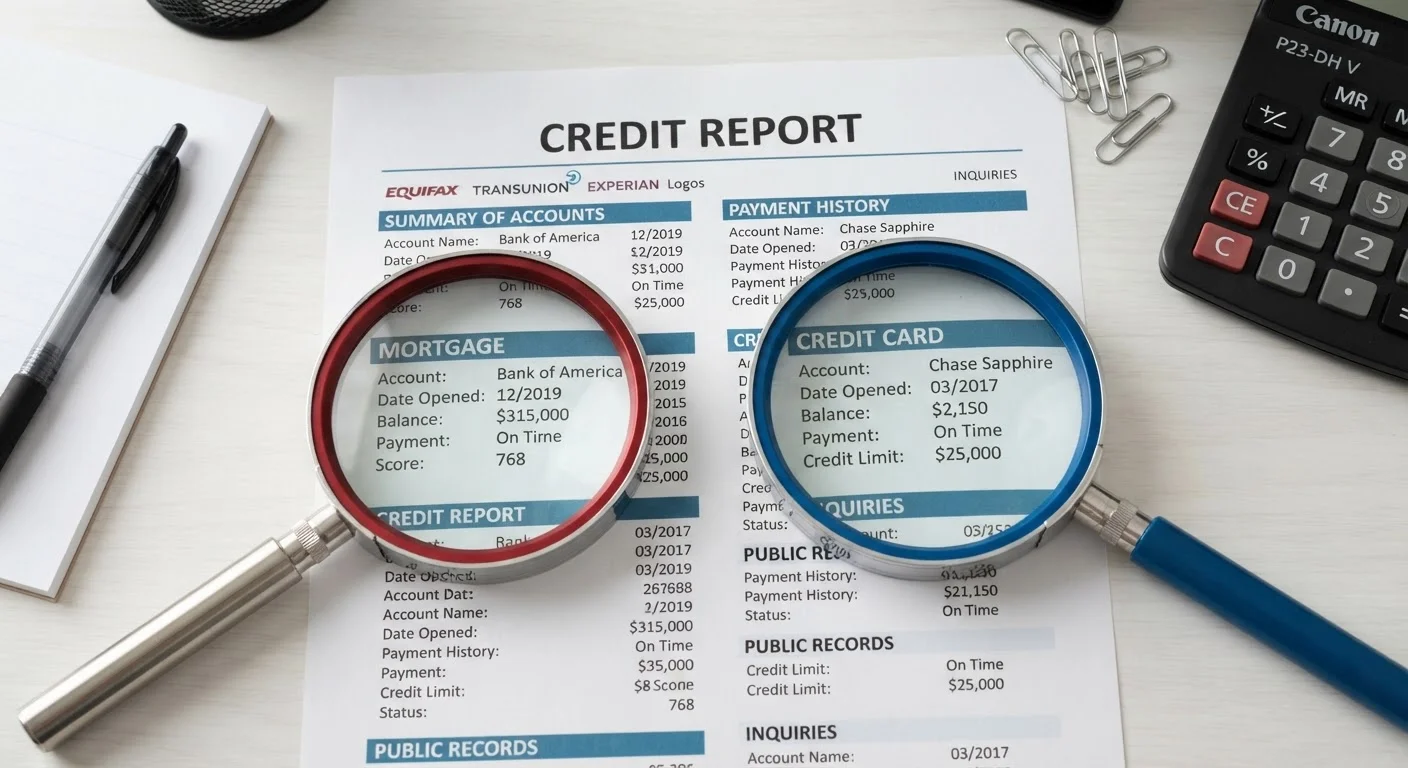
Hard inquiries are recorded under the "Inquiries" section of your credit report and remain visible to lenders for up to two years, though their scoring impact typically fades after 12 months under most scoring models.
What Makes an Inquiry Hard or Soft
When anyone accesses your credit report, the event is logged as an inquiry. But not all inquiries are treated equally by credit bureaus or scoring models. The fundamental difference comes down to purpose and consent.
A hard inquiry occurs when you actively apply for credit - a mortgage, auto loan, credit card, or personal loan. By submitting an application, you authorize the lender to pull your full credit report to evaluate your creditworthiness. This action signals to scoring models that you may be taking on new debt.
A soft inquiry, by contrast, occurs without you initiating a credit application. Checking your own report, receiving a pre-screened credit offer in the mail, or having a landlord verify your background can all generate soft inquiries. These checks do not signal new borrowing intent, so they carry no scoring consequences whatsoever.
For a broader grounding in how these terms fit into the credit landscape, see our guide to credit and banking terms.
Soft vs. Hard: The Consent Signal
A useful way to remember the difference: hard inquiries require your active consent through a credit application, while soft inquiries happen in the background without you initiating a lending decision. If you did not apply for credit, the inquiry is almost certainly soft. If you can see an inquiry under the "hard inquiries" section of your report and do not recognize it, that is worth investigating promptly.
How Hard Inquiries Affect Your Credit Score
Hard inquiries fall under the "new credit" category in most scoring models, which accounts for roughly 10% of a FICO score. A single hard inquiry typically causes a small, short-lived dip - often fewer than five points - though the precise impact varies by individual credit profile.
The effect is most noticeable when:
- You have a short or limited credit history
- You apply for several different types of credit in a brief period
- Your score is already in a borderline range between tiers
Hard inquiries remain on your report for two years, but their influence on your score generally fades after about 12 months. Most scoring models weight recent inquiries more heavily than older ones.
Understanding where inquiries fit relative to other score factors - such as payment history and utilization - helps put their impact in perspective. See how utilization works in our article on credit utilization and your score.
Rate Shopping: When Multiple Hard Inquiries Count as One
One of the most misunderstood nuances in credit scoring is the rate-shopping exception. When you shop around for a mortgage, auto loan, or student loan, applying to multiple lenders within a short window is typically treated as a single inquiry by major scoring models.
The exact window varies: FICO's older models allow 14 days, while newer FICO versions and VantageScore extend that window to 45 days for certain loan types. The logic is straightforward - comparing offers from multiple lenders is financially responsible behavior, and scoring models are designed not to penalize it.
This exception generally applies to installment loan types like mortgages and auto loans. It does not apply to credit card applications, where each application typically generates its own separate hard inquiry with its own scoring impact.
If you are just beginning to establish credit and want to understand how inquiries interact with a thin file, our guide to building credit from scratch covers the foundational steps in plain terms.
Soft Inquiries: Common Examples and Why They Don't Matter
Soft inquiries are far more common than most people realize, and because they never affect your score, they rarely require any attention. Common situations that generate soft inquiries include:
- Checking your own credit report - always a soft inquiry, regardless of which service you use
- Pre-qualification and pre-approval checks - lenders screen you for offers without a formal application
- Employer background checks - some employers review credit as part of the hiring process, especially for financially sensitive roles
- Account management reviews - existing creditors may periodically review your file to assess ongoing risk or adjust your credit limit
It's worth noting that pre-qualification from a lender is a soft inquiry - but if you proceed to a full application, that triggers a hard inquiry. Understanding this distinction helps you explore your options without unnecessary score impact.
If you have ever noticed unfamiliar entries on your report, our article on spotting and correcting credit report errors walks through how to evaluate and dispute them.
<5 pts
Typical score drop from one hard inquiry
According to FICO, a single hard inquiry generally lowers a credit score by fewer than five points for most consumers.
2 years
How long hard inquiries stay on your report
Hard inquiries remain visible on your credit report for two years, though their scoring impact usually fades significantly after 12 months.
10%
Weight of new credit in a FICO score
FICO's scoring model allocates roughly 10% of your score to the "new credit" category, which includes recent hard inquiries.
Practical Takeaways for Managing Inquiries
Keeping inquiry impact in check does not require elaborate strategy - a few practical habits cover most situations:
- Apply for new credit deliberately. Each hard inquiry has a cost, even if small. Spacing out applications when possible reduces the cumulative effect on your score.
- Use pre-qualification tools first. Many lenders offer soft-inquiry pre-qualification that lets you gauge your approval odds before committing to a formal application.
- Consolidate rate shopping into one window. If you are mortgage or auto loan shopping, aim to submit all applications within a 14-45 day period to benefit from rate-shopping protections.
- Monitor your report for unauthorized inquiries. An unfamiliar hard inquiry may indicate that someone has applied for credit in your name. You have the right to dispute inquiries you did not authorize with the credit bureau that reported them.
Inquiries are just one factor in a larger picture. For context on how scores are interpreted overall, see our explanation of what each credit score tier means in practice.
This article is for general informational and educational purposes only and does not constitute personalized financial advice. Consult a qualified financial professional for guidance specific to your situation.