

Key Takeaways
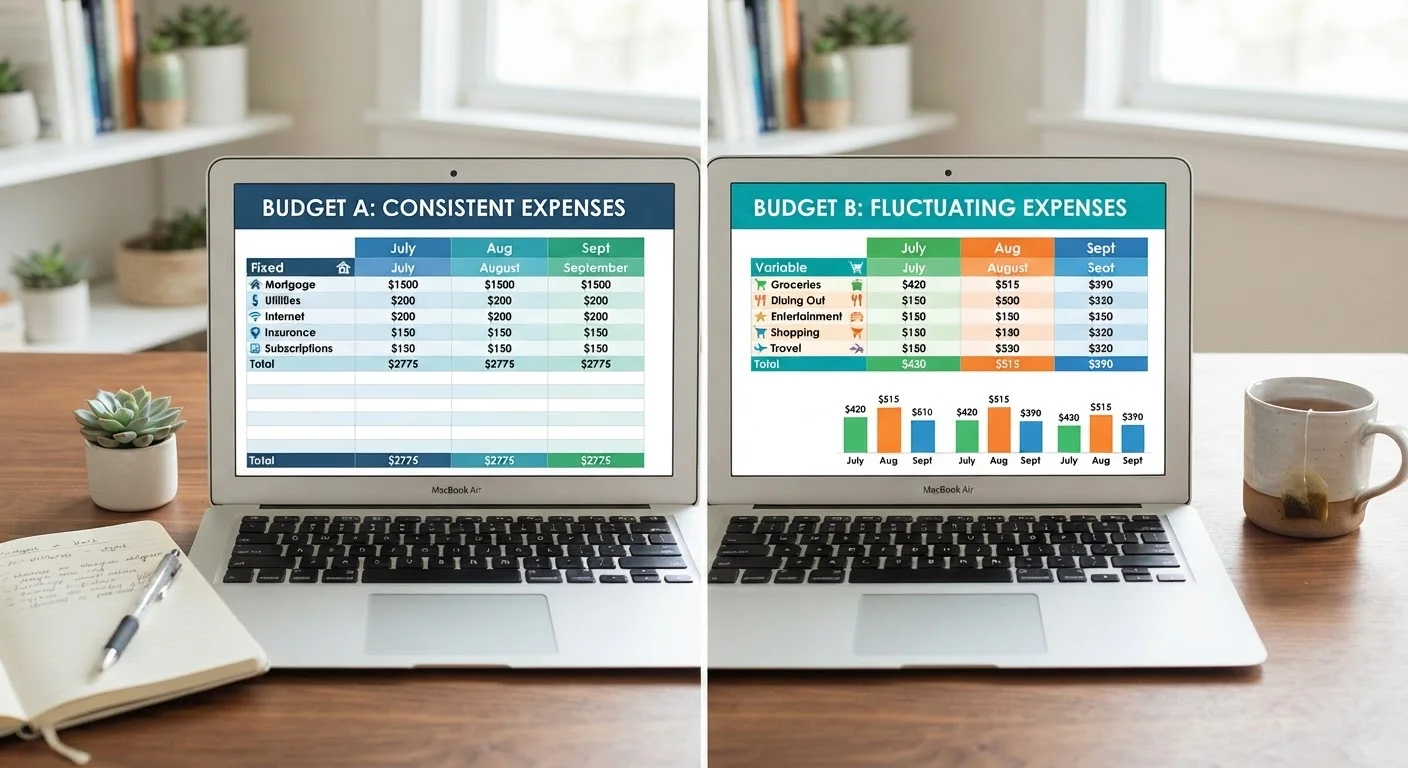
- Fixed expenses stay the same each month; variable expenses change based on usage or choices.
- Identifying both types is essential before choosing any budgeting method.
- Variable expenses offer the most immediate opportunity to reduce spending when needed.
- Some expenses are semi-fixed - they're hard to change quickly but can shift over time.
- A realistic budget accounts for the full range and unpredictability of variable costs.
Option A
Fixed Expenses
The predictable, non-negotiable anchors of your budget.
Best for: Building a reliable spending baseline, since the amount due stays the same every billing cycle.
Option B
Variable Expenses
The flexible costs that rise and fall with your choices and circumstances.
Best for: Identifying where spending can be trimmed or redirected when money gets tight.
If you want to establish a firm spending floor
Fixed Expenses
Listing your fixed expenses first tells you the minimum you must earn each month before anything else - your non-negotiable baseline.
If you want to find room to save or pay down debt
Variable Expenses
Variable costs are where spending flexibility lives. Reducing groceries, dining out, or subscriptions can free up real money relatively quickly.
If you're building your first budget from scratch
Fixed Expenses
Start by cataloguing every fixed commitment. It gives you a clear, stable foundation before tackling the harder-to-predict variable side.
If you're stress-testing your budget during a job loss or income drop
Variable Expenses
When income falls, variable expenses are typically the first and easiest place to cut without breaking contracts or incurring penalties.
What Are Fixed Expenses?
A fixed expense is any recurring cost whose amount stays the same from one billing cycle to the next. Rent or mortgage payments, car loan installments, insurance premiums, and most subscription services all fit this description. You agree to a set amount - usually through a contract or automatic payment - and that number doesn't change unless you renegotiate or cancel the arrangement.
Fixed expenses are the structural beams of your budget. They're largely outside your control on a month-to-month basis, which is both reassuring and limiting. On the upside, you can forecast them with confidence. On the downside, they're difficult to reduce quickly when cash flow tightens.
It's also worth distinguishing truly fixed costs from semi-fixed ones. A cell phone plan, for instance, tends to stay the same each month but can eventually be renegotiated or switched. In the short run, treat it as fixed. Over time, it may represent a lever you can pull.
What Are Variable Expenses?
A variable expense fluctuates - sometimes by a little, sometimes a lot - depending on your behavior, needs, or external factors. Groceries, gasoline, utility bills, dining out, clothing, and medical co-pays are all common examples. The category exists, but the exact dollar amount changes every month.
Variable expenses tend to be where most people underestimate their spending. A grocery run that averages $300 one month might reach $420 the next due to a dinner party or a price increase. Because these costs feel casual and everyday, they rarely get the same scrutiny as a rent payment.
That inconsistency is also what makes variable expenses the primary target when budgets need adjusting. Unlike a fixed car payment you can't easily change, you can decide to cook at home more often, delay a clothing purchase, or lower your thermostat to reduce a utility bill. The flexibility cuts both ways - it can work against you if left unmonitored, or for you once you're paying attention.
| Criterion | Fixed Expenses | Variable Expenses |
|---|---|---|
| Amount each month | Stays the same | Changes month to month |
| Common examples | Rent, loan payments, insurance | Groceries, gas, utilities, dining |
| Ease of forecasting | Very easy - amount is known in advance | Requires estimates and tracking |
| Ability to reduce quickly | Difficult - usually contract-bound | Often possible with behavior changes |
| Budget role | Sets your spending floor | Creates room for adjustment |
| Risk of overspending | Low - amount is fixed | Higher - easy to underestimate |
For a deeper look at how to structure your budget around both categories, see our comparison of four popular budgeting methods.
Why the Distinction Matters in Practice
Separating fixed from variable expenses isn't a bookkeeping exercise - it directly determines how you plan, respond to shortfalls, and set savings targets.
When you know your fixed expenses total, say, $2,100 a month, you know the minimum income required to keep the lights on and the roof overhead. Everything above that number is allocable - some going to variable necessities like food and transportation, some going to savings and debt repayment, and some going to discretionary spending.
This framing also helps during income disruptions. If your earnings drop unexpectedly, your fixed expenses don't. Understanding which bills are immovable lets you immediately focus your attention on the variable side - where cuts are actually possible - rather than feeling overwhelmed by your total spending.
The distinction also underpins most formal budgeting approaches. The zero-based vs. percentage-based budgeting debate, for example, hinges partly on how you categorize and assign each dollar across fixed and variable categories.
Don't Overlook Semi-Fixed Expenses
Some costs sit between fixed and variable - think streaming subscriptions, gym memberships, or a car insurance policy you could shop around. These are stable month to month but adjustable if you invest some effort. When reviewing your budget, flag these separately so you remember they're potential levers, not permanent fixtures. Even a modest annual review of semi-fixed costs can surface meaningful savings.
Finally, separating fixed and variable spending connects naturally to the needs vs. wants distinction - a complementary lens for evaluating whether each expense is truly necessary.
This article is for general informational and educational purposes only and does not constitute personalized financial or legal advice. Consult a qualified financial professional for guidance specific to your situation.