

Key Takeaways
- Financing builds equity in the vehicle; leasing provides use of it for a set period only.
- Monthly lease payments are typically lower than loan payments for the same vehicle.
- Financing costs more upfront and long-term if you hold the vehicle briefly, but ownership has real value.
- Leases include mileage caps and condition requirements that can trigger significant fees at turn-in.
- Your credit score affects the interest rate on loans and the money factor (effective rate) on leases.
- Total cost of ownership over five or more years generally favors financing over serial leasing.
Option A
Auto Loan Financing
The path to full ownership, built payment by payment.
Best for: Drivers who want to build equity, drive without mileage limits, and keep the vehicle long-term.
Option B
Vehicle Leasing
Lower monthly costs in exchange for a set term and restrictions.
Best for: Drivers who prefer lower payments, like driving newer vehicles frequently, and keep mileage predictable.
If you plan to keep a vehicle for five or more years
Auto Loan Financing
Once the loan is paid off, you eliminate the monthly payment entirely. Long-term, owning a paid-off vehicle is almost always the lower-cost path.
If you drive under 12,000-15,000 miles per year and value lower monthly payments
Vehicle Leasing
Leases are structured around predictable, lower-mileage use. Staying within the cap keeps costs controlled and the experience straightforward.
If you want to customize or modify your vehicle
Auto Loan Financing
A leased vehicle must be returned in near-original condition. Financing gives you full freedom to modify the car as you see fit.
If your driving needs or life circumstances change frequently
Auto Loan Financing
Exiting a lease early typically triggers substantial penalties. A financed vehicle can be sold or traded at any point, giving you more flexibility.
If cash flow is tight and you need a new vehicle with the lowest possible monthly outlay
Vehicle Leasing
Lease payments cover depreciation only, not the full vehicle value, which generally keeps monthly costs lower - though total outlay over time may be higher.
How Each Agreement Is Structured
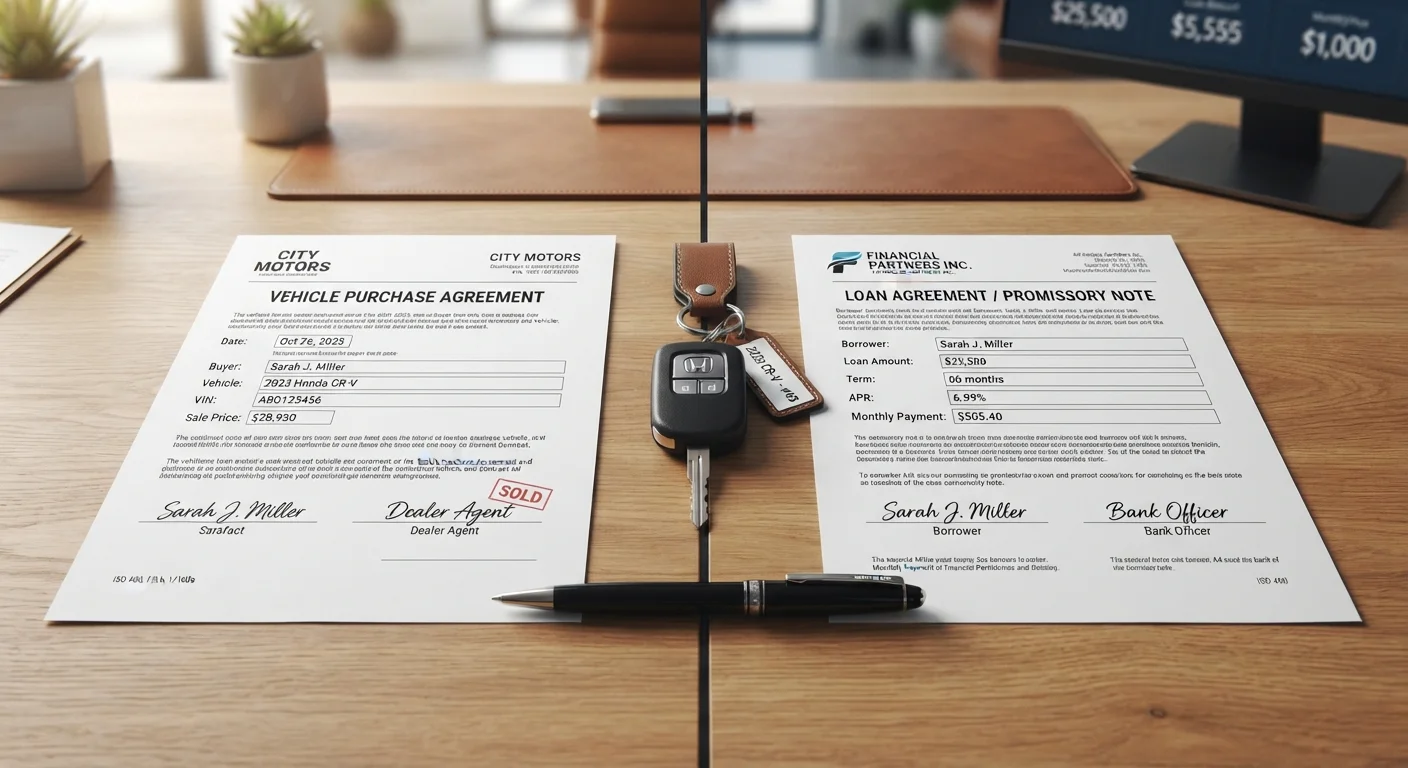
When you finance a vehicle, you borrow money - typically from a bank, credit union, or the dealership's lending arm - to purchase it outright. You make fixed monthly payments that cover principal plus interest until the loan is retired. At that point, the title transfers fully to you. The vehicle is yours to keep, sell, or trade on your own terms.
When you lease a vehicle, you are essentially renting it for a defined term, most commonly 24 to 39 months. The monthly payment is calculated to cover the vehicle's expected depreciation over the lease term, plus a finance charge known as the money factor (which functions like an interest rate). At the end of the term, you return the vehicle - or, in some agreements, you have the option to purchase it at a pre-set residual value.
The critical distinction is what you are paying for. A loan payment retires a debt and builds ownership. A lease payment pays for the right to use an asset you do not own. Understanding how depreciation works is essential here, because a leased vehicle's monthly cost is directly tied to how steeply it is expected to lose value.
| Criterion | Auto Loan Financing | Vehicle Leasing |
|---|---|---|
| Ownership at end of term | Yes - title transfers to you | No - vehicle is returned |
| Typical monthly payment | Higher (covers full value + interest) | Lower (covers depreciation only) |
| Mileage restrictions | None | Annual cap; fees for overages |
| Upfront costs | Down payment often required | First month + fees at signing |
| Equity building | Yes - grows as loan is paid | No equity accumulated |
| Modification freedom | Unrestricted | Must return in original condition |
| Early exit flexibility | Can sell or trade anytime | Early termination fees apply |
| Finance rate term | APR (Annual Percentage Rate) | Money factor (lease-equivalent rate) |
What the Numbers Actually Look Like
Consider a vehicle with a sticker price of $35,000. Under a 60-month loan at a 7% annual percentage rate (APR) with no down payment, the monthly payment would be approximately $693, and total interest paid over the life of the loan would be around $6,580. At the end, you own the car outright.
Under a 36-month lease on the same vehicle - assuming a residual value of 55% and a money factor equivalent to roughly 5% - a monthly payment might land around $400 to $450. That sounds more manageable, but at term's end you own nothing and must either start a new lease, purchase the vehicle at its residual price, or arrange alternative transportation.
Serial leasing - moving from one lease to the next without ever buying - means you carry a perpetual monthly payment with no equity accumulation. Over a decade, a driver who finances and then owns a paid-off vehicle is in a fundamentally different financial position than one who has leased continuously. For a broader look at all three acquisition paths, see our guide to buying, leasing, and financing.
~$700
Average monthly new car loan payment (U.S.)
According to Experian's State of the Automotive Finance Market reports, average new vehicle loan payments have exceeded $700 in recent quarters.
~$550
Average monthly new vehicle lease payment (U.S.)
Experian data indicates average new vehicle lease payments are meaningfully lower than loan payments for comparable vehicles.
30%
Share of new vehicles financed via lease
Experian reports that leasing has historically represented roughly 20-30% of new vehicle transactions, varying by economic conditions and interest rates.
Hidden Costs and Fine Print to Know
Both agreements carry costs that do not appear in the headline monthly payment.
Financing Risks
- Negative equity: If you owe more than the vehicle is worth - common in the early loan years - trading or selling becomes financially complicated.
- Higher upfront costs: Down payments, taxes, registration, and documentation fees are all due at signing.
- Interest rate sensitivity: Your credit profile directly determines your APR. A weaker score means substantially higher total interest paid.
Leasing Risks
- Mileage penalties: Most leases cap annual mileage at 10,000-15,000 miles. Exceeding the cap triggers per-mile charges - often $0.15-$0.30 per mile - that can add up quickly.
- Wear-and-tear charges: Lessees are responsible for returning the vehicle in acceptable condition. Scratches, interior damage, or worn tires beyond normal use may result in charges at turn-in.
- Early termination fees: Ending a lease before the term is complete can be very costly. Unlike selling a financed car, there is limited flexibility to exit cheaply.
This article provides general financial information for educational purposes only and is not personalized financial or legal advice. Consult a qualified financial professional before making vehicle financing decisions.
Which Path Fits Your Situation
There is no universally superior choice - the right answer depends on how you drive, how long you intend to keep the vehicle, and what your financial priorities are.
Financing tends to make more sense if you drive a high number of miles annually, want the freedom to modify the vehicle, or plan to hold it beyond the loan payoff date. It also builds an asset, however depreciating. Leasing tends to make more sense if you consistently drive within mileage limits, value always having a newer vehicle under warranty, and want lower monthly cash outlays in the near term.
One factor that affects both paths equally: your credit. A strong credit profile unlocks lower interest rates on loans and more favorable money factors on leases. Understanding the role that credit plays - and knowing where to look for financing, including credit unions versus traditional banks - can meaningfully affect what you pay. Whatever path you choose, read the full agreement carefully before signing, and model the total cost - not just the monthly payment - against your actual driving habits and financial situation.