

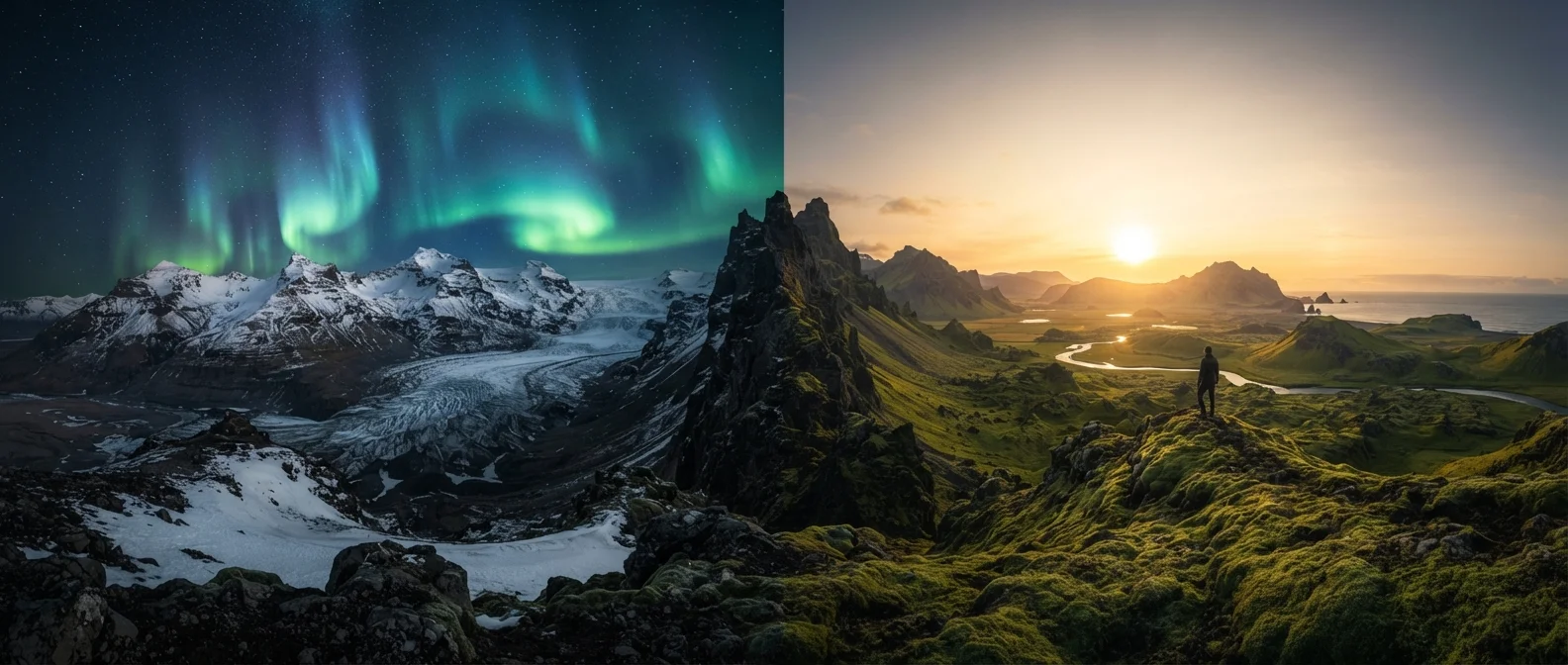
Key Takeaways
- Winter offers the only reliable chance to see the northern lights, but weather can disrupt plans frequently.
- Summer's midnight sun and open Highland roads make it the most accessible season for road trips and hiking.
- Winter airfares and accommodation rates are generally lower outside of Christmas and New Year's holiday windows.
- Some iconic sites like the Landmannalaugar Highlands are only reachable by road in summer months.
- Summer crowds at popular spots like the Blue Lagoon and Golden Circle are significantly heavier than winter.
- Neither season guarantees perfect weather - Iceland's conditions can change rapidly year-round.
Option A
Iceland in Winter
The dramatic, aurora-chasing season of long dark nights.
Best for: Travelers who prioritize northern lights, snow-covered landscapes, and fewer fellow tourists at major sites.
Option B
Iceland in Summer
The accessible, adventure-packed season of endless daylight.
Best for: Travelers who want full access to roads, hiking trails, and the Highland interior under 24-hour light.
If seeing the northern lights is your primary goal
Iceland in Winter
Aurora activity requires darkness, which Iceland's summer midnight sun eliminates entirely. Winter, particularly November through February, offers the longest dark windows for viewing.
If you want to explore the Highlands and remote interior
Iceland in Summer
The F-roads (mountain tracks) that access the Highland interior are closed by snow and ice from roughly October through May, making summer the only practical option.
If you're traveling on a tighter budget
Iceland in Winter
Outside of peak holiday dates in December and January, winter flights and hotels tend to run lower than summer rates, which spike during June and July.
If you're traveling with children or have limited mobility
Iceland in Summer
Long daylight hours, milder temperatures, and accessible roads reduce the logistical challenges that winter ice, limited daylight, and road closures can create.
If avoiding large crowds is a priority
Iceland in Winter
Tourist volumes drop substantially in winter, meaning shorter queues at popular sites and a more solitary experience at natural landmarks.
Light and Weather: The Core Difference
Iceland's two travel seasons are defined by extremes of light. In winter (roughly November through February), Reykjavik receives as few as four to five hours of daylight. In summer (June through August), the sun barely sets - the famous midnight sun means near-continuous light for weeks around the solstice.
That single fact reshapes everything from your activity schedule to how well you sleep. Blackout curtains are standard in Icelandic accommodations for good reason in summer. In winter, embrace the dark - it's your best friend for aurora hunting.
Weather in both seasons is genuinely unpredictable. Coastal areas experience frequent wind, rain, and rapid changes regardless of the month. Winter adds ice and the real possibility of road closures; summer can bring surprisingly cool temperatures even in July, often averaging in the low 50s Fahrenheit. Pack waterproof, windproof layers no matter when you go.
| Criterion | Iceland in Winter | Iceland in Summer |
|---|---|---|
| Daylight hours | 4-6 hours per day | 20-24 hours per day |
| Northern lights visibility | Possible (darkness required) | Not possible (midnight sun) |
| Highland F-road access | Closed (snow/ice) | Open mid-June to September |
| Ice cave tours | Available Nov-Mar | Not available |
| Puffin sightings | Not present | May through August |
| Crowd levels | Low (except holidays) | High, especially June-July |
| General cost level | Lower (outside holidays) | Higher, peak in July |
| Driving conditions | Ice and closures possible | Generally safer, more open |
What You Can Actually Do in Each Season
Winter visitors center their itineraries on the northern lights, glacier hikes, ice cave tours, and the Golden Circle route - all of which are accessible year-round. Ice caves inside Vatnajökull glacier are a strictly winter phenomenon, formed by freezing temperatures and typically accessible from November through March. Tour operators guide these visits, and conditions vary each season.
Summer unlocks the country's most remote landscapes. The Highlands - including Landmannalaugar with its rhyolite mountains and hot springs, and Þórsmörk nature reserve - require traversing F-roads that are impassable in winter. Hiking season peaks in July and August, with well-marked trails open and emergency huts staffed.
Whale watching runs largely from April through October, making late spring and summer the strongest window. Puffins, one of Iceland's most sought wildlife sightings, nest along coastal cliffs from May through August and are entirely absent in winter.
For travelers weighing how season timing affects cost and access more broadly, understanding peak vs. shoulder season dynamics can help frame your decision beyond Iceland specifically.
Crowds, Costs, and Practical Logistics
Iceland's tourism peaks sharply in summer. June, July, and August see the highest visitor volumes, which means longer waits at the Blue Lagoon, crowded pull-offs along the Ring Road, and accommodation that books out months in advance. Popular sites like Skógafoss and Seljalandsfoss waterfalls can feel congested mid-summer.
Winter brings noticeably fewer visitors outside the Christmas-to-New-Year's window and the growing aurora-tourism surge in January and February. Expect more space at sites, shorter waits, and a quieter overall atmosphere - though some smaller guesthouses and rural services reduce hours or close entirely in the depths of winter.
Driving considerations differ sharply. The Ring Road (Route 1) is maintained year-round, but winter driving requires genuine caution: black ice, blowing snow, and sudden closures are common. A four-wheel-drive vehicle with winter tires is strongly recommended, and the Icelandic Road and Coastal Administration's safetravel.is website is an essential resource for road conditions before any drive.
~2M
Annual tourists visiting Iceland
Iceland welcomed roughly 2 million international visitors annually before 2020, with summer months accounting for the large majority, according to the Icelandic Tourist Board.
4-5 hrs
Daily daylight in Reykjavik in December
At Iceland's latitude, the winter solstice produces only around four to five hours of usable daylight in the capital, fundamentally shaping the winter travel experience.
~700km
Length of the Ring Road (Route 1)
Iceland's main highway circumnavigates the entire island and is maintained year-round, though winter conditions require cautious driving and flexible itineraries.
Budget travelers often find January and February offer the most breathing room on price, while anyone visiting in summer should book flights and accommodation as far ahead as possible - ideally six or more months out for peak weeks.