

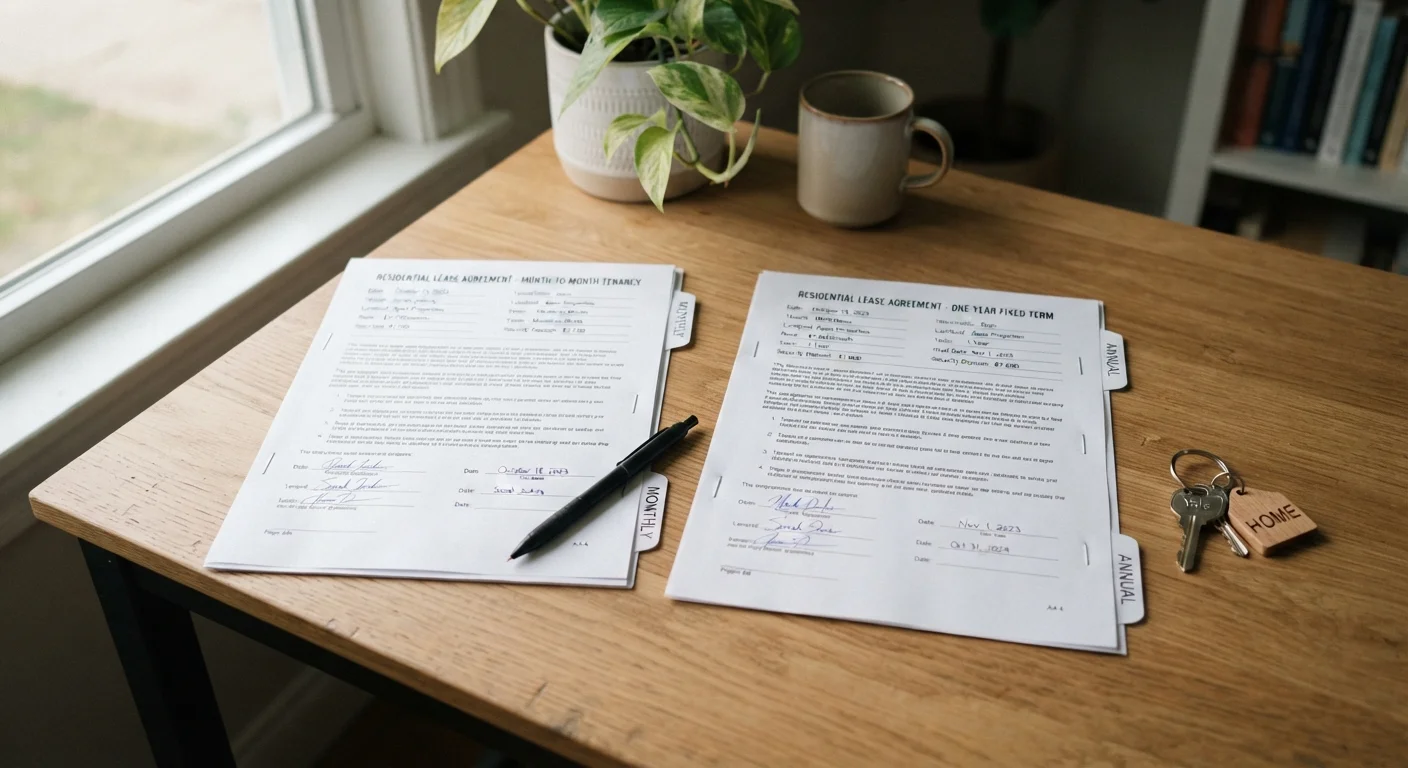
Key Takeaways
- Month-to-month leases offer flexibility but typically come with higher rent and less security.
- Fixed-term leases lock in your rent and tenancy for the agreement period, usually 12 months.
- Breaking a fixed-term lease early can result in significant financial penalties.
- Landlords can end or raise rent on month-to-month agreements with relatively short notice.
- Your life circumstances - job stability, relocation plans, family situation - should guide which option you choose.
Option A
Month-to-Month Lease
The flexible, short-commitment rental arrangement.
Best for: Renters who need mobility, expect life changes soon, or are in a transitional housing situation.
Option B
Fixed-Term Lease
The stable, predictable long-term rental agreement.
Best for: Renters who want locked-in rent, housing security, and a known timeline for at least 12 months.
If you're relocating for work or expect to move within six months
Month-to-Month Lease
The short-notice exit terms let you leave without breaching a contract or paying early termination fees, even if monthly rent runs higher.
If you've found a neighborhood and apartment you're happy with for at least a year
Fixed-Term Lease
Locking in your rent for 12 months protects you from mid-tenancy increases and gives you legal standing to remain in the unit through the lease end.
If you're testing a new city or unsure about your housing needs
Month-to-Month Lease
Committing to a month-to-month arrangement while you orient yourself avoids the risk of being stuck in a unit or neighborhood that doesn't fit.
If you're budgeting carefully and need rent predictability
Fixed-Term Lease
A fixed-term agreement makes rent a known constant in your budget for the lease period, which simplifies financial planning considerably.
If you're a homeowner waiting to sell and need temporary housing
Month-to-Month Lease
The ability to exit with 30 days' notice aligns with an unpredictable closing timeline, reducing the chance of overlapping housing costs.
What Each Lease Type Actually Means
A month-to-month lease (sometimes called a periodic tenancy) renews automatically each month unless either the renter or landlord gives written notice to end it. Most states require 30 days' notice from either party, though some require more - always check your state's landlord-tenant law. Because neither side is locked in for an extended period, both have significant flexibility, but also significant exposure.
A fixed-term lease establishes tenancy for a specific period - most commonly 12 months, though six-month and 24-month agreements exist. The rent amount, occupancy rules, and termination conditions are fixed for that duration. Neither party can unilaterally change the core terms mid-lease without the other's written consent. At the end of the term, the lease typically either renews as another fixed term, converts to month-to-month, or terminates, depending on what the agreement specifies.
Before signing either type, it's worth reading the fine print carefully. Our guide on what your lease agreement actually says walks through specific clauses - rent escalation provisions, early termination fees, and holdover terms - that affect both structures. If you're unfamiliar with common rental terminology, our rental agreement glossary provides plain-language definitions of terms you'll encounter in either lease type.
Comparing the Core Trade-Offs
The choice between these two arrangements involves trade-offs across rent cost, flexibility, and security. Neither is objectively superior - the right fit depends on your personal circumstances.
| Criterion | Month-to-Month Lease | Fixed-Term Lease |
|---|---|---|
| Commitment length | Renews monthly; no set end date | Set term, typically 12 months |
| Rent predictability | Can change with notice each month | Locked in for the lease period |
| Typical rent level | Often 10-20% higher than fixed-term | Generally lower; reflects commitment |
| Tenant exit flexibility | 30 days' notice in most states | Early exit may incur penalties |
| Landlord's ability to end tenancy | 30-60 days' notice typically required | Cannot end without cause mid-term |
| Protection from rent increases | Minimal outside rent-stabilized areas | Strong; rent fixed through term end |
| Ideal for | Transitional or uncertain situations | Stable, longer-term housing needs |
One factor renters often underestimate is the premium landlords charge for flexibility. In competitive rental markets, month-to-month rent can run 10-20% higher than the equivalent fixed-term rate for the same unit. Landlords price in the uncertainty of not knowing when the unit will turn over. That premium compounds over time - if you stay for a full year on a month-to-month arrangement, you may have paid significantly more than a neighbor on an annual lease in the same building.
On the other hand, breaking a fixed-term lease early is rarely cost-free. Most leases include an early termination clause requiring the tenant to pay a penalty - often one to two months' rent - or to continue paying until a replacement tenant is found. Some states limit what landlords can collect, but enforcement depends on the lease language and local law.
Protections and Risks for Renters
Fixed-term leases offer meaningful legal protection: your landlord generally cannot raise your rent, change the lease terms, or force you out (absent cause) during the lease period. This stability is particularly valuable in markets where rents are rising quickly.
Month-to-month tenants have far less security. In most states, a landlord can raise rent or terminate the tenancy with as little as 30 days' written notice - sometimes more, depending on local rules. Some cities with rent stabilization ordinances (local laws limiting rent increases and, in some cases, requiring cause for eviction) extend protections to month-to-month tenants, but these laws vary widely and don't exist in most U.S. jurisdictions.
Rent Stabilization Does Not Apply Everywhere
Rent stabilization and rent control ordinances exist in certain cities - including parts of New York, California, and New Jersey - but are absent in most U.S. markets. Without such protections, month-to-month tenants in most states can receive a rent increase or a notice to vacate with relatively little lead time. Before assuming local protections apply to your situation, check with your city or county housing authority to confirm what rules, if any, govern your tenancy type.
It's also worth knowing what happens at the end of a fixed-term lease if you simply continue living there without signing a new agreement. This situation, called a holdover tenancy, often converts automatically to a month-to-month arrangement under state law - but it can also expose you to penalties if the landlord doesn't wish to renew. Check your lease's holdover clause before your term ends. If you're also weighing broader housing decisions, our comparison of renting versus buying covers how lease flexibility factors into the longer-term rent-or-own question.
Matching the Lease Type to Your Life Situation
Your employment situation, family plans, and financial stability should all inform which structure you choose. There's no universally correct answer, but some patterns emerge:
- New to a city or neighborhood: A month-to-month arrangement lets you avoid being locked into a location before you've determined whether it suits you long-term.
- Stable job, settled lifestyle: A fixed-term lease makes practical sense - it typically costs less per month and protects you from rent increases through the lease period.
- In a transitional life stage (expecting a baby, caring for an aging parent, finishing a degree): Consider which direction creates more risk - flexibility or commitment - and choose accordingly.
- Renting with roommates: Lease structure takes on added complexity in shared housing. Our guide on renting with roommates explains how fixed-term and month-to-month arrangements interact with joint and individual liability.
Whatever arrangement you choose, understanding the lease before signing is non-negotiable. A lease is a legally binding contract, and misunderstanding its terms - whether you're on a month-to-month or a fixed term - can have real financial consequences.
This article provides general educational information about rental lease structures and is not legal advice. Lease laws vary significantly by state and municipality. Consult a qualified attorney or tenant rights organization in your area for guidance specific to your situation.