

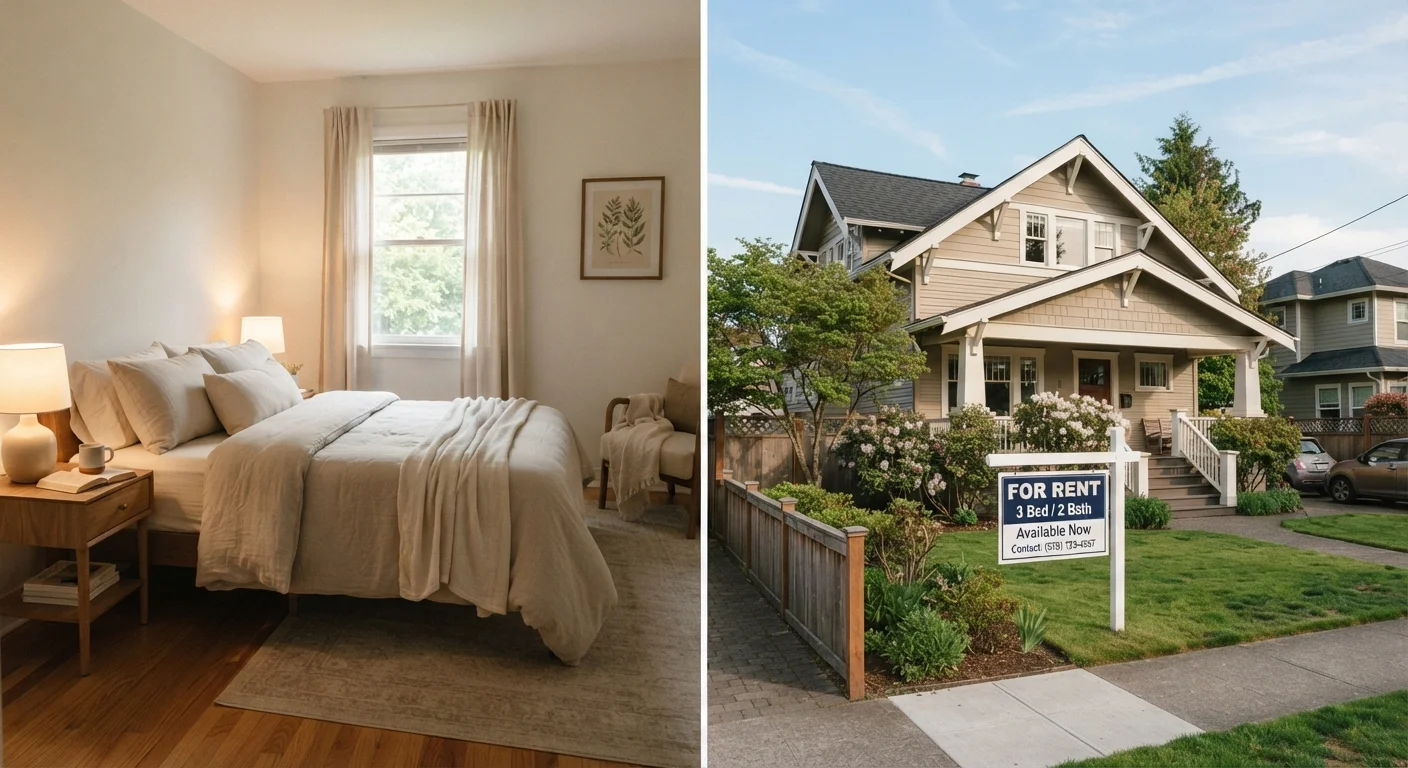
Key Takeaways
- Renting a room generates supplemental income but requires sharing your living space with a tenant.
- Listing the whole house typically yields higher rental income but means vacating and managing a full tenancy.
- Both approaches trigger landlord responsibilities including lease agreements, maintenance duties, and tax reporting.
- Rental income from either arrangement is generally taxable; consult a tax professional for your specific situation.
- Your local jurisdiction may have specific rules - such as owner-occupancy requirements - that affect which option is legally available to you.
- Long-term property value and equity considerations differ depending on how you rent and to whom.
Option A
Renting Out a Room
The lower-commitment, privacy-sharing approach.
Best for: Homeowners who want supplemental income while continuing to live in their home.
Option B
Listing the Whole House
The higher-income, full-vacancy approach.
Best for: Homeowners who can vacate their property and want to maximize rental revenue.
If you want extra income without relocating
Renting Out a Room
Room rental lets you stay in your home and generate steady supplemental income, though you'll need to be comfortable sharing common spaces with a tenant.
If you're relocating temporarily or have a vacant property
Listing the Whole House
A full rental maximizes income potential when you don't need the space, and can help cover carrying costs like the mortgage and property taxes.
If minimizing landlord responsibilities is a priority
Renting Out a Room
A single-room arrangement typically involves fewer maintenance obligations and simpler lease terms than managing an entire rental unit.
If protecting long-term equity and property condition is the top concern
Renting Out a Room
Remaining on-site as owner-occupant gives you direct oversight of upkeep, reducing the risk of deferred maintenance or tenant-related property issues.
If you need income to cover a full mortgage payment
Listing the Whole House
Whole-home rental typically commands market-rate rent that can offset most or all of your monthly housing costs, something a single room rent rarely achieves.
Income Potential: How Much Can Each Approach Generate?
The income gap between these two strategies can be significant, and it depends heavily on your local rental market. Renting a single room typically generates a fraction of what a full home commands - often ranging from a few hundred dollars to around $1,000 per month in most U.S. markets, though higher-cost cities can push that figure up. A whole-home rental, by contrast, can generate income in line with prevailing market rents for comparable properties in your area.
That said, gross income doesn't tell the whole story. When you rent out a room, you're still personally covering your own mortgage, utilities, and household expenses - room income simply offsets those costs. When listing the whole house, you'll likely need to rent or stay elsewhere, which reduces your net gain. Carefully modeling both scenarios with your actual costs is essential before deciding.
For homeowners curious about broader market dynamics when setting rent, understanding how competitive rental markets work can inform how you price and position your space.
| Criterion | Renting Out a Room | Listing the Whole House |
|---|---|---|
| Typical Income | Partial rent; offsets costs | Full market-rate rent |
| Owner Presence | Owner lives on-site | Owner vacates property |
| Privacy Impact | Shared common spaces | Full privacy elsewhere |
| Maintenance Oversight | Easier; owner on-site | Remote; inspection needed |
| Tax Deductions | Proportionate share of expenses | Broader landlord deductions |
| Capital Gains Risk | Lower; owner still resides there | Higher if primary residence status lost |
| Lease Complexity | Simpler; room-only terms | Full residential lease required |
| Local Regulation Risk | Owner-occupancy rules may apply | Short-term rental rules may apply |
Responsibilities, Maintenance, and Tenant Management
Both approaches make you a landlord - a role with real legal, financial, and practical obligations. The difference lies in scope and proximity.
When you rent a room, you remain on-site and can monitor the property's condition day-to-day. Maintenance tends to be more contained: a malfunctioning appliance or a broken fixture is something you might notice and address quickly. The tradeoff is that you share common areas - kitchens, bathrooms, living spaces - and must navigate the interpersonal dimensions of living with a tenant. Clear lease terms governing quiet hours, guest policies, and shared-space expectations are essential.
Full-home rental means you're managing a property remotely, which introduces risks around deferred maintenance, unreported damage, or utility misuse. Many whole-home landlords hire a property manager (typically 8-12% of monthly rent) or conduct regular inspections to stay informed. Managing your home as a long-term asset becomes especially important when you're not physically present to oversee its condition.
Regardless of approach, a written lease is non-negotiable. Your state's landlord-tenant laws govern security deposits, notice periods, and eviction procedures - requirements that apply whether you're renting a bedroom or an entire property.
Tax Implications for Each Rental Strategy
Rental income is generally taxable under federal law regardless of how much of your home you rent. However, the rules differ meaningfully between partial and full rentals.
When you rent a room, the IRS requires you to report rental income but also allows you to deduct a proportionate share of home expenses - such as mortgage interest, insurance, utilities, and depreciation - based on the percentage of the home used for rental purposes. The calculation can be straightforward or complex depending on how the space is used.
Listing the entire home shifts the tax picture. You may be able to deduct a broader set of landlord expenses, including repairs, property management fees, and depreciation on the full structure. However, your ability to later exclude capital gains on the home sale (currently up to $250,000 for single filers and $500,000 for married couples filing jointly, under the primary residence exclusion) may be reduced if the home has been used as a rental - particularly if it no longer qualifies as your principal residence during the required two-of-five-year window.
Tax rules in this area are nuanced and change periodically. Consult a qualified tax professional before making rental decisions that could affect your property's long-term tax treatment.
Primary Residence Exclusion: A Key Tax Consideration
The IRS primary residence capital gains exclusion allows qualifying homeowners to exclude up to $250,000 (single) or $500,000 (married filing jointly) in gain when selling their home. To qualify, you generally must have lived in the home as your primary residence for at least two of the five years before the sale. Converting your entire home to a rental property may affect this qualification. Additionally, any period of non-qualified use (time spent as a rental rather than a primary residence) can reduce the excludable gain proportionately. A tax professional can help you model the long-term implications before you commit to a rental strategy.
Lifestyle, Privacy, and Long-Term Property Considerations
The lifestyle implications of these two strategies are perhaps the most immediately felt. Renting a room means giving up a degree of privacy in your own home. Even with a well-matched tenant, sharing a residence requires patience, communication, and clear expectations. Some homeowners thrive in this arrangement; others find the lack of solitude untenable after a short time.
Listing the whole house solves the privacy issue - but creates a different kind of stress. You're dependent on a tenant to respect and maintain a property you may still be financially and emotionally invested in. Wear and tear is inevitable, and damage beyond normal use can be costly to remediate.
From an equity standpoint, both arrangements can support or harm your property's value depending on execution. A well-screened tenant in either scenario is a significant protective factor. For guidance on what good rental documentation looks like from a tenant's perspective - which can inform what you require as a landlord - see documenting a rental unit before move-in.
Local regulations also matter: some municipalities require owner-occupancy for room rentals, while others have short-term rental restrictions that affect whole-home listings. Always verify your local zoning and rental laws before listing.
This article is for general informational purposes only and does not constitute legal, tax, or financial advice. Readers should consult qualified professionals for guidance tailored to their individual circumstances and jurisdiction.