

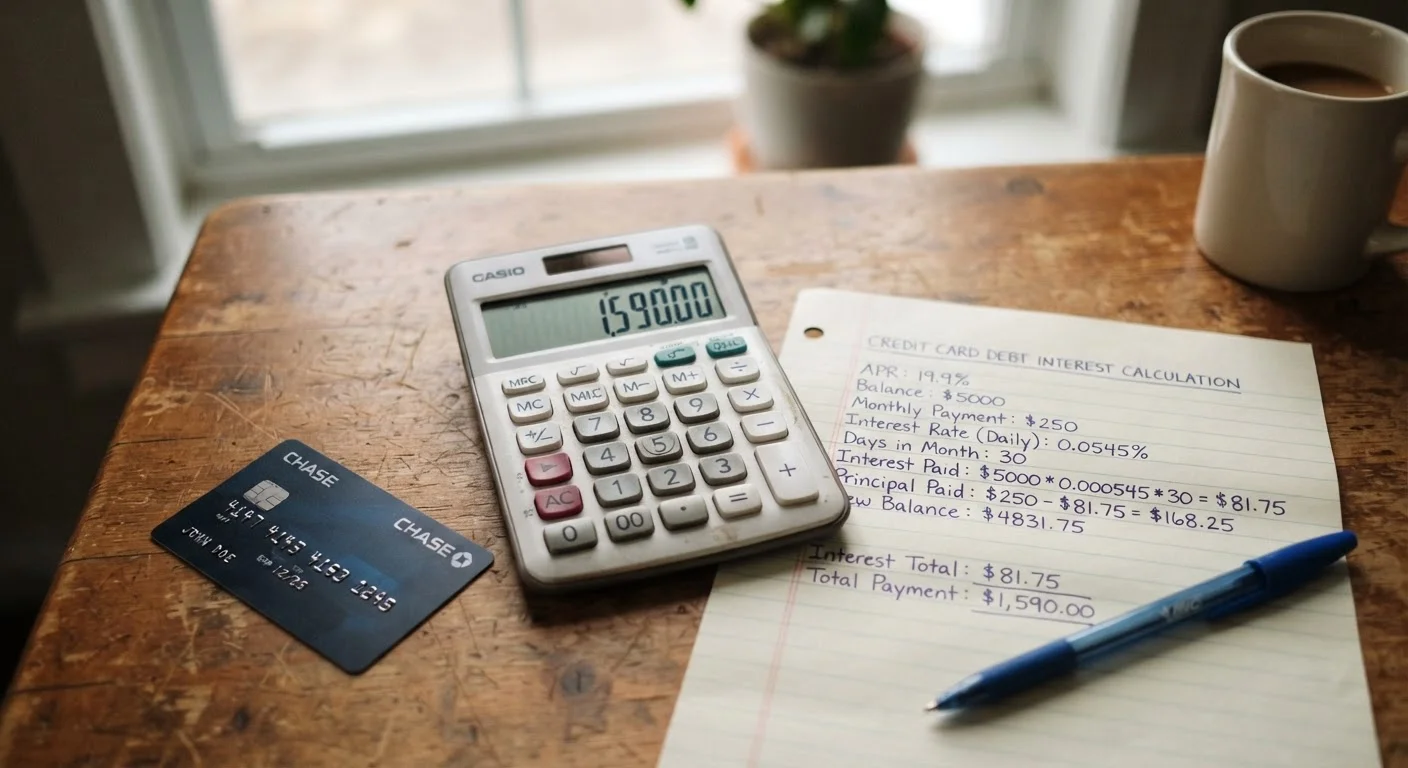
Key Takeaways
- A $5,000 credit card balance at 24% APR can cost over $1,000 in interest in just one year if only minimum payments are made.
- Compound interest means you pay interest on top of previously unpaid interest, accelerating how fast a balance grows.
- Minimum payments are designed to keep you in debt longer - most of each payment goes toward interest, not principal.
- Even a small extra payment each month can significantly reduce total interest paid and shorten repayment time.
- Understanding the actual dollar cost of your debt rate is more motivating than the percentage alone.
High-Interest Debt
High-interest debt is money you owe on which a lender charges a relatively high annual percentage rate (APR). Credit cards are the most common example, often carrying APRs between 20% and 30%. Because interest compounds - meaning you're charged interest on your growing balance, not just the original amount borrowed - the total cost of carrying this debt can far exceed what you originally spent.
Compound interest on revolving debt is typically calculated using the daily periodic rate (APR ÷ 365), then multiplied by the average daily balance each billing cycle. Even a single missed full payment triggers this compounding effect.
Why the Percentage Doesn't Tell the Whole Story
Most people understand that 24% APR is "high," but few translate that into actual dollars. Seeing the number as a percentage makes it feel abstract. Seeing it as a dollar amount makes it unavoidable.
Here's a straightforward example: Suppose you carry a $5,000 balance on a credit card with a 24% APR. If you make only the minimum payment each month - often around 2% of the balance - you could spend more than five years paying it off and hand over more than $3,000 in interest alone. That's over 60% of the original balance paid in fees for borrowing.
This is not a fringe scenario. It reflects how credit card debt behaves for millions of Americans who make on-time minimum payments and still watch their balances barely move. As highlighted in our look at common money myths that slow financial progress, the belief that minimum payments are "fine" is one of the most quietly damaging assumptions in personal finance.
~21%
Average U.S. credit card APR
Federal Reserve data has shown average credit card interest rates climbing to around 21% or higher in recent years - near historic highs for revolving consumer debt.
$1,000+
Annual interest on $5,000 at 24% APR
A $5,000 balance at 24% APR accrues over $1,000 in interest charges in a single year when only minimum payments are made.
5+ years
Time to repay $5,000 at minimums only
Consumer finance calculators consistently show that minimum-only payments on a mid-sized credit card balance at high APR can take five to seven years to fully repay.
How Compound Interest Works Against You
Compound interest is the engine behind why high-rate debt is so expensive. When you don't pay your full balance, the unpaid interest gets added to your principal. The next month, you're charged interest on that larger total. Then it happens again. And again.
Contrast this with simple interest, where each charge is calculated only on the original amount borrowed. Credit card debt doesn't work that way. Your balance is a living number that grows every day you carry it.
The daily math looks like this: A 24% APR divided by 365 gives a daily rate of roughly 0.066%. On a $5,000 balance, that's about $3.29 in interest accruing every single day - before you've made a single purchase. Over 30 days, that's nearly $100 added to what you owe, even if you don't touch the card.
This is why carrying a high-interest balance during a period of tight finances can feel like running on a treadmill - income comes in, minimum payments go out, but the balance stays stubbornly high.
The Minimum Payment Trap: A Closer Look
Credit card minimum payments are structured to keep you current without helping you escape debt. A typical minimum might be 1-2% of your balance. On a $5,000 balance, that's $50-$100 per month.
At 24% APR, the monthly interest charge on $5,000 is roughly $100. That means a minimum payment near the low end of the range barely covers the interest - and reduces the actual principal by almost nothing. Month after month, the treadmill keeps running.
Increasing your payment even modestly changes the outcome dramatically. Adding just $50 above the minimum on a $5,000, 24% APR balance can cut years off repayment and save hundreds in interest. The math rewards any extra dollar directed at the balance.
If you're weighing whether those extra dollars should go toward debt or a savings account, that's a real trade-off worth examining. Our piece on paying off debt while saving at the same time breaks down how to think through that decision based on your rates, risk tolerance, and financial cushion.
When High-Interest Debt Becomes Unmanageable
There's a point at which debt stops being a manageable monthly line item and becomes a structural problem. Warning signs include using credit to cover essentials like groceries or utilities, missing payments, or borrowing from one card to pay another. These patterns signal that the debt load has outpaced your ability to service it through normal repayment.
Understanding these signals early matters because options narrow as balances grow and credit scores fall. Our article on signs your debt load is becoming unmanageable walks through the specific patterns to watch for and what they mean for your next steps.
If you find yourself in this situation, nonprofit credit counseling agencies can help you explore options such as a debt management plan, which may reduce your interest rate and consolidate payments under a structured repayment schedule. These services are generally low- or no-cost and are distinct from for-profit debt settlement companies.
This article is for general informational and educational purposes only and does not constitute personalized financial advice. Readers should consult a qualified financial professional for guidance specific to their circumstances.