

Key Takeaways
- A working budget is possible even when income barely covers essential expenses.
- Tracking every dollar - including small purchases - is the essential first step.
- Small, consistent savings matter more than large one-time contributions.
- Identifying spending categories honestly helps reveal where money can be redirected.
- A budget is a living document that should be adjusted regularly, not set once and forgotten.
What you will need
Why a Tight Budget Is Not a Reason to Skip Budgeting
Many people assume budgeting is for those who have extra money to manage. The reality is the opposite: a spending plan matters most when there is very little room for error. Without one, small financial shocks - a car repair, a medical bill, an unexpected utility spike - push already-stretched households into debt or overdraft.
The goal of a first budget is not to save aggressively or pay off years of debt in one month. It is to build an accurate picture of where money goes and create just enough margin to make intentional choices. Even modest improvements - freeing $30 or $40 a month - change the financial trajectory over time.
If you have tried to budget before and found it did not stick, the problem is rarely willpower. It is usually a structural one. Understanding what makes budgets break down can help you approach this attempt differently.
What you will need
What You Need Before You Start
The tools required are minimal. You do not need sophisticated software or financial expertise. What you do need is accurate information about your actual income and spending - not estimates from memory, which are almost always optimistic.
Bank or credit union statements
Provides an accurate record of actual spending over the past 30-90 days.
Pay stubs or income records
Establishes a reliable baseline for your take-home income each pay period.
Notebook or basic spreadsheet
Used to record income, expenses, and spending categories in an organized way.
Calculator
Helps total spending categories and verify that your numbers balance.
Budgeting app
Can automate transaction tracking for those who prefer a digital approach.
If you are curious about digital tools after you have a manual budget working, our honest look at budgeting apps explores both their benefits and their limitations before you commit to one.
Step-by-Step: Building the Budget
Follow each step in order. The sequence matters - income must be established before expenses are mapped, and the gap between the two determines every decision that follows.
Calculate Your True Take-Home Income
Start with what actually lands in your bank account after taxes and deductions - not your gross salary. If your income varies, use your lowest typical pay period as the baseline rather than your best month. This conservative approach prevents you from building a plan around money that may not arrive.
Include all income sources: wages, freelance payments, child support, government benefits, or any other regular inflow. Add them up to arrive at your total monthly take-home figure.
List Every Fixed Monthly Obligation
Fixed expenses are bills that stay the same amount each month: rent or mortgage, car loan payments, insurance premiums, and minimum debt payments. Write each one down with its exact dollar amount. These are non-negotiable in the short term - they must be paid or the consequences are immediate.
Do not estimate from memory. Pull your actual statements to confirm figures. A $12 subscription you forgot counts too.
Map Your Variable Spending Honestly
Variable expenses - groceries, gas, dining out, clothing, household supplies - shift month to month and are where most budgets lose accuracy. Review your last two or three bank and credit card statements and categorize every transaction. Add up each category total.
Resist the urge to record what you wish you were spending. Underestimating here is the most common reason a first budget fails within weeks. For a deeper look at why spending plans break down, see why your budget keeps failing.
Find the Gap Between Income and Expenses
Subtract your total fixed obligations and variable spending from your take-home income. If the result is zero or negative, you are spending every dollar - or more than you earn. That is not a moral failure; it is a math problem that can be worked on.
If the number is positive but small, that margin is your starting point for saving and debt paydown. Even $20 left over is something to work with.
Identify One or Two Spending Areas to Trim
Look at your variable expense categories and identify where actual spending is highest relative to the value it provides you. Common areas with room to reduce include dining out, streaming and subscription services, and impulse purchases. You do not need to eliminate categories - a meaningful reduction is enough to start with.
If food costs are high, practical strategies for stretching that category can be found in our eating well on a budget guide. Focus on changes that feel sustainable, not punishing.
Assign Every Freed Dollar a Job
Any money you free up through trimming should be deliberately assigned before the month begins - otherwise it will disappear into miscellaneous spending. Divide it between two priorities: a small emergency buffer and the smallest or highest-interest debt you carry.
Even a minimal emergency reserve reduces reliance on credit cards when unexpected costs arise, which keeps debt from growing. For guidance on building that buffer over time, see our emergency fund basics resource.
Review and Adjust After 30 Days
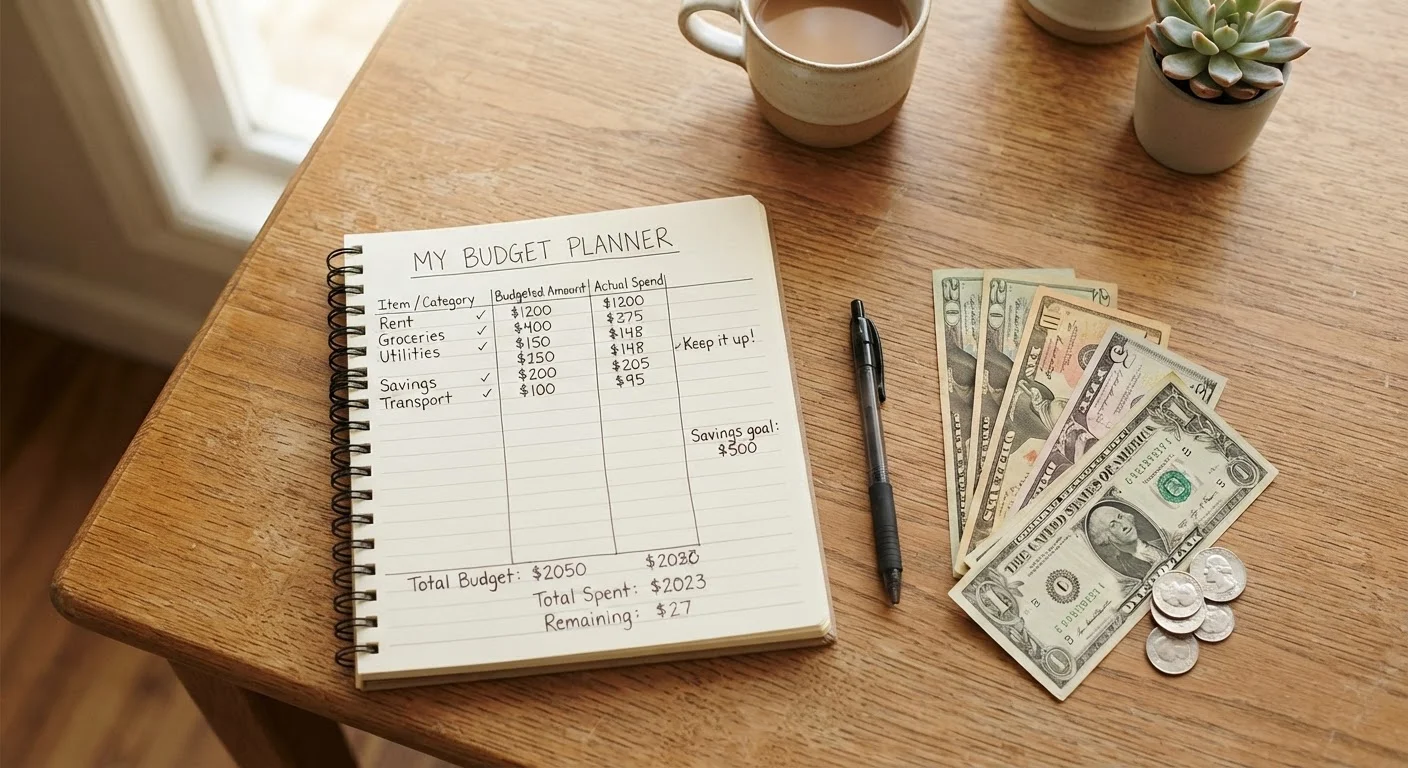
A budget is a working document, not a one-time exercise. After your first full month, compare what you planned with what actually happened. Most people find at least one category that ran over. Adjust the plan to reflect reality rather than giving up because it was not perfect.
For the habits that help a budget stick beyond the first month, see habits that make a budget work over the long term.
Start With $5 - Not $500
When money is tight, any savings goal that feels out of reach will quickly be abandoned. Even setting aside $5 to $10 per pay period into a separate account builds the habit and creates a small buffer. The amount matters far less than the consistency. See our emergency fund basics guide for context on sizing that buffer over time.
This article is for general informational and educational purposes only. It does not constitute personalized financial, legal, or tax advice. Consult a qualified financial professional for guidance specific to your situation.
Handling Debt When There Is Nothing Extra
When income barely covers expenses, debt paydown can feel impossible. The priority system here is straightforward: first, cover all minimums on every debt to protect your credit profile and avoid penalty fees. Second, direct any freed dollars - even small amounts - toward the debt carrying the highest interest rate or the smallest balance, depending on which approach motivates you more.
Minimum Payments Can Cost You More Long-Term
Paying only the minimum on credit card debt keeps accounts current but allows interest to compound significantly over time. Even a small additional payment above the minimum can meaningfully reduce the total interest paid. If you are struggling with debt payments, a nonprofit credit counseling agency may be able to help you explore options.
This Is General Information, Not Financial Advice
The guidance in this article is educational and intended to give you a general framework for budgeting. It is not personalized financial, tax, or legal advice. Your specific situation may differ significantly. Consider speaking with a nonprofit credit counselor or a licensed financial professional if you need guidance tailored to your circumstances.
If you are carrying no credit history alongside existing debt, building a credit profile carefully matters for future financial flexibility. Our guide to building credit from scratch covers the foundational steps. For those with variable or unpredictable income, budgeting on an irregular income addresses the specific challenges that come with inconsistent pay.